

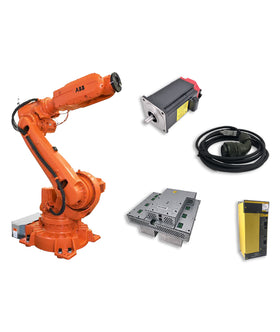

Industrial robots rarely fail without warning. In most manufacturing environments, robot problems begin as small intermittent symptoms long before production stops completely.
A teach pendant disconnects randomly during operation. The robot gradually loses position accuracy. Servo power refuses to enable after restart. Communication errors appear intermittently and then disappear. Motion becomes unstable during acceleration.
These symptoms are often early indicators of deeper failures inside encoder feedback systems, servo communication architecture, teach pendant cables, safety circuits, internal controller buses, or robot power distribution systems.
This Industrial Robot Symptoms & Troubleshooting Center helps maintenance engineers, automation technicians, system integrators, and robot operators diagnose failures using actual machine behavior instead of relying only on alarm codes.
Instead of starting from controller alarms alone, you can diagnose failures through:
Observed Symptom → Affected System → Root Cause → Failed Component → Corrective Action
| Symptom | Frequently Related System | Common Root Cause |
|---|---|---|
| Teach Pendant Not Working | Pendant cable / HMI | Cable fatigue |
| Teach Pendant Black Screen | Display system | LCD or internal communication failure |
| Robot Loses Position | Encoder feedback | Signal instability |
| Robot Not Moving | Servo drive | Power or communication fault |
| Robot Disconnects Randomly | Communication system | Intermittent signal loss |
| Controller Cannot Detect Motor | Encoder feedback system | Feedback loss |
| Robot Stops Suddenly | Servo or safety system | Communication interruption |
| Ethernet Connection Lost | Network communication | Cable or switch instability |
Teach pendant failures are among the most common industrial robot symptoms because pendants experience constant movement, repetitive cable bending, vibration, operator handling, and harsh factory environments.
In many industrial robots, teach pendant problems begin intermittently. The pendant may disconnect briefly, the screen may flicker occasionally, or touchscreen response becomes unstable before complete failure occurs.
One of the most common root causes is internal cable fatigue. After years of repeated movement near strain relief points, internal communication conductors gradually break down and create unstable signal transmission.
Teach pendant failures can also affect robot safety systems because emergency stop circuits, enabling switches, and communication lines are often integrated inside the same cable assembly.
Modern industrial robots rely heavily on stable communication between controllers, servo systems, PLCs, safety modules, and external automation equipment.
Communication problems are often intermittent during early failure stages. A robot may freeze briefly, lose PLC communication for several seconds, or randomly disconnect before recovering automatically.
In real factory environments, communication instability is frequently caused by shielding degradation, grounding problems, connector contamination, damaged communication cables, or internal controller bus instability.
Even small communication interruptions can create production downtime, robot synchronization problems, or unexpected safety stops.
Encoder and feedback systems form the foundation of industrial robot motion control. Even small signal instability can create positioning errors, synchronization faults, and unexpected motion behavior.
In many industrial robots, encoder problems begin gradually. Position repeatability changes slightly, TCP accuracy becomes inconsistent, or axis drift appears intermittently before complete encoder failure occurs.
Common causes include encoder cable fatigue, connector oxidation, signal interference, resolver communication instability, or damaged feedback boards.
Because industrial robots rely heavily on accurate feedback loops, unstable encoder communication can affect both motion quality and overall robot safety.
Motion instability is commonly associated with servo synchronization faults, unstable encoder feedback, communication interruption, mechanical transmission wear, or power delivery problems.
Servo-related failures often begin intermittently. The robot may stop briefly during acceleration, vibrate during motion, or refuse to enable servo power after restart.
In many factories, unstable servo communication or damaged cable assemblies create symptoms long before a complete drive shutdown occurs.
Understanding whether the root cause originates from power delivery, communication architecture, or feedback synchronization is critical for accurate diagnostics.
Safety systems intentionally interrupt robot motion when unsafe operating conditions are detected. However, repeated safety-related faults often indicate deeper instability inside communication, wiring, or control systems.
Safety interruptions may originate from damaged pendant cables, unstable safety relays, broken E-stop loops, connector looseness, or intermittent communication failures inside safe-motion systems.
In many industrial environments, safety faults initially appear randomly before becoming permanent. Understanding the relationship between safety architecture and communication stability is critical for accurate troubleshooting.
Successful industrial robot diagnostics usually follow a structured process:
Observed Symptom → Affected Subsystem → Root Cause → Failed Component → Corrective Action
Following this workflow helps reduce unnecessary component replacement, shortens production downtime, and improves repair accuracy.
Although industrial robot manufacturers use different controller architectures and alarm systems, many failures ultimately originate from similar physical mechanisms.
Understanding the affected subsystem is usually more effective than replacing parts based only on alarm codes.
Industrial robots usually reveal the real failure through machine behavior long before a major alarm appears.
Learning to diagnose symptoms first — and alarm codes second — leads to faster troubleshooting, lower maintenance cost, reduced production downtime, and better long-term robot reliability.
Robot position loss is commonly related to encoder feedback instability, resolver communication faults, incorrect mastering values, or damaged encoder cables.
In many industrial robots, intermittent signal degradation appears before complete encoder failure occurs. Position drift often becomes more noticeable during acceleration, restart cycles, or high-speed motion.
Related diagnostics:
Teach pendant communication failures are frequently caused by cable fatigue, connector looseness, internal display hardware faults, or unstable communication architecture inside the robot controller.
Repetitive cable bending near strain relief areas gradually damages internal conductors, creating intermittent signal instability before complete communication loss occurs.
Related diagnostics:
Unexpected robot stops may originate from servo communication interruption, unstable encoder feedback, safety circuit faults, or intermittent power instability.
In many factories, communication-related failures initially appear randomly before becoming permanent. Temporary communication loss between servo systems and controllers can trigger sudden motion interruption.
Related diagnostics:
Yes. Repetitive robot motion gradually damages internal cable conductors, shielding layers, and connectors over time.
Cable degradation frequently creates intermittent communication loss, encoder instability, servo faults, teach pendant disconnects, and random production interruptions.
Related diagnostics:
Servo enable failures are commonly associated with drive communication faults, unstable safety circuits, power supply instability, or motor feedback errors.
In some industrial robots, servo enable problems may also originate from brake release failures, encoder communication instability, or controller-side power distribution faults.
Related diagnostics:
Ethernet communication instability is often caused by damaged communication cables, shielding degradation, connector contamination, grounding problems, or unstable industrial switches.
In industrial environments with vibration, electrical noise, and repetitive robot motion, communication quality can gradually degrade before complete network failure occurs.
Related diagnostics:
Teach pendant touchscreen problems are commonly related to damaged touch membranes, failed digitizers, internal cable instability, or controller communication faults.
In many industrial robots, touchscreen instability first appears intermittently before complete touch failure occurs. Some touch areas may stop responding while other areas continue functioning normally.
Related diagnostics:
Yes. Industrial robots rely heavily on stable encoder feedback for accurate motion control and TCP positioning.
Even small encoder signal instability can create position drift, inconsistent repeatability, synchronization faults, and motion quality degradation.
Related diagnostics:
Intermittent communication errors are commonly caused by unstable cable connections, shielding degradation, grounding problems, network synchronization instability, or internal controller bus faults.
Communication failures often become more frequent during robot motion, vibration, or high electrical interference conditions.
Related diagnostics:
In many industrial robot failures, actual machine behavior provides more accurate diagnostic clues than alarm codes alone.
Symptoms often reveal intermittent communication instability, encoder degradation, cable fatigue, or safety interruptions long before alarms become permanent.
Diagnosing symptoms first usually reduces unnecessary component replacement and improves troubleshooting accuracy.
Key components commonly involved in issues and replacements.
No related parts found. Please check available components in our catalog.


{"one"=>"Select 2 or 3 items to compare", "other"=>"{{ count }} of 3 items selected"}
Leave a comment on this topic