

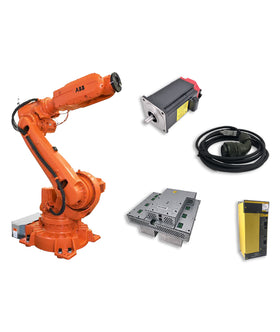


Encoder signal loss occurs when the robot controller or servo drive can no longer receive stable position feedback from one or more robot axes.
In industrial robots, encoder feedback is essential for:
When encoder communication becomes unstable, the controller may stop motion immediately to protect the robot and surrounding equipment.
Typical results include:
Although encoder-related alarms appear similar across ABB, FANUC, KUKA, and Yaskawa robots, the internal feedback architecture differs significantly between brands.
Understanding the underlying signal chain is the key to accurate troubleshooting.
Encoder feedback problems usually appear through one or more of the following symptoms:
In many factories, these problems initially appear only occasionally before becoming permanent over time.
This gradual progression is a strong indicator of signal degradation inside the feedback system.

Industrial robots rely on continuous real-time position feedback to calculate:
Without stable encoder signals, the controller loses confidence in the robot’s actual position.
To prevent mechanical damage or uncontrolled motion, the system may disable servo power immediately.
This is why encoder signal loss often appears together with:
Although robot manufacturers use different technologies, most encoder systems rely on three major layers.
This layer carries encoder data between the motor and controller.
Components typically include:
This is the most failure-prone area in industrial environments.
This layer converts and processes encoder signals.
Depending on robot architecture, components may include:
Failure here can interrupt feedback interpretation even if the signal cable remains healthy.
This layer synchronizes encoder information throughout the robot system.
Examples include:
Communication instability at this level can affect multiple axes simultaneously.
Signal cable failure is the single most common root cause of recurring encoder alarms.
Industrial robot cables operate under:
Over time, this leads to:
In high-cycle robotic applications such as welding, palletizing, and material handling, cable fatigue is responsible for a large percentage of recurring encoder-related failures.
Intermittent alarms are especially common because cables often fail internally before visible external damage appears.
Loose or degraded connectors can create unstable feedback signals that mimic serious hardware failures.
Common locations include:
High-vibration robot joints are particularly vulnerable.
Depending on the robot platform, failures may involve:
System-level failures may also interrupt encoder communication.
Possible causes include:
Although less common than cable failures, these issues should still be considered during diagnos is.
Different robot brands use completely different encoder communication systems.
Understanding the architecture helps narrow down failures much faster.
| Brand | Feedback Architecture | Common Weak Point |
| FANUC | FSSB fiber communication | Fiber cable, pulse coder, servo amplifier chain |
| ABB | SMB-based encoder system | SMB board, encoder cable, DSQC communication |
| KUKA | Resolver + RDC architecture | RDW cable, resolver chain, RDC conversion |
| Yaskawa | Sigma encoder + SGDV drive | Encoder cable, battery, connector instability |
FANUC robots commonly use:
Typical failure points include:
Related troubleshooting topics naturally connect with:
ABB systems often rely on:
Common causes include:
Related troubleshooting resources include:
KUKA robots commonly use:
Frequent weak points include:
KUKA systems are particularly sensitive to feedback conversion quality.
Related topics include:
Yaskawa systems commonly rely on:
Typical failure causes include:
A weak encoder battery can sometimes create symptoms that resemble cable failure.
Related resources include:
Determine whether the issue is:
Intermittent alarms usually indicate cable or connector degradation.
Check:
Focus especially on high-flex joints and moving cable sections.
Check for:
These alarms often reveal whether the problem affects one axis or the entire communication system.
Replacing the suspected cable with a known-good cable is often the fastest confirmation method.
If the alarm disappears after substitution, cable degradation is confirmed.
Although cables are the leading cause, encoder signal loss can also originate from:
Accurate diagnos is requires evaluating the complete feedback chain before replacing major components.
When encoder signal loss occurs repeatedly:
In many cases, replacing aging high-flex signal cables restores stable operation without replacing expensive servo hardware.
To reduce unexpected encoder failures:
Preventive maintenance is especially important for robots used in:
These applications create the highest mechanical stress on encoder wiring systems.
It is a condition where the robot controller cannot receive stable position feedback from the encoder system.
Signal cable degradation is the most common cause across nearly all industrial robot brands.
Yes. ABB, FANUC, KUKA, and Yaskawa all rely on encoder feedback systems that can degrade over time.
No. Battery failure, resolver faults, fiber optic damage, servo amplifier issues, and communication board failures can produce similar symptoms.
Start with:
Then move to system-specific components such as batteries, fiber networks, or resolver systems.
Additional topics that naturally support encoder diagnostics include:
Explore the Full Guide: Industrial Robot Knowledge Hub → Repair & Troubleshooting Cluster
Explore the complete guide for troubleshooting, repair strategies, and component replacement across industrial robot systems.
Key components commonly involved in encoder signal loss in industrial robots issues and replacements.


{"one"=>"Select 2 or 3 items to compare", "other"=>"{{ count }} of 3 items selected"}
Leave a comment on this topic