

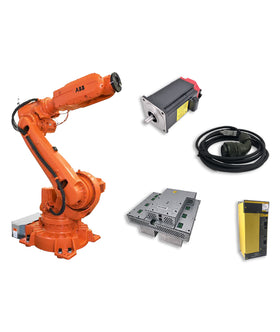


In industrial environments, sudden robot stops are one of those faults that rarely present in a clean or repeatable way. The robot may run normally for hours, sometimes days, then stop unexpectedly during automatic operation, jogging, or even while holding position.
This behavior is seen across ABB IRC5, FANUC R-30iB, KUKA KRC4/KRC5, and Yaskawa DX200 / YRC1000 systems.
In practice, these stops are less about mechanical failure and more about the control system reacting to unstable signals somewhere in the chain.
Most cases trace back to:
The key is not the stop itself, but what signal dropped first.
Before touching servo motors or controllers, first identify when and how the stop occurs.
Focus your inspection on:
In production environments like welding, machining, or material handling, this pattern is often linked to continuous motion stress, cable flex fatigue, or EMI exposure inside the cell.
Shift attention to:
In many field cases, what looks like a controller fault is actually just a degraded pendant cable.
A sudden stop is rarely a “random failure.” It is the controller deliberately entering a protective state.
Typical triggers include:
In other words, the robot is reacting to missing validation signals — not breaking mechanically.
Field behavior is usually inconsistent, but not random:
These patterns almost always point to intermittent electrical or signal instability.
Industrial robots rely on continuous real-time communication between:
Cables operate under constant stress:
Over time, this leads to:
The key issue: externally the cable still looks fine.
The teach pendant is not just an interface — it is part of the safety and enable chain in most robot systems.
Common stress factors:
Typical symptoms:
In real maintenance work, this is frequently misdiagnosed as controller or servo failure.
Safety circuits always override motion commands.
Even brief instability can stop the robot:
Even millisecond-level signal dropouts can trigger a full stop.
Encoder feedback is the foundation of motion control.
When it becomes unstable, the controller immediately reacts:
This is common across:
External systems can also trigger stops:
However, in real-world diagnostics, these are often traced back to wiring or connector issues rather than logic faults.
👉 Strong indication of encoder or signal cable degradation
Sudden stops often generate system alarms, but these are usually secondary reactions.
Typical categories:
👉 Important point: alarms describe the consequence, not the root cause.
A common field mistake is replacing hardware too early:
In most cases, the real issue is still in the signal chain:
👉 Hardware replacement without signal validation often leads to repeated failures.
While the robot is running, gently move cable harnesses.
If behavior changes:
→ Internal cable damage is highly likely
Because intermittent signal interruption may only last milliseconds, creating unstable or changing alarm behavior.
Yes. Robot signal and safety cables carry critical motion authorization and feedback data. Even brief interruption can trigger a full system stop.
If the stop occurs during jogging, teaching, or pendant movement, the Teach Pendant cable becomes a primary suspect.
No. Signal integrity and safety-loop stability should always be verified before replacing major servo hardware.
Across ABB, FANUC, KUKA, and Yaskawa systems, sudden robot stops are most often caused by:
Mechanical failure is far less common than signal instability.
In field maintenance terms, the difference between a 30-minute repair and a 3-day shutdown usually comes down to whether the signal path is checked first.
Explore the Full Guide: Industrial Robot Knowledge Hub → Repair & Troubleshooting Cluster
Explore the complete guide for troubleshooting, repair strategies, and component replacement across industrial robot systems.
Key components commonly involved in robot stops suddenly issues and replacements.


{"one"=>"Select 2 or 3 items to compare", "other"=>"{{ count }} of 3 items selected"}
Leave a comment on this topic