



Motor overload alarms in industrial robots are not always caused by real mechanical overload.
In many field cases, the alarm is triggered by incorrect load estimation inside the servo system, usually caused by encoder feedback issues, cable degradation, or signal instability rather than actual motor stress.
A Ghost Overload refers to a situation where:
This happens when the control system misinterprets feedback signals and overcompensates torque output.
In practice:
Correct motion + incorrect system interpretation = false overload alarm

Motor load calculation is based on a closed-loop system:
Encoder Feedback → Servo Controller → Current / Torque Output
When any part of this loop becomes unstable:
Result: Motor overload alarm without mechanical failure
| Symptom | Condition | Likely Cause | Priority |
| Overload at startup | Cold start | Brake not released | Brake system |
| Overload during motion | High-speed operation | Encoder instability | Encoder cable |
| Random overload | Intermittent operation | Signal interruption | Cable harness |
| Overload + drift | Accuracy loss | Feedback distortion | Encoder system |
| Overload after warm-up | Thermal condition | Cable resistance increase | Power cable |
Encoder signals define real-time position and load interpretation.
When unstable:
This leads to false overload detection.
Brake behavior directly affects startup load calculation.
Typical failure behavior:
Result:
→ Controller interprets it as excessive load
Power delivery instability affects motor efficiency.
Common symptoms:
Mechanism:
Reduced power efficiency → higher current draw → overload alarm
High-flex robot cables degrade over time.
Typical field behavior:
Root cause:
Internal conductor micro-fractures → unstable signal transmission
In high-motion axes (especially wrist joints):
Over time:
Result:
→ Intermittent “ghost overload” with no mechanical fault
Although alarm codes differ across manufacturers, failure logic is consistent:
Encoder instability + cable degradation = false overload across all platforms
Focus on:
Cable or encoder-related overload cases typically show:
If two or more conditions match:
→ Prioritize cable + encoder system inspection
| Action | Cost | Result |
| Motor replacement | High | Problem often remains |
| Parameter tuning | Low | Temporary relief |
| Cable system repair | Medium | Root cause resolved |
If overload is not mechanical:
Outcome:
Improves:
Includes:
Motor overload is often not a motor problem.
It is usually a signal interpretation problem inside the servo loop.
Once feedback becomes unstable, the controller will continuously “correct a problem that does not exist”.
1. Does motor overload mean motor damage?
No. Most cases are caused by incorrect feedback interpretation.
2. What is a Ghost Overload?
A false overload triggered by unstable signal or encoder feedback.
3. Can cables really cause overload alarms?
Yes. Signal instability leads to incorrect torque compensation.
4. Why does reboot sometimes help?
It temporarily resynchronizes signals, but does not fix hardware degradation.
Explore the Full Guide: Industrial Robot Knowledge Hub → Repair & Troubleshooting Cluster
Explore the complete guide for troubleshooting, repair strategies, and component replacement across industrial robot systems.
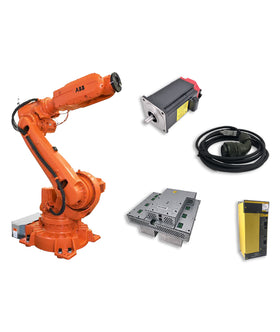
Key components commonly involved in motor overload-alarm issues and replacements.


{"one"=>"Select 2 or 3 items to compare", "other"=>"{{ count }} of 3 items selected"}
Leave a comment on this topic