

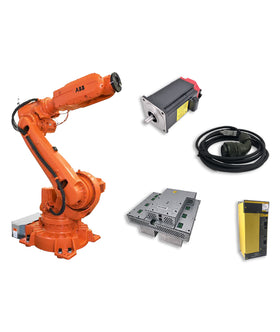


When a Yaskawa controller reports that a motor cannot be detected, the issue is often misinterpreted as a servo motor failure.
In field maintenance practice, this condition is most commonly caused by Σ-series encoder communication instability, servo pack signal interruption, or encoder cable degradation.
The motor itself is usually mechanically functional. The controller simply cannot complete the feedback handshake required for axis initialization.
Yaskawa robots rely on a closed-loop validation process:
Σ encoder → servo pack → controller
During startup, the controller must receive valid encoder feedback before enabling motion.
If this chain fails:
This is a feedback validation failure, not a direct motor failure.
These alarms indicate:
Motor detection depends on one condition:
Encoder data must remain stable and synchronized with servo pack interpretation
When this breaks:
Actual position ≠ controller perception → axis is disabled
This mismatch is typically caused by:
Encoder cables are one of the highest failure-risk components in Yaskawa systems.
Typical degradation mechanisms:
The cable often appears physically intact while already causing:
Check:
If the axis returns after restart → strongly indicates communication instability, not motor failure
While system is safe:
If fault appears/disappears with movement:
→ Internal conductor fatigue is highly likely
Check both ends:
Motor side:
Servo pack side:
Even minor instability can disrupt Σ encoder communication.
Inspect:
Multi-axis failure usually indicates shared communication path or servo pack issue, not multiple motor failures
| Result | Diagnos is |
| Fault follows cable | Cable failure confirmed |
| Fault remains on axis | Motor or servo pack issue |
| Fault intermittent | Progressive cable degradation |
In real Yaskawa field cases:
Σ encoders operate at high resolution and are extremely sensitive to signal quality.
Even minor degradation can trigger:
Improper shielding or cable replacement can reproduce identical symptoms.
No. In most cases, the motor is mechanically normal. The issue is feedback loss.
Because unstable contacts temporarily reconnect under static conditions.
Yes. Internal fatigue is usually not visible externally.
Usually not, but position verification is recommended.
When a Yaskawa controller cannot detect a motor, the issue is rarely the motor itself.
In most real cases, the root cause is:
A structured diagnos is starting from the feedback path ensures:
Explore the Full Guide: Repair & Troubleshooting Cluster → controller cannot detect motor
Explore the complete guide for troubleshooting, repair strategies, and component replacement across industrial robot systems.
Key components commonly involved in yaskawa controller cannot detect motor issues and replacements.


{"one"=>"Select 2 or 3 items to compare", "other"=>"{{ count }} of 3 items selected"}
Leave a comment on this topic