

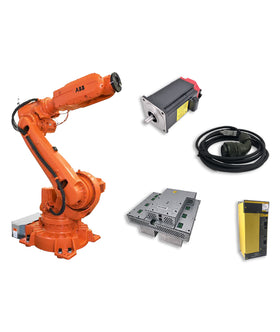

In industrial robotics, the dresspack system is far more than a cable holder. It is a dynamic cable-management subsystem responsible for protecting power cables, encoder cables, feedback circuits, communication lines, and pneumatic hoses throughout millions of robot motion cycles.
Every robot movement generates a combination of mechanical stresses, including bending fatigue, torsional loading, vibration, acceleration, and continuous flexing. If these forces are not properly controlled, cable degradation can eventually lead to encoder faults, communication instability, servo alarms, and unplanned downtime.
To manage these risks, robot manufacturers and system integrators typically use one of two routing architectures:
Although both approaches perform the same basic function, they differ significantly in cable protection, signal reliability, maintenance accessibility, thermal behavior, and lifecycle cost.
Understanding these differences is essential when designing a new robotic cell, upgrading an existing automation system, or selecting replacement dresspack components.
An internal dresspack routes cables through hollow sections of the robot arm instead of mounting them externally.
Power cables, encoder cables, industrial Ethernet lines, safety circuits, and pneumatic hoses are installed inside dedicated routing channels within the robot structure.
This design is commonly found in:
The primary advantage is protection.
Because the cables are enclosed within the robot arm, they are shielded from:
Internal routing also creates a cleaner robot profile and reduces the overall motion envelope, allowing robots to operate efficiently in space-constrained environments.
However, cable wear remains hidden from view, and replacement often requires partial robot disassembly, increasing maintenance time and labor costs.
An external dresspack routes cables outside the robot arm using protective cable-management components such as:
Unlike internal systems, cables remain visible throughout the robot's working range.
External dresspacks are widely used in:
The primary advantage is accessibility.
Maintenance teams can quickly inspect cable condition, identify wear points, and replace damaged components without opening the robot structure.
External routing also provides greater flexibility when adding:
The trade-off is increased exposure to environmental hazards, making proper protection and routing design essential.

| Feature | Internal DressPack | External DressPack |
| Cable Location | Inside robot arm | Outside robot arm |
| Environmental Protection | Excellent | Moderate |
| Visual Inspection | Difficult | Easy |
| Maintenance Accessibility | Limited | Excellent |
| Cable Replacement Time | Longer | Shorter |
| Routing Flexibility | Limited | High |
| Workspace Footprint | Compact | Larger |
| Thermal Dissipation | Moderate | Better |
| Expansion Capability | Limited | Easy |
| Downtime During Repair | Higher | Lower |
Neither architecture is universally better. The optimal choice depends on the operating environment, maintenance strategy, and production requirements.
One of the most important considerations in dresspack design is how mechanical stress is managed over time.
Internal routing provides excellent protection from environmental hazards.
Because cables are enclosed within the robot structure, they are protected from:
However, protection does not eliminate fatigue.
Inside the robot arm, cables still experience:
The highest stress concentration often occurs near J4, J5, and J6 wrist axes, where rotational motion is greatest.
External systems rely on engineered protection rather than enclosure.
Protective components may include:
When properly designed, external routing distributes stress over larger bending radii, reducing localized fatigue.
The downside is that conduits, brackets, and protective components themselves become maintenance items that require regular inspection.
Modern robots depend on stable transmission of encoder, feedback, and communication signals.
Signal degradation can result in:
Internal routing typically benefits from a more controlled electromagnetic environment.
The robot's metallic arm structure can help reduce exposure to electromagnetic interference generated by:
This is especially beneficial in robotic welding applications where electrical noise levels are high.
A commonly overlooked issue is heat accumulation inside enclosed routing cavities.
When power cables operate continuously under high load:
These conditions can contribute to intermittent communication errors and difficult-to-diagnose signal instability.
External systems are more exposed to surrounding electrical equipment.
For this reason, proper separation between:
becomes increasingly important.
With high-quality shielded robot cables and proper routing practices, external dresspacks can achieve excellent signal reliability.
Internal dresspacks are highly protected, but failures can be difficult to detect until production is affected.
Common issues include:
Continuous motion may cause cables to rub against internal guides or routing channels, gradually damaging insulation.
Repeated rotation of wrist axes can create accumulated twisting stress that eventually breaks conductors or shielding layers.
Limited airflow inside the robot arm can accelerate insulation aging and cable degradation.
Internal connectors may loosen or degrade over time without visible external signs.
Typical symptoms include:
Because external systems are exposed to the environment, wear points are usually easier to identify.
Common issues include:
Protective conduits may crack, wear, or separate after prolonged use.
Chain links, guide systems, or mounting hardware may wear over time.
Improper strain relief can transfer excessive force to connectors and cable terminations.
External cable loops may be damaged by tooling, fixtures, forklifts, or accidental impacts.
Typical symptoms include:
Regular inspections can significantly extend cable life and reduce unexpected downtime.
✓ Review encoder and communication alarm history
✓ Monitor servo fault frequency
✓ Check for unusual temperature increases
✓ Listen for abnormal cable drag or friction noises
✓ Inspect cable condition during scheduled robot maintenance
✓ Inspect conduit and protective sleeve condition
✓ Verify strain-relief clamp integrity
✓ Check energy chain wear and alignment
✓ Look for cable twisting accumulation
✓ Inspect exposed connectors for damage or contamination
✓ Confirm adequate cable separation between power and signal circuits
Preventive inspections are often far less costly than emergency cable replacement.
The true cost of a dresspack system extends far beyond its initial purchase price.
Advantages:
Challenges:
Advantages:
Challenges:
For most facilities, the key question is not which system lasts longer, but which system minimizes total production interruption throughout the robot's lifecycle.
The best choice depends on the priorities of the application.
| Application Requirement | Recommended Solution |
| Compact Workcells | Internal DressPack |
| Welding Environments | Internal DressPack |
| High Collision Risk | Internal DressPack |
| Fast Maintenance | External DressPack |
| Maximum Uptime | External DressPack |
| Frequent Cable Upgrades | External DressPack |
| Tooling Expansion | External DressPack |
| Flexible Automation Systems | External DressPack |
As a general rule:
A complete dresspack system typically includes several critical cable-management and connectivity components:
The primary cable assembly carrying power, feedback, and communication signals throughout robot motion.
Provides position feedback from servo motors to the robot controller.
Supports closed-loop motion control and positioning accuracy.
Supports communication protocols such as PROFINET, EtherCAT, EtherNet/IP, and other industrial networks.
Controls cable movement and reduces mechanical stress in external routing applications.
Protects connectors and prevents fatigue-related cable failures.
Provide secure electrical interfaces between moving and stationary components.
Neither internal nor external dresspack systems are universally superior.
Internal dresspacks excel in compactness, environmental protection, and reduced interference risk. External dresspacks excel in maintenance accessibility, routing flexibility, and minimizing downtime during service operations.
The optimal solution depends on the balance between protection, maintainability, production uptime, and workspace constraints.
For facilities where downtime costs dominate, external dresspacks often provide the greatest operational flexibility. For highly constrained or harsh industrial environments, internal dresspacks may deliver superior long-term protection.
Ultimately, the most reliable dresspack system is the one that aligns with the mechanical, electrical, and maintenance realities of the application.
Neither is universally better. Internal dresspacks offer superior protection and a compact design, while external dresspacks provide easier maintenance and faster cable replacement.
They are generally better protected from external damage, but wear can be harder to detect and repairs often require more labor.
Because cables remain visible and accessible, technicians can inspect, troubleshoot, and replace components without opening the robot structure.
In many applications, yes. The robot arm structure can help reduce exposure to external electromagnetic interference.
Internal dresspacks are frequently used in welding applications because they provide better protection from welding spatter, heat, and environmental contaminants.
Inspection frequency depends on robot duty cycle and operating conditions. High-cycle applications typically benefit from routine inspections during scheduled preventive maintenance intervals.
Key components commonly involved in issues and replacements.
No related parts found. Please check available components in our catalog.


{"one"=>"Seleziona 2 o 3 articoli da confrontare", "other"=>"{{ count }} di 3 elementi selezionati"}
Seleziona il primo elemento da confrontare
Seleziona il secondo elemento da confrontare
Seleziona il terzo elemento da confrontare
Lascia un commento