

Introduction: The Rise of Robotics in Industry
Industrial robots are no longer futuristic concepts—they are the backbone of modern manufacturing. According to the International Federation of Robotics (IFR), global corporate spending on robotics is projected to reach nearly $66.9 billion by 2025, driven by rising labor costs, demand for high-precision manufacturing, and advances in AI-powered automation.
The history of industrial robotics began with George Devol, who in 1948 developed the prototype that would become the Unimate, the world’s first industrial robotic arm. Partnering with Joseph F. Engelberger, Devol co-founded Unimation, a pioneer in industrial robot manufacturing. General Motors’ adoption of Unimate in its automotive assembly lines during the 1960s marked the beginning of a manufacturing revolution—one that continues to evolve at an unprecedented pace.
Part1. What is an Industrial Robot?
An industrial robot is a programmable, automated machine designed to perform production-related tasks with speed, accuracy, and repeatability in industrial environments. Classified as flexible automation, these robots can be reprogrammed to handle multiple tasks, making them a preferred choice for manufacturers seeking scalability.
Key advantages include:
-
Productivity gains: Continuous operation without fatigue.
-
Quality consistency: Precision machining and assembly.
-
Cost reduction: Lower long-term labor and rework costs.
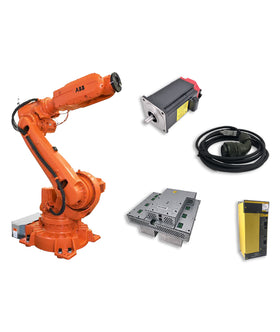
Industrial robots are not just mechanical arms—they are integrated systems combining hardware, sensors, software, and control units that work together to execute complex workflows.
Part2. What Kinds of Industrial Robot?
Articulated Robots
-
Structure: Rotating joints, usually 4–6 axes.
-
Use case: Welding, painting, assembly, material handling.
-
Example: FANUC LR Mate 200iD – versatile six-axis arm for compact workspaces.
Delta Robots
-
Structure: Parallel-link design suspended over the workspace.
-
Strength: Extremely fast, lightweight, ideal for pick-and-place.
-
Example: FANUC M-2iA – high-speed packaging and sorting.
SCARA Robots
-
Structure: Selective Compliance Assembly Robot Arm, operating in a single plane.
-
Strength: High-speed assembly and material transfer.
-
Example: Epson G-Series SCARA – electronics assembly.
Cartesian Robots
-
Structure: Linear actuators moving in X, Y, Z axes.
-
Strength: High accuracy in large work envelopes.
-
Example: Gantry-style robots for CNC loading/unloading.
Collaborative Robots (Cobots)
-
Structure: Force-limited joints and advanced safety systems.
-
Strength: Direct human interaction, quick reprogramming.
-
Example: Universal Robots UR5 – adaptable for assembly and inspection.
Part3. What Applications of Industrial robots
Industrial robots are now embedded in virtually every manufacturing sector:
-
Automotive: Spot welding, body painting, component assembly.
-
Electronics: PCB soldering, microchip placement, cleanroom assembly.
-
Food & Beverage: Hygienic packaging, sorting, palletizing.
-
Pharmaceuticals: Sterile drug handling, precise dispensing.
-
Logistics: Automated picking, order fulfillment, warehouse AMRs.
-
Aerospace: Composite material cutting, precision drilling.
-
Agriculture: Automated harvesting, sorting, and planting.
With machine vision and AI algorithms, robots now perform real-time defect detection and adaptive assembly—tasks once thought impossible to automate.
Part4. How do industrial robots work?
At their core, industrial robots integrate:
-
Controller (Brain): Executes motion programs and logic sequences.
-
Actuators (Muscles): Motors driving joints and end effectors.
-
Sensors (Eyes & Skin): Vision systems, force/torque sensors, encoders.
-
End Effector (Hands): Grippers, welders, cutters, or custom tools.
Robots operate using kinematic modeling to calculate joint movements and path planning, ensuring collision-free and efficient operations. Many modern robots feature teach pendants or intuitive graphical interfaces, reducing programming time.
Advanced systems leverage offline programming and digital twin simulation—allowing manufacturers to optimize tasks virtually before deploying them on the shop floor.
Part5. Industrial Robots vs. Collaborative Robots (Cobots)
| Feature | Industrial Robots | Collaborative Robots |
|---|---|---|
| Speed & Payload | High | Lower |
| Safety | Requires cages/barriers | Works alongside humans |
| Programming | Complex, specialized | Intuitive, often hand-guided |
| Ideal Use Case | High-volume, repetitive tasks | Flexible, small-batch production |
| Cost | Higher initial investment | Lower entry cost |
Industrial robots dominate in mass production environments, while cobots excel in human-centric workflows with frequent task changes.
Part6. Evolution & Future Trends
Past:
-
1960s–80s: Introduction to automotive assembly lines.
-
1990s: Expanded into electronics and general manufacturing.
-
2000s: Integration with sensors, vision, and basic AI.
Present:
-
Multi-axis flexibility.
-
Integration with IoT for predictive maintenance.
-
Real-time data analytics for process optimization.
Future:
-
AI-driven autonomy: Robots that learn tasks without manual programming.
-
Cloud robotics: Remote updates, shared learning across fleets.
-
Human-robot symbiosis: Mixed teams in manufacturing.
-
Green manufacturing: Energy-efficient, recyclable robot designs.
Conclusion
From George Devol’s Unimate to AI-powered autonomous systems, industrial robots have become indispensable drivers of efficiency and innovation. Their role will only expand as industries push toward smarter, safer, and more sustainable manufacturing.
FAQs
1. What are the main types of industrial robots?
Articulated, delta, SCARA, cartesian, and collaborative robots.
2. What’s the difference between industrial robots and cobots?
Industrial robots excel in speed and payload for mass production, while cobots are designed for flexibility and human interaction.
3. Which industries use industrial robots the most?
Automotive, electronics, logistics, food, pharmaceuticals, and aerospace.
4. How do industrial robots ensure precision?
Through a combination of advanced motion control, sensors, and real-time feedback systems.
5. What is the future of industrial robotics?
AI-powered autonomous operation, greater human-robot collaboration, and sustainable manufacturing.


Lascia un commento