

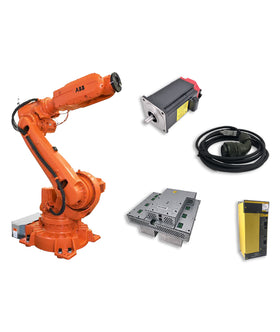

Industrial robots rely on a complex network of power cables, encoder cables, communication lines, and pneumatic hoses to perform precise and repeatable motion. While servo motors, controllers, and end-of-arm tooling often receive most of the attention, cable management is frequently the hidden factor that determines long-term system reliability.
A robot dresspack is far more than a protective sleeve or conduit. It is an engineered cable management system designed to guide, protect, and control moving cables throughout the robot's operating envelope. By managing bend radius, torsional loads, cable routing, and environmental exposure, a properly designed dresspack helps prevent premature cable failures and communication problems.
In high-duty-cycle robotic applications such as automotive welding, material handling, palletizing, packaging, and machine tending, dresspack performance directly influences:
In many facilities, recurring cable faults are ultimately traced not to defective cables but to an improperly designed, installed, or maintained dresspack system.
Dresspack-related problems often appear as electrical, communication, or motion-control issues before visible cable damage is discovered.
Common warning signs include:
| Symptom | Possible DressPack-Related Cause |
| Encoder communication alarm | Feedback cable fatigue or shielding damage |
| Random servo alarm | Uncontrolled cable movement |
| Position drift | Encoder signal degradation |
| Intermittent Ethernet loss | Cable compression or EMI exposure |
| Premature cable jacket wear | Internal friction or abrasion |
| Frequent Axis 6 faults | Excessive torsional loading |
| Pneumatic leakage | Hose fatigue or routing failure |
| Unexpected robot downtime | Cable routing or strain-relief failure |
Because these symptoms often resemble controller or servo issues, technicians frequently replace components before identifying the actual root cause within the dresspack system.
A robot dresspack is a dynamic cable management system that routes and protects all moving electrical and pneumatic connections attached to an industrial robot.
The system typically manages:
Unlike conventional cable bundles, a dresspack must accommodate continuous multi-axis motion while maintaining proper cable geometry, bend radius, and torsional control.
Its primary engineering objectives include:
A well-designed dresspack functions as a dynamic mechanical subsystem that continuously absorbs and redistributes motion-induced stress away from cable conductors, shields, and connectors.

Modern dresspacks consist of multiple integrated components working together to ensure reliable cable movement.
The dresspack contains the robot's moving electrical and pneumatic connections, including:
Each cable type has unique flex-life, shielding, and torsional performance requirements.
Protective systems commonly include:
These layers protect cables from abrasion, impact, coolant exposure, dust, oil, and environmental contamination.
Strain-relief systems distribute mechanical loads away from:
Proper strain relief significantly reduces conductor fatigue and connector failures.
Mounting brackets establish controlled cable routing paths throughout the robot's motion envelope.
Proper bracket placement minimizes excessive cable displacement during acceleration, deceleration, and wrist articulation.
One of the most overlooked dresspack components is the cable retraction system.
As the robot moves through different positions, cable slack constantly changes. Without compensation, excess cable length can form loops that interfere with fixtures, tooling, or workpieces.
Advanced dresspacks may utilize:
Spring retractors automatically recover excess conduit length during robot movement.
Benefits include:
Large robotic welding cells sometimes employ pneumatic pullback devices to actively manage conduit positioning during complex motion sequences.
Tether systems help maintain cable alignment and prevent uncontrolled conduit movement across large work envelopes.
High-speed robot wrists generate complex multi-directional torsional loads.
To accommodate these movements, some advanced dresspacks incorporate:
These designs help distribute twisting forces generated by simultaneous Axis 4, Axis 5, and Axis 6 motion while reducing localized fatigue.
Robot cables experience continuous bending, twisting, acceleration, and vibration throughout normal operation.
The dresspack protects these cables through several engineering mechanisms.
The dresspack establishes predictable cable paths and prevents uncontrolled movement.
This reduces:
Repeated over-bending remains one of the leading causes of robot cable failure.
Dresspack systems maintain manufacturer-specified bend-radius limits throughout robot motion.
Proper bend-radius management helps prevent:
Robot wrist axes generate significant rotational stress.
The dresspack distributes torsional loads across longer cable sections rather than concentrating stress in a single location.
Protective conduit systems shield cables from:
Most robot cable failures result from cumulative mechanical fatigue rather than electrical overload.
By controlling cable movement and minimizing repetitive stress cycles, a properly designed dresspack significantly extends cable lifespan and reduces replacement frequency.
Dresspack performance affects more than mechanical reliability.
It also plays a critical role in signal quality and communication stability.
Maintaining consistent conductor spacing helps preserve:
Excessive cable movement can gradually alter these electrical characteristics.
Industrial environments often contain significant electromagnetic interference sources, including:
Proper cable separation within the dresspack helps reduce electromagnetic coupling between power and signal circuits.
Encoder and feedback cables carry low-voltage signals that are highly sensitive to:
Effective dresspack design minimizes these risks and helps maintain accurate position feedback.
Reliable cable routing supports stable operation of:
Maintaining signal integrity is essential for deterministic industrial communication networks where timing accuracy directly affects robot performance.
One of the most important principles in dresspack engineering is internal free-space management.
A widely accepted industry guideline is to limit conduit fill ratios to approximately 60–70% of available capacity.
The remaining 20–30% free space allows individual cables to move and slide relative to one another during robot motion.
When dresspacks become overfilled:
This phenomenon is sometimes referred to as internal cable strangulation.
Although external cable jackets may appear undamaged, hidden conductor fatigue and shielding degradation can develop within the dresspack, eventually leading to intermittent communication faults and premature cable failure.
Among all robot axes, Axis 6 is typically the most failure-prone area for moving cables.
Several factors contribute to this:
Over time, accumulated torsional stress can lead to:
For this reason, experienced technicians often begin dresspack inspections at the wrist area when troubleshooting recurring cable-related alarms.
A significant percentage of encoder cable failures and feedback cable faults originate near Axis 6 rather than elsewhere in the robot arm.
Although both systems manage moving cables, they are designed for fundamentally different motion profiles.
| Feature | Robot DressPack | Energy Chain |
| Motion Type | Multi-axis robotic motion | Linear travel |
| Torsional Capability | High | Limited |
| Axis 4-6 Support | Yes | No |
| Cable Flexibility | Optimized for robot motion | Optimized for linear motion |
| Typical Application | Industrial robots | CNC machines, gantries |
Energy chains excel in applications involving long linear travel distances, while dresspacks are specifically engineered to accommodate complex robotic kinematics.
Selecting the wrong cable management system can significantly reduce cable life and increase maintenance requirements.
Most dresspack failures develop gradually through accumulated mechanical stress.
Repeated bending below the cable's minimum bend radius accelerates conductor fatigue and insulation damage.
Overfilled dresspacks generate excessive friction and pressure between cables.
Common symptoms include:
Repeated wrist rotation can eventually damage shielding and conductors through cumulative torsional stress.
Incorrect clamp placement transfers mechanical loads directly into cable terminations and connectors.
Damaged conduit or protective coverings expose cables to abrasion, oil, coolant, chemicals, and welding spatter.
Incorrect routing creates localized stress concentrations that significantly reduce cable lifespan.
Automotive welding cells represent some of the most demanding dresspack environments.
Dresspacks may carry:
These systems must withstand high-duty-cycle motion, heat, vibration, and welding spatter.
Dresspacks protect cables from heat, slag, electromagnetic interference, and continuous wrist movement.
High-speed robots depend on controlled cable routing to maintain cycle consistency and prevent cable entanglement.
Dresspacks improve reliability during repetitive loading and unloading operations where robots perform identical motion cycles for extended periods.
Modern packaging robots require lightweight cable management systems capable of supporting high-speed operation without increasing arm inertia.
Selecting a dresspack involves more than simply matching a robot model number.
Several engineering factors should be considered.
Evaluate:
These factors determine the mechanical stresses applied to cables.
Higher cycle counts require greater flex-life and torsional resistance.
A dresspack suitable for low-duty operation may fail prematurely in high-volume production environments.
Engineers should ensure adequate free space remains inside the conduit to comply with the 20–30% clearance guideline.
Dresspacks may require protection against:
After installation, technicians should move the robot through its most extreme positions and verify:
Many integrators use approximately 50–100 mm of remaining slack as a practical field guideline, although final requirements should always follow manufacturer recommendations.
The dresspack should allow:
with minimal downtime and minimal disruption to production.
A dresspack works together with several critical robot cable assemblies.
Provides position and speed feedback from servo motors and encoders.
Transmits closed-loop control signals between servo devices and robot controllers.
Supplies electrical power to robot axes and end-of-arm equipment.
Supports industrial communication protocols such as EtherCAT, PROFINET, and Ethernet/IP.
Provide secure electrical interfaces between moving cables and control systems.
Together with the dresspack, these components form the foundation of reliable robot cable management.
A robot dresspack is a dynamic cable management system that routes and protects power cables, encoder cables, communication lines, and pneumatic hoses during multi-axis robot motion.
Most failures originate from mechanical fatigue caused by over-bending, torsional stress, overfilled conduits, poor routing practices, or inadequate strain relief.
Axis 6 experiences the highest rotational velocity and torsional cycling while providing limited installation space, making it the most common location for cable fatigue failures.
Yes. Poor cable routing, shielding deformation, and excessive cable compression can increase EMI susceptibility and contribute to communication failures and encoder signal instability.
The rule recommends leaving approximately 20–30% free space inside the conduit so cables can move freely without excessive friction, compression, or hidden mechanical stress.
Dresspacks should be inspected during routine preventive maintenance. High-duty-cycle welding and material-handling robots typically require more frequent inspections due to increased cable stress and environmental exposure.
Key components commonly involved in issues and replacements.
No related parts found. Please check available components in our catalog.


{"one"=>"Seleziona 2 o 3 articoli da confrontare", "other"=>"{{ count }} di 3 elementi selezionati"}
Seleziona il primo elemento da confrontare
Seleziona il secondo elemento da confrontare
Seleziona il terzo elemento da confrontare
Lascia un commento