
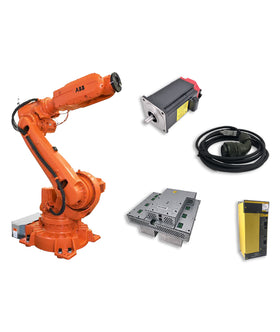


An industrial robot controller is the central unit that manages all robot operations. It acts as the “brain” of the system, executing programmed instructions, controlling motion, and coordinating communication between the robot and external equipment.
In a typical automation environment, the controller is responsible for:
Without a controller, even the most advanced robot arm cannot function.
Unlike general industrial computers, robot controllers are designed for real-time performance, high reliability, and precise synchronization across multiple axes.
Understanding controller components is essential for troubleshooting, maintenance, and spare parts replacement. Most failures in industrial robots originate from a small number of key components.
The CPU (main board) is responsible for executing robot programs, processing logic, and coordinating all system operations.
When the main board fails, the entire robot system may stop responding or fail to boot.
Common failure signs include:
In many cases, repairing or replacing the main board is more cost-effective than replacing the full controller.
Servo drives control the movement, speed, and positioning accuracy of each robot axis.
They are one of the most failure-prone components due to continuous operation, heat buildup, and electrical stress.
Typical symptoms of servo drive issues:
For most industrial users, replacing a faulty servo drive is significantly cheaper and faster than replacing the entire controller system.
The power supply unit ensures stable electrical input for all controller components.
Power-related failures are extremely common in older systems or unstable environments.
Common issues include:
A faulty power supply can also damage other components, so early replacement is highly recommended.
I/O (Input/Output) modules enable communication between the robot controller and external devices such as sensors, conveyors, and safety systems.
Failure symptoms:
Replacing I/O modules is usually straightforward and low-cost compared to system-wide repairs.
The teach pendant is a handheld interface used for programming, monitoring, and manual control.
Due to frequent handling, it is one of the most commonly damaged parts.
Typical issues:
In most cases, replacing the teach pendant is the fastest way to restore operation.
Different robot manufacturers use proprietary controller systems. Understanding these platforms helps with maintenance, spare parts sourcing, and system upgrades.
ABB systems like ABB IRC5 controller are widely used in automation and known for reliability and modular design.It supports advanced motion control and integrates well with factory automation systems.
FANUC controllers FANUC controllers are among the most widely deployed globally.
These controllers are known for durability, but still require periodic maintenance and part replacement.
KUKA C4 controllers is designed for high-performance automation and precision tasks.
It is commonly used in automotive and advanced manufacturing environments.
Yaskawa’s YRC1000 controller is compact, efficient, and widely used in welding and handling applications.
Even high-quality controllers experience failures over time.
These issues often require component-level repair or replacement.
When a robot controller fails, the key decision is whether to repair or replace it.
In many cases, replacing specific parts is more cost-effective than replacing the entire controller.
Selecting the right controller depends on several factors:
Ensure the controller matches your robot model and system requirement.
Different tasks (welding, assembly, handling) require different controller capabilities.
Refurbished controllers or spare parts replacement can significantly reduce costs while maintaining performance.
To learn more about specific systems and solutions:
We supply a wide range of industrial robot controller components, including:
👉 Browse available parts of robot controller repair parts index
Explore the Full Guide: Industrial Automation System Cluster → Robot Controller & Control System Cluster
Explore foundational knowledge and practical insights to better understand industrial robot systems and components.
Key components commonly involved in robot controllers issues and replacements.


{"one"=>"Select 2 or 3 items to compare", "other"=>"{{ count }} of 3 items selected"}
Leave a comment on this topic