
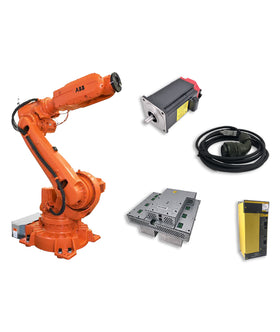
As the nerve center of any industrial robot, the robot controller is what transforms a mechanical arm into an intelligent, precise, and coordinated automation tool. From controlling joint movement and managing sensor data to integrating safety systems and external devices, the controller is what allows a robot to operate with real-world intelligence.
If you're planning to build, upgrade, or maintain a robotic system, understanding controllers is essential. This guide explores the architecture, types, FANUC controller models, and how to choose the right one for your application.
Part 1: What Exactly Is a Robot Controller?
A robot controller is a computer-based unit that governs every aspect of a robot's operation, including:
-
Coordinating multiple servo motors and axis movement
-
Executing user programs in real-time
-
Monitoring sensor feedback (force, vision, torque, temperature)
-
Managing communication protocols (Fieldbus, Ethernet/IP, OPC UA)
-
Enforcing safety logic such as E-Stop, zone control, and collision detection
✅ Key Components of a Modern Controller
| Component | Role |
|---|---|
| CPU & memory | Real-time processing of motion commands and IO |
| Servo drives | Convert control signals into physical motion |
| I/O modules | Interface with grippers, sensors, conveyors, etc. |
| Fieldbus interfaces | Enable connectivity with external factory systems |
| Safety logic hardware | Handles dual-channel safety, lockouts, E-Stops |
Advanced controllers also integrate real-time operating systems (RTOS), machine vision processing, and AI inference engines for adaptive control.
Part 2: FANUC Robot Controllers – Which One Is Right for You?
FANUC is one of the most trusted names in industrial automation. Its range of controllers caters to entry-level users and high-end manufacturers alike.
🔹 FANUC Controller Generations
| Controller | Description | Typical Use |
|---|---|---|
| R-J3 / R-J3iB | Early 2000s models; still used in legacy systems | Automotive retrofits, welding |
| R-30iA | Transitional model with Ethernet/IP support | General-purpose manufacturing |
| R-30iB / R-30iB Plus | High-speed, multi-axis coordination with advanced I/O and vision system support | Assembly, packaging, precision automation |
| R-30iB Mate | Compact controller for LR Mate series | Electronics, medical devices |

🔍 Popular Pairings
-
LR Mate 200iD + R-30iB: Great for small parts handling
-
M-10iA/12 + R-30iB Plus: For high-speed pick-and-place
-
M-710iC/50 + R-30iA: Mid-payload tasks, such as machining or deburring
🛠️ Tip: Older controllers like the R-J3iB are still supported and widely available in the used market — great for reducing upfront automation costs.
Part 3: Why Do Some Users Still Love the FANUC XRC?
While the XRC is a legacy controller, it’s still actively used by manufacturers across Asia and Europe. Here's why:
✅ Advantages of the XRC
-
Durability: 100,000+ hours MTBF (Mean Time Between Failure)
-
Precision: 0.1 ms control cycle, ±0.05 mm accuracy
-
Modularity: Easy to replace power units, IO boards, or teach pendant
-
Cost-saving: Proven 2–3x ROI when modernized with IoT upgrades
🔄 Modern Upgrades for XRC Systems
-
Add EtherNet/IP or PROFINET gateways for IIoT integration
-
Use KAREL language to develop vision-guided applications
-
Upgrade teach pendants to color screen versions
💡 Did you know? Many companies are now upgrading XRC controllers with cloud-monitoring plugins and predictive maintenance dashboards—turning old robots into smart robots.
Part 4: Why Are Robot Controllers So Important?
A robot without a controller is like a car without a steering system. The controller:
-
Turns programmed logic into precise physical movement
-
Manages feedback loops from torque, speed, and force sensors
-
Makes real-time decisions (e.g., path corrections or object detection)
-
Connects to manufacturing execution systems (MES) and SCADA platforms
In smart factories, controllers also:
-
Support predictive maintenance using vibration and cycle count data
-
Enable machine-to-machine communication
-
Store diagnostics logs for troubleshooting and compliance audits
Part 5: Types of Robot Controllers (By Architecture & Function)
Modern controllers vary by structure and specialization. Here are key types:
💡 By Architecture:
-
Centralized: Single CPU governs all tasks (e.g., FANUC R-30iB)
-
Distributed: Multiple processors for motion, safety, and vision (e.g., ABB IRC5)
-
Cloud-connected: IoT-enhanced controllers with real-time monitoring
⚙️ By Motion Control Method:
-
Position-based: For pick-and-place, palletizing
-
Force/torque controlled: For polishing, welding, or cobots
-
Hybrid adaptive: AI-enhanced motion control for dynamic environments
Part 6: Components That Power a Robot Controller
Here’s a deeper look at what’s inside:
-
Servo Drives: Convert digital signals to analog power for motors
-
Feedback Devices: Encoders and resolvers send positional data
-
Teach Pendant: Handheld interface to program, teach, and monitor robot
-
Real-Time OS: Software kernel like RT-Linux ensures deterministic response
-
Safety PLCs: Dedicated logic circuits that oversee emergency systems
Emerging features include:
-
FPGA-based acceleration
-
Edge AI chips (for on-device decision-making)
-
OPC UA + MQTT integration for cross-platform compatibility
Final Thoughts: Choosing the Right Controller for Your Robot
When choosing a robotic controller, consider:
-
Compatibility with your existing robot arm (e.g., model, axis count)
-
Required precision and response time (e.g., sub-mm applications)
-
Factory communication standards (PROFINET, EtherCAT, etc.)
-
Budget & upgrade path (legacy support or future-proofing?)
As robots take on more intelligent, collaborative, and high-speed tasks, your choice of controller will determine system scalability, reliability, and ROI.
👉 Shop the latest robot controllers at inrobots.shop and get expert advice on selecting and configuring the right controller for your operation.
FAQs
Q1: What’s the role of the CPU inside a robot controller?
It executes real-time control algorithms, processes feedback from sensors, and ensures smooth motion transitions.
Q2: Are older controllers like the R-J3iB still usable?
Yes, especially for retrofitting. Many still support modern IO interfaces and can be integrated with Ethernet/IP or DeviceNet.
Q3: How often should robot controllers be serviced?
Every 1–2 years for inspection, and every 5 years for internal fan/filter/PCB cleaning and battery replacement.


Leave a comment on this topic