

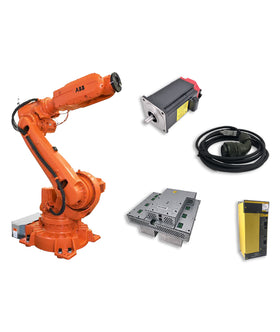
If you’re new to industrial robotics, FANUC is one of the most trusted names in the field. Their robots are widely used in manufacturing, automation, and other industries. In this guide, we’ ll break down the basics of FANUC robots, focusing on their controllers and teach pendants —essential tools for operating and programming these machines.

How FANUC Robots Are Built
A FANUC robot consists of several key components:
Axes (Joints) : The robot’s movement is controlled by servo motors that drive its axes. The first three axes (J1, J2, J3) are called the basic axes, which determine the robot’s primary range of motion

Wrist (End Effector) : Attached to the robot’s flange, the wrist holds the tool (like a gripper or welder) and performs precise movements such as twisting, tilting, and rotating.
Think of it like a human arm—the basic axes are the shoulder, elbow, and wrist, while the end effector is the hand holding a tool.
The FANUC Controller: The Robot’s Brain
The controller is the central unit that powers and manages the robot. It includes:
1. Power Supply–Provides energy to the robot’s motors and circuits.
2. User Interface Circuit–Allows interaction via the teach pendant.
3. Motion Control Circuit–Uses a main CPU board to send commands to servo amplifiers, controlling each axis.
4. Memory Circuit–Stores programs and settings in CMOS RAM (a type of non-volatile memory).
5. I/O (Input/Output) Circuit–Handles communication with external devices (like sensors or conveyor belts) via I/O modules.
Why the Controller Matters
It ensures smooth and precise robot movements.
It stores all programmed tasks, so the robot can repeat them accurately.
It connects with factory automation systems for seamless integration.
The Teach Pendant: Your Robot Remote Control
The teach pendant is a handheld device used to program and control the robot. It connects to the controller via a cable and serves as the main interface for:
1 . Manual Robot Movement (Jogging)–Adjusting the robot’s position step by step.
2. Creating & Editing Programs–Writing instructions for the robot.
3. Testing Programs–Running simulations before full execution.
4. Changing Settings–Adjusting speed, torque, and other parameters.
5. Monitoring Status–Checking errors, alarms, or operational data.
Types of Teach Pendants
R-30iB Controller–Uses a 640×480 (VGA) LCD screen.
R-30iB Plus Controller–Upgraded to a 1024×768 (VGA) LCD screen for better visibility.

Touchpad Option
Some teach pendants come with a touchpad, allowing:
Navigation in soft panel, web browser, and status windows.
Use of an on-screen keyboard.
Switching between screens and moving the cursor.
Why Learn FANUC Robotics?
1. High Demand in Automation–Many industries rely on FANUC robots for assembly, welding, and material handling.
2. User-Friendly Programming–The teach pendant makes it easy to learn robot programming.
3. Strong Industry Support–FANUC offers extensive training and documentation.
The Significance of Mastering FANUC Basic Operations for Aspiring Engineers
If you're a college student eyeing a career in manufacturing, automation, or related fields, getting to grips with FANUC basic operations is a game - changer.
Boosting Work Efficiency
In today's fast - paced industrial environment, time is money. FANUC is a leading name in CNC (Computer Numerical Control) systems, powering a vast array of machine tools. When you know the basics of FANUC operations, you can quickly navigate the system interface, set up workpiece coordinates, and call up programs. This means less time spent on trial - and - error during machine setup, allowing you to start the actual manufacturing process faster. Whether it's a simple part or a complex component, efficient operation translates to higher productivity and more projects completed within deadlines.
Ensuring Workplace Safety
Safety should always be a top priority. CNC machines are powerful and potentially dangerous if not handled correctly. By learning FANUC basic operations, you'll understand how to use safety features like emergency stops and limit switches. You'll also be aware of common error messages and know how to respond appropriately to avoid accidents. This knowledge not only protects you but also your colleagues and the expensive equipment in the workshop.
Enhancing Career Prospects
Employers value candidates with practical skills. Having FANUC basic operations on your resume gives you an edge over other applicants. It shows that you're proactive and have a head start in understanding the core technology used in modern manufacturing. As you progress in your career, this foundation will make it easier for you to learn advanced FANUC programming and maintenance techniques, opening up more opportunities for growth and advancement.
Understanding FANUC robots starts with mastering the **controller** and **teach pendant**. These tools allow you to program, test, and optimize robotic tasks efficiently. Whether you're a student or an aspiring automation engineer, learning FANUC robotics opens doors to exciting career opportunities in manufacturing and beyond.


Leave a comment on this topic