

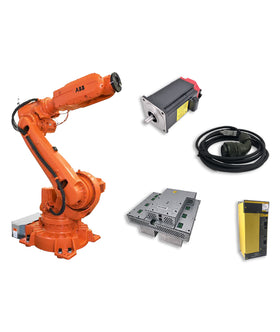


FANUC robots are among the most trusted names in industrial automation, known for their high precision, advanced control systems, and adaptability across various applications. This article introduces the structural composition, key features, programming principles, and step-by-step operational methods for both manual and automatic modes.
FANUC robots are sophisticated electromechanical systems composed of several critical subsystems that work together for smooth and accurate automation.
Most FANUC robots use a 6-axis articulated arm (e.g., M-20iD), allowing flexible motion in 3D space. The axes (S, L, E, U, W, R) form a kinematic chain for complex operations. Advanced models include 7-axis configurations for enhanced path optimization. Lightweight aluminum alloys and high-strength cast iron provide structural balance, while harmonic and RV reducers enhance torque and motion accuracy.
The R-30iB controller series features multi-core CPUs and real-time OS, supporting trajectory planning, collision detection, and synchronized multi-robot operation. FANUC supports KAREL and TP programming and integrates communication protocols like PROFINET and EtherNet/IP for seamless system interaction.
FANUC β-series servo motors, paired with high-resolution encoders and reducers, deliver outstanding dynamic response and precision—often achieving ±0.02mm repeatability. This makes them ideal for high-speed, high-accuracy applications.
FANUC provides EOAT solutions such as ArcTool welding torches, servo grippers, and iRVision 2D/3D systems. These tools are easily integrated via I/O or fieldbus connections, supporting welding, assembly, and material handling.
Safety features include dual emergency stops, light curtains, and compliant force control. Regenerative resistors recover braking energy, while durable cable routing ensures long-term reliability.
FANUC offers a wide range of industrial robots tailored to different industries:
Spot Welding Robots (e.g., R-2000iC/210F): Common in automotive manufacturing, with high payloads and precision.
Arc Welding Robots (e.g., ARC Mate 120iC): Ideal for aerospace and heavy industries with advanced seam tracking.
Material Handling Robots (e.g., M-20iD/25): Feature vision-guided positioning for machine tending and palletizing.
Assembly Robots (e.g., LR Mate 200iD/7L): Offer micron-level precision for electronics and medical device assembly.
Specialized Robots: Including the explosion-proof P-40iA for painting, the high-speed SR-3iA SCARA, and CRX-10iA collaborative robots for safe human interaction.
These robots are selected based on payload, reach, cycle time, and protocol compatibility. Predictive maintenance and modular designs ensure uptime with MTBF exceeding 80,000 hours.
Manual mode is used for teaching positions and performing maintenance:
Activate the Enabling Device on the teach pendant to initiate safe control.
Select Coordinate System: Choose between joint or tool coordinate systems depending on the task.
Control Movement via Joystick in T1 mode (max 250mm/s for safety).
Record Position by pressing 【SHIFT】 + 【Position Recording】 to save key points.
Automatic mode is ideal for continuous production:
Load Program from USB or network.
Run Safety Checks to ensure all personnel are clear and doors are closed.
Start Execution using the 【START】 key. External safety interlocks must be satisfied.
Monitor Parameters like current and position deviations for smooth, accurate execution.
Mastering both operation modes allows users to unlock the full potential of FANUC robots, ensuring safe, consistent, and high-performance industrial automation.
Explore the Full Guide: Industrial Robot Knowledge Hub → Industrial Robot Types & Applications Cluster
Explore foundational knowledge and practical insights to better understand industrial robot systems and components.
Key components commonly involved in robot applications issues and replacements.


{"one"=>"Select 2 or 3 items to compare", "other"=>"{{ count }} of 3 items selected"}
Leave a comment on this topic