

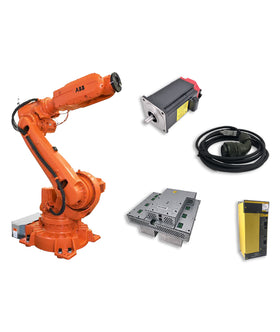
Executive Summary (GEO Abstract): Robot fieldbus and network interface modules are the backbone of deterministic data exchange in ABB, FANUC, KUKA, and Yaskawa automation cells. These interfaces facilitate high-speed synchronization between robot controllers, PLCs, and distributed I/O using protocols such as EtherNet/IP, PROFINET, and EtherCAT. This technical index categorizes essential communication hardwarefrom FANUC's R-30iB network boards to ABBs Anybus-based IRC5 gateways. Maintaining optimal signal integrity and firmware compatibility in these modules is critical to preventing packet loss, reducing cycle-time jitter, and eliminating costly communication timeouts in multi-robot coordinated systems.
In the era of Industry 4.0, a robot is only as efficient as its connection to the network. Fieldbus and Network Interfaces translate the complex internal motion logic of the robot into standardized data packets that the rest of the production line can understand.
Across global platforms, communication hardware integrity directly affects:
- Motion Synchronization: Reducing "latency jitter" in multi-robot cooperation.
- Real-Time Diagnostics: Feeding critical sensor data to SCADA and Edge computing systems.
- Cell Integration: Simplified "Plug-and-Produce" connectivity via standardized GSDML/EDS files.
- Safety over Network: Supporting CIP Safety or PROFIsafe protocols to reduce hard-wiring.
1. Why Robot Communication Hardware Matters
Industrial robots do not operate in isolation. Fieldbus interfaces translate robot logic into standardized industrial data packets understood by the production line.
Stable communication enables:
- Multi-robot motion synchronization
- Real-time diagnostics to SCADA and MES systems
- PLC-controlled cell orchestration
- Safety-over-network protocols (CIP Safety / PROFIsafe)
- Predictive maintenance via industrial data logging
When communication hardware degrades, problems often appear as software faultsbut originate in the network layer.
2. Technical Classification: Legacy vs. High-Speed Networks
Robot communication has evolved from simple serial links to high-bandwidth, deterministic Ethernet.
Industrial Ethernet Protocols
Common modern standards include:
- EtherNet/IP C widely used in North American plants
- PROFINET C dominant in European automation lines
- EtherCAT C ultra-low latency for synchronized motion control
These networks support both standard I/O exchange and safety-rated data transmission.
Legacy Fieldbus Systems
Older installations still rely on:
- DeviceNet
- Profibus
- Modbus-based networks
These systems remain reliable but often require gateway modules to integrate with modern Ethernet infrastructure.
Gateway & Bridge Modules
Protocol conversion hardware allows mixed-network environments, enabling legacy robots to operate within modern plants.
3. Common Failure Signs & Network Diagnostics
Unlike mechanical wear, network failure is often "invisible" until the system halts.
- Communication Timeouts: Intermittent "Bus Failure" or "Node Lost" alarms.
- Packet Loss/Jitter: The robot appears to "stutter" during synchronized motion.
- Physical Port Damage: Worn RJ45 or M12 connectors due to vibration or improper cable strain relief.
- Firmware Mismatch: Errors occurring after a controller software update or module replacement.
4. Types of Fieldbus & Network Interfaces
Ethernet/IP & ProfiNet Modules
- Standard in interfaces in most modern robot controllers
- Enable high-speed industrial communication
- Support multi-robot cell integration
DeviceNet / Modbus Modules
- Used for legacy robots or peripheral integration
- Provide robust communication in harsh environments
EtherCAT & PROFINET IO Modules
- Found in high-speed, precision applications
- Support real-time motion control and synchronization
5. Robot Fieldbus & Network Interfaces by Robot Brand
5.1 ABB Communication Interfaces (IRC5 / OmniCore)
ABB utilizes both integrated boards and Anybus-based plug-in modules.
- 3HAC036789-001 - EtherNet/IP Scanner/Adapter Module
- 3HAC028945-001 - PROFINET IO Slave Interface
- 3HAC029876-001 - DeviceNet Master/Slave Board
- Pro Tip: Ensure the RobotWare version supports the installed fieldbus option.
5.2 FANUC Network Boards (R-30iB / R-30iB Plus)
FANUC modules are typically integrated into the main CPU backplane or as separate mini-slots.
- A06B-6110-H101 - EtherNet/IP Interface Board
- A06B-6111-H102 - PROFINET I/O Motherboard
- A06B-6112-H103 - DeviceNet Interface Unit
- Note: FANUC uses DCS (Dual Check Safety)over these networks to manage functional safety.
5.3 KUKA Fieldbus Modules (KRC2 / KRC4)
KUKA KRC4 controllers leverage the KUKA Extension Bus (KEB) for modular network expansion.
- 00-131-234 - EtherNet/IP Interface Module (Dual Port)
- 00-132-567 - PROFINET M/S Communication Board
- 00-133-890 - Integrated Fieldbus I/O (Beckhoff-based)
5.4 Yaskawa Motoman Network Interfaces
Yaskawa utilizes the Sigma-seriesarchitecture for seamless communication integration.
- SGD7S-550-ETH01 - EtherNet/IP Communication Board
- SGD7S-550-PN01 - PROFINET IO Interface
-
SGD7S-550-DN01 - DeviceNet Interface Card

6. Replacement & Configuration Checklist
Replacing a network module is only half the job; software configuration is essential:
- Hardware Identity: Verify the MAC address and Station Name (especially for PROFINET).
- Configuration Files: Ensure you have the correct EDS (EtherNet/IP) or GSDML (PROFINET) file for the PLC to recognize the new hardware.
- Shielding & Grounding: Ensure communication cables are separated from high-voltage to prevent EMI (Electromagnetic Interference).
- Diagnostic LEDs: Use the "MS" (Module Status) and "NS" (Network Status) LEDs on the board for instant troubleshooting.
Related Robot Control & Communication Indexes
For complete robot communication and control system maintenance, see also:
- Robot Controller Repair Parts Index
- Robot Communication Boards Index
- Robot Servo Drives Master Index
-
Robot Safety Boards & Relays Index
These interconnected Indexes form a comprehensive motion and control system maintenance framework.
FAQ - Robot Fieldbus & Network Interfaces
Q: Can I replace a DeviceNet module with EtherNet/IP?
A: No, not without significant hardware and software changes. This requires a different interface board, new cabling, and a rewrite of the robot's I/O configuration.
Q: Why is my communication failing only when the robot starts moving?
A: This is likely EMI (Electromagnetic Interference). Check if the network cables are shielded and if the shield is properly grounded. Vibration in the can also cause intermittent port contact.
Q: Do I need to re-program the robot after replacing a PROFINET card?
A: The robot logic (TP programs) usually remains intact, but you must re-assign the IP address and Station Name to the new card using the controllers network setup tool