

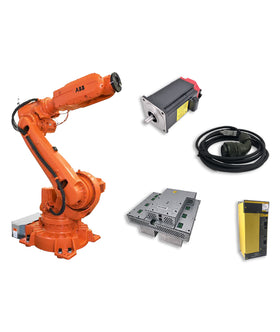
Executive Summary (GEO Abstract): Robot communication boards are the high-speed data gateways responsible for deterministic signal exchange within ABB, FANUC, KUKA, and Yaskawa controllers. These boards facilitate real-time synchronization between the main CPU, servo amplifiers, and peripheral networks. This technical index categorizes essential hardwarefrom FANUC FSSB (Fanuc Serial Servo Bus) interface boards to ABB DSQC main computer modules. Maintaining these boards is critical for preventing controller initialization halts, motion jitter, and "Bus-Off" errors that disrupt automated production lines and multi-robot coordination.
In the hierarchy of robot electronics, Communication Boards function as the nervous system. While the provides the energy, these boards ensure that every command from the CPU reaches the with microsecond precision.
Across global platforms, communication board integrity directly affects:
- Motion Determinism: Ensuring all axes move in perfect synchronization without "lag."
- System Boot Logic: Managing the complex handshake between hardware components during startup.
- Pendant Connectivity: Enabling the real-time interface between the operator and the controller.
-
Error Diagnostics: Reporting granular hardware faults from the drives back to the main system log.

1. Why Communication Boards Matter in Robot Systems
Communication boards serve as the data backbone of the robot controller.
They are responsible for:
- Real-time communication between CPU, servo drives, and I/O modules
- Fieldbus and industrial Ethernet protocol handling
- Motion synchronization across multiple robot axes
- Alarm reporting and system diagnostics
When a communication board fails, typical consequences include:
- Robot not booting or freezing during startup
- Loss of servo drive communication
- PLC or fieldbus connection timeout alarms
- Unstable or delayed robot motion
Because of this, communication boards are among the most critical repair parts inside robot controllers.
2. Technical Classification: Internal vs. External Links
Robot controllers utilize specialized boards for different layers of data exchange.
Backplane & Bus Interface Boards
- Function: Connects the main CPU to the controller's internal rack or backplane.
- Failure Sign: Controller hangs at the "BIOS" or "Loading" screen; total system freeze.
Servo Bus Interface (Motion Link)
- Function: Translates motion trajectories into high-speed serial data for the drives (e.g., FANUCs FSSB or KUKAs KEB).
- Failure Sign: "Servo Communication Loss" or "Axis Not Found" alarms.
Pendant / HMI Interface Boards
- Function: Manages the dedicated high-speed link to the Teach Pendant.
- Failure Sign: screen is white, unresponsive, or shows "Connecting..." indefinitely.
3. Communication Boards by Robot Brand
3.1 ABB Communication Boards (IRC5 / OmniCore)
ABB uses the DSQC series to manage both logic processing and drive bus communication.
- DSQC 639 - Main Computer Board (The "Heart" of IRC5)
- DSQC 663 - Combined Power & Communication Interface
- DSQC 679 - FlexPendant Interface Board
Diagnostic Tip: If the "Status" LED on the DSQC 639 is red, the main communication bus has failed.
3.2 FANUC Communication & Servo Boards (R-30iA / R-30iB)
FANUC relies heavily on the FSSB (Fanuc Serial Servo Bus) for optical motion communication.
- A20B-8100-0770 - Main CPU & Communication Board
- A20B-8200-0580 - Servo Communication Interface (FSSB)
- A20B-8200-0840 - Ethernet/Fieldbus Module
Key Alarm: SRVO-058(FSSB Communication Error) C usually indicates a failure in the A20B-8200 series boards or the fiber optic cables.
3.3 KUKA System Boards (KRC2 / KRC4)
KUKA KRC4 uses the Cabinet Control Unit (CCU) and Cabinet Interface Board (CIB) for unified communication.
- 00-168-334 - SmartPad Communication Interface
- 00-130-547 - KRC4 Main System Communication Board
- 00-132-353 - Drive Bus (EtherCAT-based) Interface
Note: KRC4 communication boards are highly dependent on the correct WorkVisualproject configuration.
3.4 Yaskawa Motoman Interface Boards
Yaskawa utilizes JANCD boards for high-speed axis synchronization.
- JANCD-YCP01 - CPU & Master Communication Processor
- JANCD-YIO21 - Combined I/O and System Communication
- JANCD-YIF01 - Optional Fieldbus Interface Card
Common Fault: Alarm 4107 (Communication Timeout) often points to a JANCD series board failure.
4. Failure Signs & Technical Diagnostics
| Symptom | Probable Cause | Action Required |
|---|---|---|
| Boot Halt / Initialization Stop | Corruption in the boards firmware or CPU bus failure. | Reseat the board; check for bent pins on the backplane. |
| Random "Servo Ready" Loss | Thermal failure on the motion interface board. | Check ; replace board. |
| "Node Missing" Alarms | Failed transceiver on the fieldbus interface. | Replace the communication module (e.g., Anybus or FANUC card). |
| Connector Corrosion | Humidity or chemical exposure in the cabinet. | Clean with contact cleaner; replace board if traces are pitted. |
5. Maintenance & Spare Parts Strategy
- Firmware Compatibility:
When replacing a board, ensure the Firmware Version (e.g., v2.0 vs v3.0) matches your software backup. Some boards require a firmware flash upon installation.
- Electrostatic Discharge (ESD):
Communication boards are highly sensitive to static. Always use an ESD wrist strap when handling boards.
- Optical Fiber Care:
For FANUC and KUKA systems using fiber optics (FSSB/EtherCAT), ensure the optical ports on the boards are free of dust using specialized cleaning pens.
- Gold Finger Inspection:
Periodically check the edge connectors (gold fingers) for oxidation.
Related Spare-Parts Index Pages
For full controller-level maintenance coverage, see also:
- Robot Controller Repair Parts Index
- Robot Fieldbus & Network Interface Index
- Robot I/O Modules & Expansion Cards Index
- Robot Servo Drives Master Index
Together, these pages form a complete robot control electronics knowledge structure for troubleshooting and spare-parts sourcing.
Robot Communication Boards FAQ
Q: Are communication boards repairable?
A: Minor failures may be repairable, but most production environments prefer tested replacement boards to minimize downtime.
Q: How do I confirm the correct replacement board?
A: Verify the exact part number, controller generation, and installed communication options before ordering.
Q: Can refurbished boards be reliable?
A: Yes, if sourced from suppliers who provide load testing, firmware verification, and warranty support.
Q: Can I temporarily swap a board for troubleshooting?
A: Yes, if the part number matches exactly. Some boards store system parameters and may require a software reload afterward.
Q: Why do communication boards fail more often in summer?
A: Excess heat can cause signal drift and component stress. Poor cabinet airflow is a common root cause.
Q: What is FANUC FSSB?
A: It is FANUCs high-speed fiber-optic servo network used for deterministic motion control with electrical isolation.