

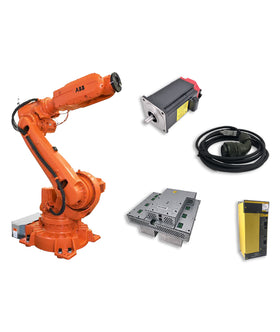
Panasonic industrial robots are the backbone of high-precision arc welding and automated assembly lines worldwide. From the versatile TA and TM series to high-speed G-series cells, maintaining these systems requires a strategic approach to component replacement.
This index serves as a professional technical resource for engineers and procurement teams to identify, categorize, and source critical Panasonic robot spare parts to minimize downtime and preserve welding integrity.
1. Why Strategic Spare Parts Management Matters
In high-duty cycle environments like automotive fabrication, Panasonic robots face extreme thermal and mechanical stress. Using the correct OEM-spec or certified refurbished parts is non-negotiable for:
- Precision Repeatability: Ensuring the robot hits the same weld point millions of times.
- Arc Stability: Maintaining the delicate communication between the controller and the welding power source.
- Safety Compliance: Keeping emergency stops and interlock circuits within factory specifications.
2. Core Component Categories
To simplify troubleshooting, Panasonic spare parts are categorized by their functional systems:
Controller Boards & Logic Electronics
The "brain" of the Panasonic system often requires intervention when communication alarms or boot failures occur.
- Main CPU Boards: The primary processing unit for motion logic.
- I/O & Fieldbus Modules: For communication with external PLCs and sensors.
- Power Supply Units (PSUs): Converting factory power for sensitive logic circuits.
Servo Systems: Motors, Drives & Feedback
The "muscles" of the robot. These components have the highest failure rates due to continuous motion and heat.
- AC Servo Motors: Precise brushless motors for each axis.
- Servo Amplifiers (Drives): Units that regulate the current and voltage to the motors.
- Pulse Coders / Encoders: High-resolution feedback devices that track position.
- Brake Assemblies: Vital for preventing "axis drop" during power loss.
Welding-Specific Hardware (Dress Packs & Torches)
As a specialist in robotic arc welding, Panasonics peripheral hardware is unique.
- Robot Dress Packs: The protective umbilical housing for power, gas, and air.
- Torch Necks & Contact Tips: High-wear consumables that dictate weld quality.
- Wire Feeders: Precision drive rolls and motors that ensure smooth wire delivery.
Human-Machine Interface (HMI)
The Teach Pendant is the most physically vulnerable part of the system.
- Replacement LCDs & Overlays: Fixing cracked screens or worn membranes.
- Communication Cables: Often damaged by being stepped on or pinched.
- Enable Switches: Critical safety "dead-man" switches.

3. Maintenance Focus: Common Failure Signs
Recognizing these symptoms early can prevent catastrophic production halts:
| Symptom | Likely Faulty Component |
|---|---|
| Erratic Path Deviation | Encoder failure or motor cable interference |
| "Communication Lost" Alarm | I/O board or Teach Pendant cable |
| Unstable Welding Arc | Torch liner, contact tip, or interface board |
| Sudden Axis Drop | Failed motor brake assembly |
| Overheating Alarms | Controller cooling fans or clogged filters |
4. Panasonic Robot Series Compatibility
Before sourcing parts, verify the generation of your controller (e.g., G2, G3, WG3) and the robot arm model.
- TA / TM Series: Specialized for high-speed arc welding.
- TL Series: Long-reach variants for larger workpieces.
- Integrated Power Sources: Ensure the internal welding interface matches the spare part revision.
Pro Tip: Always cross-reference the Part Number found on the components physical nameplate rather than relying solely on the robot model name.
Related Robot Spare Parts Index Pages
To build a complete maintenance knowledge structure, see also:
- Robot Servo Motors & Encoders Index
- Robot Servo Drives Master Index
- Robot Dress Packs & Welding Torch Index
- Robot Controller Repair Parts Index
- Robot Power Supply Units Index
These interconnected indexes form a full lifecycle spare-parts framework for welding robots.
Brand Comparisons
- Universal Robots Part Number Index
- Panasonic Robot Spare Parts Index
- Staubli Robot Spare Parts Index
- Kawasaki Robot Spare Parts Index
Compare Other Robot Controller Spare Parts
FAQ - Panasonic Robot Spare Parts
Q1: Are Panasonic parts cross-compatible?
A: Rarely. While a motor might look identical, the encoder resolution or connector pinout often changes between controller generations (e.g., shifting from G2 to G3). Always verify the specific firmware/hardware version.
Q2: Should I choose New or Refurbished parts?
A: New OEM parts are preferred for critical safety circuits. However, Refurbished parts are an excellent, cost-effective solution for legacy models (like the TA series) where new parts may have long lead times. Ensure your supplier provides load-testing reports.
Q3: What is the most common cause of "Servo Alarm" errors?
A: It is often not the motor itself, but the cables. Friction inside the robot arm can wear down the internal shielding, leading to signal noise.
Reference Notes
This section provides supplementary reference links related to Panasonic robot system architecture, welding-integrated hardware classification, and component identification structures.
Referenced materials are intended to support index navigation and part number orientation within the Panasonic/TA/TM series ecosystem only. They are informational in nature and do not replace official Panasonic industrial technical documentation, system manuals, or software release notes.