


Few automation problems are more difficult to troubleshoot than an intermittent servo alarm.
Unlike permanent failures, intermittent servo faults appear unexpectedly, disappear after a reset, and often return without warning. A machine may operate normally for hours—or even days—before suddenly generating a servo communication alarm, encoder fault, synchronization error, or following error.
Because the alarm is not continuously active, maintenance teams frequently replace components without solving the underlying problem. Servo drives, motors, and controllers are often suspected first, yet many intermittent servo alarms actually originate elsewhere in the feedback chain.
In industrial robots and servo-driven machines, reliable motion control depends on stable communication between the controller, servo amplifier, encoder, and motor. Any disruption in this feedback loop can create temporary signal instability that eventually triggers a servo alarm.
Understanding how signal degradation develops—and why it often appears only under specific operating conditions—is essential for diagnosing recurring servo faults and preventing unexpected downtime.
Intermittent servo faults rarely present as a complete system failure. Instead, they tend to appear as recurring but unpredictable events.
Common symptoms include:
A key characteristic of intermittent faults is that the machine often runs normally between alarm events, making root-cause identification much more difficult than diagnosing a permanent failure.
Modern servo systems operate using closed-loop control.
The controller continuously compares:
The actual position is provided by the encoder through a high-speed feedback network.
Every servo movement depends on accurate feedback data. The controller uses this information to calculate:
If feedback quality deteriorates—even briefly—the controller may lose confidence in the actual motor position. Once this occurs, corrective actions increase rapidly and can eventually trigger a servo alarm.
For this reason, many servo alarms are actually symptoms of communication or feedback instability rather than failures inside the servo amplifier itself.

Permanent failures are relatively straightforward.
A damaged servo drive typically remains failed until repaired or replaced.
Intermittent failures behave differently because they are influenced by operating conditions such as:
A partially fractured conductor may only lose continuity when the cable bends in a particular direction.
Similarly, a worn connector may only create excessive resistance when vibration levels increase during production.
This explains the common maintenance scenario:
As a result, intermittent servo alarms often remain unresolved for extended periods.
Although servo alarms can originate from many sources, most intermittent faults fall into five categories:
Understanding each failure mechanism helps narrow the diagnostic process significantly.
Encoder communication problems are among the most common causes of intermittent servo alarms.
Servo controllers rely on continuous position updates from the encoder. If these signals become corrupted, delayed, or interrupted, the controller can no longer accurately determine motor position.
Typical causes include:
As feedback quality deteriorates, the controller may experience:
The resulting alarm may appear as a servo fault even though the encoder network is the actual root cause.
Robot and servo cables experience millions of bending and twisting cycles throughout their service life.
High-stress locations typically include:
Over time, conductor strands begin to fatigue.
Importantly, complete wire breakage is not required to create a fault.
Even partial conductor fractures can cause:
This explains why a servo alarm may occur only when the robot reaches specific positions.
The cable passes a static continuity test, yet fails under dynamic motion conditions.
Connectors are often overlooked during troubleshooting because they appear physically intact.
However, many intermittent servo faults originate at connector interfaces.
Over time, environmental exposure can produce:
In addition, vibration can cause fretting corrosion.
Fretting occurs when microscopic movement repeatedly breaks and reforms contact surfaces. The resulting oxide debr is gradually increases electrical resistance and degrades signal quality.
Common symptoms include:
Because the connector may look normal externally, electrical testing is often required to identify the problem.
Electromagnetic interference is another common source of intermittent servo alarms.
Industrial facilities contain numerous noise-generating devices, including:
When shielding or grounding becomes compromised, electrical noise can couple into encoder and feedback circuits.
Unlike mechanical failures, EMI typically leaves no visible evidence.
Instead, symptoms may include:
Because noise levels vary throughout production, alarms may appear only during specific machine operations.
Modern motion-control systems depend on precise communication timing between:
Most controllers can tolerate occasional communication disturbances.
However, repeated delays eventually exceed synchronization limits.
When this occurs, the controller may generate:
These alarms often indicate a developing signal-integrity problem rather than a failed servo drive.
One of the most confusing aspects of intermittent faults is that resetting the alarm often restores normal operation.
This happens because the reset only clears the controller's fault state.
It does not eliminate the underlying problem.
Several conditions may temporarily improve after a reset:
Cooling can temporarily improve connector contact quality and cable performance.
Stopping and restarting the machine may slightly reposition damaged cables.
Controllers may automatically re-establish communication after transient disturbances.
Noise levels may fluctuate depending on nearby equipment operation.
As a result, the machine appears fixed even though the fault remains present.
Begin by reviewing:
Patterns often reveal valuable diagnostic clues.
Pay particular attention to:
Static continuity testing alone is often insufficient.
Instead:
Many faults become visible only during motion.
Modern controllers provide powerful diagnostic capabilities.
Examples include:
Monitor:
Correlating signal disturbances with servo behavior is often the fastest path to root-cause identification.
If no mechanical fault is found:
Production-related alarm patterns frequently point toward hidden EMI problems.
Preventive maintenance is often more effective than reactive troubleshooting.
Recommended practices include:
Do not wait for complete conductor breakage.
Replacement schedules should consider:
Regular inspection helps prevent:
Proper routing reduces:
Advanced maintenance programs increasingly track:
Identifying degradation early significantly reduces unplanned downtime.
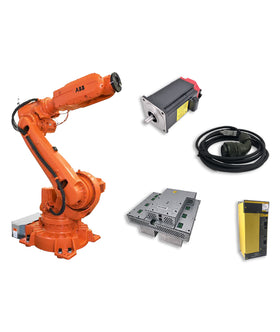
The following components are frequently associated with intermittent servo alarms:
The most common causes are encoder feedback instability, cable fatigue, connector degradation, EMI interference, and communication timing errors.
A reset clears the fault state but does not repair the underlying problem. If the root cause remains, the alarm will eventually return.
Many cable and connector faults are position-dependent and only affect signal quality when the machine reaches specific positions.
Yes. Electrical noise can corrupt encoder and feedback signals, causing communication errors and synchronization faults.
Dynamic testing combined with servo trace analysis is usually far more effective than static continuity measurements because most intermittent failures occur only under real operating conditions.
Key components commonly involved in issues and replacements.
No related parts found. Please check available components in our catalog.


{"one"=>"Seleziona 2 o 3 articoli da confrontare", "other"=>"{{ count }} di 3 elementi selezionati"}
Seleziona il primo elemento da confrontare
Seleziona il secondo elemento da confrontare
Seleziona il terzo elemento da confrontare
Lascia un commento