

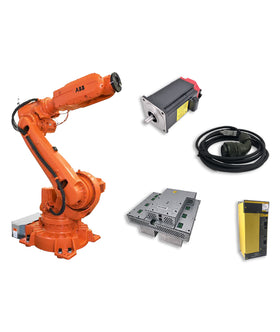


FANUC industrial robots use pulse coder (encoder) feedback transmitted through the FSSB (FANUC Servo Serial Bus) system to control axis position, speed, and motion accuracy.
Encoder signal loss occurs when the controller fails to receive stable feedback from one or more servo axes in the system.
This typically results in motion interruption, servo shutdown, or axis communication failure.
Common symptoms include:
Related FANUC alarm codes may include SRVO-021, SRVO-062, and SRVO-068, which generally indicate encoder or communication interruptions within the servo loop rather than mechanical motor failure.
Signal cable failure is the most common root cause of encoder signal loss in FANUC systems.
Typical failure modes include:
In FANUC systems, pulse coder feedback depends on stable transmission through the servo loop cable system, making signal cables a critical failure point.
FANUC robots use the FSSB system to transmit pulse coder and servo data between controller, servo amplifiers, and motors.
In many R-30iA and R-30iB systems, FSSB communication is transmitted via optical fiber cables.
Faults in this communication chain can cause system-wide encoder signal loss.
Common issues include:
Note: In optical FSSB systems, even minor bending beyond recommended radius can introduce internal fiber damage, resulting in intermittent signal loss similar to electrical cable fatigue but without visible external wear.
Pulse coder failure inside FANUC servo motors can also trigger encoder signal loss.
Typical causes include:
This type of failure is less frequent but typically results in persistent axis-specific alarms.
Pulse coder data is processed through FANUC servo amplifiers and controller modules.
Possible issues include:
Determine whether the issue is:
Intermittent and motion-related faults are strongly associated with signal cable or connector degradation.
Focus on high-stress areas:
FANUC encoder systems rely on both internal robot cables and external servo amplifier communication cables for pulse coder feedback.
Inspect servo system communication:
Any interruption in the FSSB chain may result in multi-axis encoder signal loss.
If possible, swap signal cables or test alternative servo amplifier connections.
If the fault follows the cable, the signal cable is confirmed as the root cause.
FANUC robots operate with high-speed servo feedback loops requiring stable pulse coder communication between controller, servo amplifier, and motor.
Signal cables and FSSB links are exposed to:
As a result, signal cables are among the most failure-prone components in the encoder feedback system.
| Symptom | Likely Cause |
| Intermittent encoder loss | Signal cable degradation |
| Startup communication failure | FSSB or connector issue |
| Single axis error | Pulse coder (encoder) failure |
| Multi-axis failure | FSSB communication chain issue |
Stable pulse coder feedback depends on reliable servo communication and signal transmission integrity.
Key requirements include:
The most common cause is signal cable degradation or damage within the servo feedback or FSSB communication chain.
Yes. In optical FSSB systems, micro-cracks or excessive bending in fiber cables can cause intermittent pulse coder signal loss similar to electrical cable failure.
A cable substitution test or movement-based fault variation test is the fastest way to confirm signal cable failure.
No. Most encoder-related alarms are caused by signal cable or FSSB communication issues rather than internal pulse coder failure.
Yes. While signal and communication faults are common, SRVO-062 can also be triggered by a depleted encoder battery (BZAL condition). If the alarm persists after inspection and power cycling, battery voltage should be checked.
Explore the Full Guide: Repair & Troubleshooting Cluster → Encoder Signal Loss in Industrial Robots
Explore the complete guide for troubleshooting, repair strategies, and component replacement across industrial robot systems.
Key components commonly involved in encoder signal loss in industrial robots issues and replacements.


{"one"=>"Select 2 or 3 items to compare", "other"=>"{{ count }} of 3 items selected"}
Leave a comment on this topic