



When a Yaskawa robot starts losing positioning accuracy, it usually doesn’t fail in a single moment.
In most production lines, the issue builds up gradually and becomes noticeable only after repeated cycles or restart conditions.
Typical field symptoms include:
In real maintenance situations, this is rarely linked to mechanical wear.
The problem is usually inside the feedback system of the Sigma servo architecture, especially:
The key is not the symptom itself, but which part of the feedback chain is no longer behaving normally.
Before replacing hardware, the first step is always to observe how the error behaves in motion.
Typical situation:
In most cases, this comes from:
This is usually not a hardware issue. It’s a configuration or setup problem.
More concerning pattern:
This usually points to the feedback side:
In Yaskawa systems, this pattern is far more related to signal stability than mechanical wear.
In real plants, another sign often appears:
This is usually a sign that the Sigma servo loop is over-correcting due to unstable feedback input.
Yaskawa robots rely on a fast closed-loop control system designed for real-time motion correction.
The simplified signal chain is:
Encoder → Sigma Servo Drive → Motion Compensation → Controller Execution
If any part of this chain becomes unstable, small feedback errors don’t stay small.
They get corrected, amplified, and reflected back into motion behavior.
What you start seeing:
Encoders in Sigma motors rarely fail suddenly. They degrade over time.
Common field causes:
What appears on the robot side:
Early-stage issues are often intermittent and only show under motion, not static checks.
The Sigma servo system handles real-time compensation across all axes.
When it becomes unstable, the system may start correcting incorrectly instead of accurately.
Typical causes:
In field cases, this often looks identical to encoder failure from the outside.
That’s why separating “servo loop vs encoder” behavior is critical in diagnos is.
Even when encoder and servo drive are healthy, signal quality can still break down in the cable layer.
Common causes:
Typical behavior:
High-flex areas near wrist axes are usually the first weak point.
Yaskawa Sigma systems also rely on battery-supported memory for position retention during shutdown.
When battery voltage drops:
Typical symptoms:
Battery-related issues often develop slowly without clear alarms at the beginning.
In DX100 / DX200 / YRC1000 systems, most positioning issues fall into two patterns.
Usually caused by:
Usually caused by:
In real maintenance work, this second category is far more common than mechanical failure.
Many Yaskawa cases are initially mistaken for:
But field experience shows a different reality:
Most “position accuracy problems” come from feedback system instability, not mechanical damage.
Observe:
Focus on variation, not single readings.
Check:
Servo loop instability is often underestimated in field troubleshooting.
Inspect:
Motion-based testing usually reveals more than static continuity checks.
A simple but very effective field method:
Procedure:
Interpretation:
Cold-start behavior is one of the most reliable indicators of feedback instability in Yaskawa systems.
Most cases are related to encoder instability or battery-backed position retention issues in the Sigma system.
It is Yaskawa’s closed-loop motion control system combining encoder feedback, servo compensation, and multi-axis synchronization.
Yes. In practice, servo compensation instability often produces identical symptoms such as drift and repeatability loss.
No. In industrial field diagnostics, feedback system issues are statistically more common than mechanical damage.
Most Yaskawa position accuracy issues are not mechanical failures.
They come from instability inside the Sigma feedback loop and encoder signal chain.
That’s why experienced technicians usually check:
before replacing motors, reducers, or servo amplifiers.
Explore the Full Guide: Repair & Troubleshooting Cluster → Robot Position Accuracy
Explore the complete guide for troubleshooting, repair strategies, and component replacement across industrial robot systems.
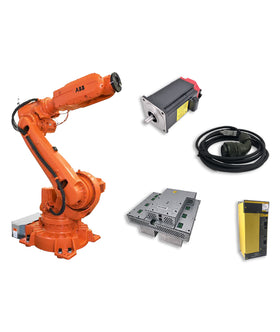
Key components commonly involved in robot position accuracy issues and replacements.


{"one"=>"Seleziona 2 o 3 articoli da confrontare", "other"=>"{{ count }} di 3 elementi selezionati"}
Seleziona il primo elemento da confrontare
Seleziona il secondo elemento da confrontare
Seleziona il terzo elemento da confrontare
Lascia un commento