

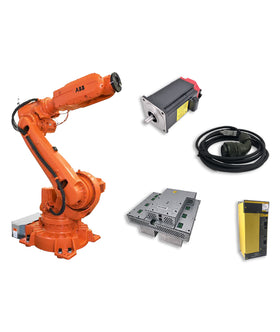

A Yaskawa communication error (also known as a communication fault, bus error, or servo pack communication failure) occurs when data exchange between system components becomes unstable or completely lost.
Th is typically involves:
When communication is interrupted, motion is immediately stopped to prevent uncontrolled axis behavior and ensure system safety.
Field Insight:
In real-world applications, over 70% of Yaskawa communication errors are caused by signal transmission issues (cables or connectors), while the remaining cases are usually linked to internal servo drive PCB failures or network configuration problems.
Although closely related, these faults occur at different system levels:
|
Type |
Description |
Impact |
|
Servo Pack Alarm |
Internal drive protection |
Stops individual axis |
|
Communication Error |
Signal failure between components |
Stops entire system |
In practice:
Communication failures can trigger, mask, or cascade into servo pack alarms, especially encoder-related faults.
Communication errors are rarely random events. In field diagnostics, they almost always originate from one of three failure domains:
Typical causes:
Field reality:
Most intermittent communication errors originate from cable instability.
If the issue persists after cable replacement:
Key insight:
If the controller cannot detect the drive → internal PCB failure is highly likely.
Use th is fast logic to identify the root cause:
|
Error Pattern |
Symptoms |
Root Cause |
Recommended Action |
|
Intermittent faults |
Signal drops during motion |
Cable / connector degradation |
Inspect or replace cable |
|
Persistent loss |
Drive not detected |
Servo drive PCB failure |
Replace servo drive |
|
Multi-axis failure |
Several drives offline |
Network / controller issue |
Check configuration |
Use a structured isolation process to avoid misdiagnosis between cable, network, and internal drive failure.
Classify the fault:
Th is determines whether the issue is network-level or hardware-level.
Check for:
Cable integrity must always be verified before internal diagnostics.
Replace the communication cable with a verified good one:
This is the fastest method to eliminate 70%+ of field causes.
Check:
If cables and configuration are correct:
Basedon field diagnostics, communication faults typically converge to these components:
First-line suspect when:
Required when:
Consider only when:
In most real-world cases, communication errors are resolved by either cable replacement or servo drive replacement.
Once the root cause of the communication fault has been identified, restoring stable signal transmission typically involves replacing the affected hardware. The following solutions apply basedon where the failure occurs:
When faults appear intermittently or are triggered during robot movement, the issue is often linked to physical signal transmission. Wear, bending stress, or shielding degradation can all lead to unstable communication at the hardware level.
In these cases, it’s recommended to replace the Yaskawa communication cables to restore consistent data exchange.
If the controller cannot reliably detect the drive, or communication errors persist despite stable wiring, the problem is likely internal. Failures in the drive’s communication circuitry or PCB layer will prevent proper signal processing.
Under these conditions, you should replace the Yaskawa servo drive to re-establish normal system communication.
Regardless of the solution, all replacement components should be tested under real operating conditions to ensure stable bus communication and synchronization during actual load cycles.
|
Option |
When to Use |
Risk |
|
Repair |
Cleaning connectors, temporary fixes |
High recurrence risk |
|
Replace |
Cable or drive failure confirmed |
Stable long-term solution |
Decision Rule:
If errors persist after cable and configuration checks, the fault is almost always inside the servo drive communication hardware.
Cable degradation, especially in high-motion applications.
Perform a cable swap test. If the error remains, the issue is likely inside the drive.
Yes, especially after system updates or incorrect protocol settings.
No. Communication loss can lead to loss of axis synchronization and unsafe motion.
Replacing the communication cable is the fastest and lowest-risk first step.
To fully diagnose and prevent recurring issues, you may also need:
Explore the Full Guide: Repair & Troubleshooting Cluster → Yaskawa Communication Error
Explore the complete guide for troubleshooting, repair strategies, and component replacement across industrial robot systems.
Key components commonly involved in yaskawa communication error issues and replacements.
No related parts found. Please check available components in our catalog.


{"one"=>"Seleziona 2 o 3 articoli da confrontare", "other"=>"{{ count }} di 3 elementi selezionati"}
Seleziona il primo elemento da confrontare
Seleziona il secondo elemento da confrontare
Seleziona il terzo elemento da confrontare
Lascia un commento