



When a Universal Robots system suddenly stops during production and displays:
the message itself usually does not identify the real problem.
In most production environments, a UR safety shutdown is not a single fault. It is the result of the robot safety architecture reacting to an unsafe or invalid condition somewhere in the system.
In practice, the root cause usually comes from one of these areas:
At this level, diagnos is is not about reading the alarm text — it is about understanding why the safety system forced the stop.
UR robots follow safety stop principles aligned with:
In real production environments, two stop categories appear most frequently.
Stop Category 0 is a hard safety stop.
Servo power is removed immediately and mechanical braking is applied without controlled deceleration.
In real-world troubleshooting, Category 0 almost always indicates a hard interruption somewhere in the safety chain.
This is normally not caused by robot program logic.
Common triggers
If the robot enters Category 0 repeatedly, focus on:
before investigating software or robot motion programming.
Stop Category 1 performs a controlled deceleration before transitioning the robot into a safe power-off condition.
Unlike Category 0, motion is stopped in a controlled manner.
Many technicians mistake Category 1 stops for software-level program interruptions.
In reality, these stops are still fully safety-controlled events executed by the robot safety architecture, not by the robot program itself.

UR safety architecture uses redundant safety channels managed by the Safety Control Board (SCB).
Typical Structure
If the two channels do not match within expected timing, the robot forces a safety stop.
Common field causes
Real-World Behavior
This type of failure is often difficult to identify because:
Intermittent safety faults are frequently caused by unstable signal integrity rather than failed hardware components.
Many UR safety shutdowns originate outside the robot controller.
Common External Sources
Typical Failure Pattern
In practice, this often points to:
rather than PLC logic or software failure.
In integrated automation lines, UR safety depends heavily on PLC coordination.
Common failure patterns
Field observation
In many cases:
This is typically an integration-layer issue rather than a robot hardware failure.
Safety configuration problems commonly appear after:
Common Causes
Typical Symptoms
The core problem is usually configuration inconsistency across the safety system.
UR safety faults rarely remain isolated to one component.
A single safety interruption can propagate across multiple layers, including:
Once the safety chain is interrupted, normal program execution is no longer relevant.
At that point, the robot safety architecture takesfullfull control of the system state.
Experienced field engineers usually follow a fixed troubleshooting process.
Determine whether the robot behavior matches:
This immediately narrows the possible fault area.
Check:
Review:
Many integration issues only appear when both systems are analyzed together.
Verify:
Inspect:
In real production environments, failure patterns are often consistent:
| Failure Pattern | Most Likely Cause |
| Stop at cycle start | PLC handshake or timing issue |
| Stop during motion | Protective or motion-triggered safety event |
| Random intermittent shutdown | Wiring instability or SCB signal drift |
| Failure after maintenance | Safety configuration mismatch |
| Restart temporarily fixes issue | Contact or signal instability |
Core rule:
Every Safety Error has a physical or logical trigger — even if it is not clearly shown on UI.
Frequent troubleshooting mistakes include:
Misdiagnosed safety faults often lead to:
Always ask:
“What physically or logically triggered the safety chain?”
Every UR safety shutdown has a trigger, even if the HMI message is vague.
The goal is not just reading the alarm — it is identifying which safety layer forced the robot into a protected state.
Because safety stops operate at the safety architecture level, not standard runtime logic.
The UI often only reports the result of the safety event, not the exact originating trigger.
Rarely.
Most safety shutdowns originate from:
Because many safety events are condition-triggered rather than permanent hardware failures.
Once the triggering condition disappears, the robot can often restart normally.
No.
Most cases involve:
rather than failed controller hardware.
Explore the Full Guide: Industrial Robot Knowledge Hub → Repair & Troubleshooting Cluster
Explore the complete guide for troubleshooting, repair strategies, and component replacement across industrial robot systems.
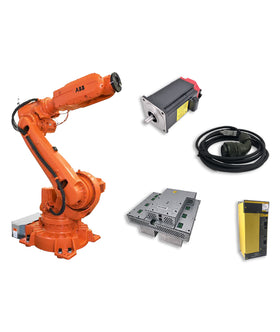
Key components commonly involved in ur safety errors issues and replacements.


{"one"=>"Seleziona 2 o 3 articoli da confrontare", "other"=>"{{ count }} di 3 elementi selezionati"}
Seleziona il primo elemento da confrontare
Seleziona il secondo elemento da confrontare
Seleziona il terzo elemento da confrontare
Lascia un commento