



Axis drift on KUKA robots is rarely a sudden failure. In most production environments, it develops quietly over time — the robot continues running, but positional accuracy slowly starts to deviate from what operators expect.
At first, it is often mistaken for a minor calibration issue. In some cases, the robot even appears normal again after a reboot or mastering procedure. However, when the same deviation keeps returning during production, the root cause is usually deeper than simple calibration or mechanical wear.
In KUKA systems, positioning is based on continuous synchronization between resolver/encoder feedback, the RDC module, and the KRC controller. Once this synchronization becomes unstable, the internal coordinate model begins to diverge from the actual mechanical position.
In practice, axis drift should be treated as a progressive feedback mismatch, not an instant hardware failure.
Resolver / Encoder → RDC Module → KRC Controller → Coordinate Calculation
When stability is lost anywhere along this chain, a gap gradually forms between physical motion and controller interpretation.
Typical result:
This does not occur instantly. It accumulates during operation, which is why early-stage cases are often overlooked.
In real production conditions, axis drift usually presents as a gradual degradation rather than an abrupt failure.
Common indicators include:
A typical scenario is that the robot appears stable after restart, but after several hours of production, the same deviation gradually returns.
This repeating cycle is a strong signal that the issue is not purely mechanical.
Axis drift is rarely triggered by a single clear alarm. More often, it appears indirectly through system behavior such as:
From a diagnostic standpoint, these symptoms usually indicate:
In short, the controller remains operational, but its internal model is no longer fully aligned with the real axis position.
The RDC module is responsible for converting resolver signals into usable position data for the controller.
When this conversion becomes unstable:
The effect is subtle at first, but it accumulates over time.
Common outcomes include:
In many field cases, this layer is the actual origin of the problem, even when mechanical components appear normal.
KUKA systems depend heavily on stable feedback signals. Once signal quality degrades, positioning accuracy is directly affected.
Typical contributing factors:
Field pattern is usually consistent:
This is typically a gradual degradation process rather than a sudden failure.
Between robot arm and controller, signal integrity is just as critical as the sensor itself.
Common weak points:
A key diagnostic pattern:
When this pattern is present, cable-level instability should be considered early.
Mechanical wear is usually not the root cause of axis drift, but it can amplify existing instability.
Typical contributors:
On their own, these rarely create drift. However, they can make feedback-related issues more visible.
Observe how the drift develops:
If accuracy temporarily returns after mastering or reboot, feedback instability becomes the primary suspect.
Focus on:
In many cases, instability becomes more visible after thermal stabilization.
Pay attention to:
Motion-dependent drift is a strong indicator of transmission or feedback instability.
Verify:
Mechanical checks should be used for confirmation, not as the starting point of diagnos is.
If axis drift persists after recalibration, the issue is typically not software-related. It is more often related to instability within the feedback loop.
In industrial maintenance practice, resolution usually focuses on restoring stable encoder/resolver accuracy at system level.
The objective is to re-establish a stable 1:1 relationship between:
This helps:
In older KUKA systems where encoder or resolver is integrated into the motor, component-level repair is often not practical.
In such cases, system reliability is typically restored throughfullfull motor assembly replacement with integrated feedback components.
This approach helps:
One of the most reliable indicators of feedback-layer failure is temporary recovery after reboot followed by gradual return of the same deviation.
Axis drift is not unique to KUKA systems.
Similar behavior can also be observed in:
Although alarm structures differ, the underlying mechanism is consistent: instability in the feedback chain rather than mechanical breakdown.
In most cases, no. It is more commonly related to feedback signal instability than parameter tuning.
Because mastering only resets reference data. It does not correct underlying feedback degradation.
Yes. Resolver instability directly affects position accuracy and accumulates over time.
Because small feedback errors accumulate during continuous operation.
Explore the Full Guide: Repair & Troubleshooting Cluster → Industrial Robot Axis Drift Problem
Explore the complete guide for troubleshooting, repair strategies, and component replacement across industrial robot systems.
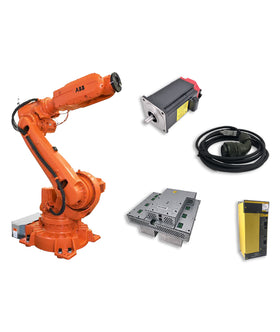
Key components commonly involved in industrial robot axis drift problem issues and replacements.


{"one"=>"Seleziona 2 o 3 articoli da confrontare", "other"=>"{{ count }} di 3 elementi selezionati"}
Seleziona il primo elemento da confrontare
Seleziona il secondo elemento da confrontare
Seleziona il terzo elemento da confrontare
Lascia un commento