



Cable failure in a Universal Robots system is often misdiagnosed as:
encoder instability, communication loss, random Protective Stops, servo failure.
Actual culprit usually = signal/power instability from: cable fatigue, shielding damage, internal conductor fracture.
Unlike hardware failures, cable issues = intermittent. Robot may:
This is why UR cable problems are frequently mistaken for encoder, joint, or controller failures.
In many real-world cases, the root cause is signal or power instability caused by:

One of the earliest signs is unstable communication during robot motion.
Typical behavior includes:
These symptoms are commonly linked to:
Unlike permanent hardware failure, cable instability often comes and goes.
If the robot repeatedly fails at the same wrist angle, reach position, or trajectory, cable fatigue becomes highly suspicious.
This happens because arm movement changes cable tension and bending radius.
At certain positions:
A robot that always stops near the same posture is often experiencing flex-related harness failure rather than software issues.
UR robots rely on stable encoder feedback for precise motion control.
When cable degradation affects encoder signals, the controller may see:
The encoder itself may still be healthy while the signal path becomes unstable.
Cable-related Protective Stops are usually inconsistent and difficult to reproduce.
Unlike payload or collision-related stops, these faults often:
A common failure chain looks like this:
Signal instability → Encoder synchronization loss → Motion confidence drops → Protective Stop triggered
| Error Family | Typical Meaning | Possible Cable Relation |
| C19x | Communication synchronization loss | CAN wiring or shielding damage |
| C15x | Joint deviation or current anomaly | Voltage instability from conductor fatigue |
| C4 / C1x | Communication timeout | Intermittent harness instability |
These faults do not automatically confirm cable damage, but recurring motion-dependent communication errors are strong indicators.
Most UR cable failures are dynamic rather than permanent.
A healthy conductor maintains stable resistance during movement.
A fatigued conductor changes electrically while bending:
R(t)=R0+ΔR(θ,t)
As the robot moves:
This explains why many robots pass idle testing but fail during production cycles.
Not every cable issue involves a fully broken wire.
In many cases, the real problem is damaged shielding or weak grounding.
Once shielding deteriorates, electromagnetic interference can corrupt encoder and communication signals.
Typical symptoms include:
EMI-related issues are especially difficult to isolate because the robot may operate normally in low-noise conditions.
Not all UR cable problems originate inside the robot arm.
Common external failure points include:
Joint 6 is particularly vulnerable because continuous wrist rotation creates constant torsional stress.
Another common issue is over-tight cable fastening.
Excessively tight zip ties prevent natural cable movement and accelerate copper fatigue over time.
Start by asking:
If the answer is yes, cable fatigue becomes far more likely than controller failure.
Move the robot through:
Watch for:
Motion-triggered faults are a major indicator of harness instability.
With the robot powered on and diagnostics visible in PolyScope:
Carefully manipulate:
Look for:
If signal behavior changes physically while moving the cable, the problem is usually electrical rather than software-related.
Do not rely only on popup alarms.
PolyScope logs often reveal important patterns such as:
A useful diagnostic rule:
A damaged robot cable can pass a continuity test while stationary.
Many failures only appear under:
This is why static multimeter testing alone is often misleading.
If a UR robot shows:
inspect the cable system before replacing:
In many cases, the actual issue is a fatigued harness rather than a failed electronic component.
Repeated flexing changes conductor resistance or temporarily interrupts signal continuity during motion.
Yes. Damaged shielding can allow EMI interference to corrupt encoder or communication signals, causing the controller to trigger Protective Stops.
Yes. Gripper, camera, Ethernet, and dress-pack cables often fail earlier than internal robot harnesses because they experience higher torsional stress.
Yes. Many damaged cables appear electrically normal while stationary but fail dynamically during bending or vibration.
Explore the Full Guide: Industrial Robot Knowledge Hub → Repair & Troubleshooting Cluster
Explore the complete guide for troubleshooting, repair strategies, and component replacement across industrial robot systems.
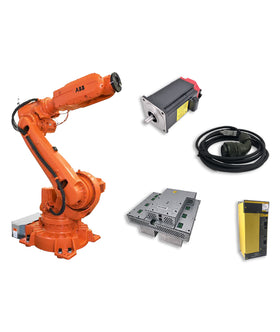
Key components commonly involved in issues and replacements.


{"one"=>"Seleziona 2 o 3 articoli da confrontare", "other"=>"{{ count }} di 3 elementi selezionati"}
Seleziona il primo elemento da confrontare
Seleziona il secondo elemento da confrontare
Seleziona il terzo elemento da confrontare
Lascia un commento