

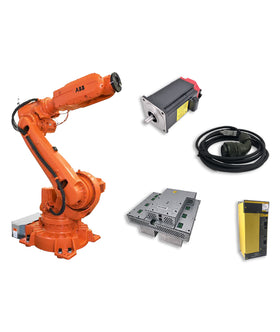

An Ethernet Connection Lost alarm in industrial robot systems is not always caused by switches, PLCs, or external network hardware.
In many real factory environments, the root cause is actually located inside the robot communication and motion feedback system — especially within high-flex robot communication cables operating under continuous movement.
Modern robot platforms such as:
no longer process encoder feedback as an isolated analog signal.
Instead, real-time communication continuously occurs between:
The servo drive acts as the communication bridge between encoder feedback and the controller’s real-time Ethernet system.
When a robot communication cable develops intermittent micro-disconnections during robot motion, the drive may instantly lose valid communication frames.
This creates:
The controller then interprets the condition as:
even when the external Ethernet infrastructure itself is functioning normally.
Industrial robots affected by communication cable instability commonly show:
In many systems, these symptoms appear long before complete communication failure occurs.
Many modern industrial robots no longer separate:
into completely independent cable systems.
Instead, manufacturers increasingly use hybrid robot cable assemblies containing:
inside the same high-flex cable structure.
Because of this architecture, cable degradation may simultaneously trigger:
even when external network hardware remains normal.
Robot communication cables operate under constant mechanical and electrical stress.
Unlike standard industrial networking cables, robot motion cables experience:
Over time, this may create:
Because modern robot systems rely on deterministic real-time Ethernet communication, even microsecond-level signal interruption may destabilize the entire communication chain.
The result is often:
Eventually the controller reports Ethernet communication alarms instead of a traditional cable fault.

High-motion robot areas experience constant bending during production cycles.
Common failure zones include:
Copper conductors may partially fracture internally while still passing static continuity testing.
This is why many Ethernet Connection Lost alarms only appear during robot movement.
Industrial environments generate strong electromagnetic interference from:
Once shielding performance weakens:
Robot communication connectors experience:
This can produce:
Even minor connector instability may interrupt real-time Ethernet communication.
High-speed industrial Ethernet communication depends heavily on stable twisted-pair geometry.
If cables become:
signal impedance characteristics change significantly.
This increases:
Communication cable failures most commonly occur near:
These locations experience the highest long-term mechanical fatigue.
A highly effective field diagnostic method is the “shake test.”
If Ethernet Connection Lost alarms appear immediately during cable movement, the fault is highly likely related to:
This method is extremely effective for detecting motion-dependent communication cable failures that do not appear during static resistance testing.
In many industrial robot systems, communication cable instability can be identified directly through drive diagnostics.
Engineers should inspect:
If these error counters increase sharply during:
The root cause is often cable instability rather than controller hardware failure.
This diagnostic pattern is especially common in aging high-flex robot cable systems.
If communication remains stable while idle but fails during robot movement, dynamic cable fatigue becomes highly likely.
Certain arm positions may stretch or compress damaged cable sections.
This creates highly position-dependent communication instability.
Restarting the controller may temporarily restore communication.
However, once robot movement resumes, the signal interruption typically returns.
Communication cable degradation often triggers mixed alarms such as:
This combination usually indicates underlying signal integrity problems rather than pure controller failure.
When diagnosing Ethernet Connection Lost conditions:
In many industrial robot systems, replacing the damaged communication cable resolves intermittent Ethernet alarms long before controller replacement becomes necessary.
Communication instability related to Ethernet Connection Lost frequently involves:
An Ethernet Connection Lost alarm should not automatically be treated as a pure network infrastructure issue.
In modern industrial robot systems, encoder feedback, servo synchronization, and real-time Ethernet communication are deeply integrated within the robot communication architecture.
Because robot communication cables operate under:
they frequently become the weakest point in the communication chain.
Even extremely short signal interruptions may destabilize the real-time communication bus and trigger Ethernet-related alarms.
Proper diagnos is should therefore focus on:
before replacing expensive controllers, drives, or network hardware.
In many industrial environments, the real root cause behind Ethernet Connection Lost conditions is unstable robot communication cabling inside the motion system.
Replacement solutions for:
Yes.
Intermittent damage inside robot communication cables can interrupt real-time Ethernet data transmission during motion, triggering Ethernet Connection Lost, Fieldbus Timeout, or drive communication alarms.
Robot cables flex continuously during operation.
A partially damaged conductor may disconnect only during certain movements, especially around Axis 3, wrist sections, or dress pack areas.
Common diagnostic methods include:
If communication errors increase during movement, cable instability is highly likely.
The most common failure zones are:
Key components commonly involved in issues and replacements.
No related parts found. Please check available components in our catalog.


{"one"=>"Seleziona 2 o 3 articoli da confrontare", "other"=>"{{ count }} di 3 elementi selezionati"}
Seleziona il primo elemento da confrontare
Seleziona il secondo elemento da confrontare
Seleziona il terzo elemento da confrontare
Lascia un commento