
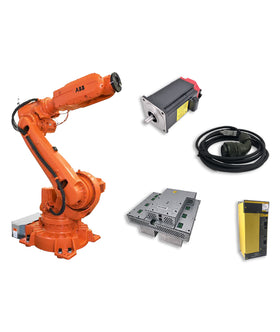


Yaskawa industrial robots (Motoman series) use Sigma series servo systems (Σ-5 and Σ-7) combined with SGDV servo drives to process feedback from absolute encoders installed on each servo motor.
Encoder signal loss occurs when the controller or servo drive fails to receive stable position feedback from one or more axes.
This condition may result in axis alarms, servo shutdown, or motion control interruption.
Common symptoms include:
Related Yaskawa alarm codes may include A.020, A.710, and A.810, which can indicate encoder signal interruption, feedback instability, or system-level data loss.
Signal cable failure is the most common root cause of encoder signal loss in Yaskawa systems.
Typical failure modes include:
In Yaskawa systems, encoder feedback depends on a closed-loop connection between servo motor, encoder, and SGDV drive, making cable integrity critical for stable operation.
Check the encoder connectors at the motor end, including snap-on or screw-type interfaces.
In Yaskawa robots, vibration and long-term operation can gradually loosen these connections, leading to intermittent encoder signal loss.
This condition often results in:
These symptoms are often misdiagnosed as signal cable failure, while the root cause is connector instability.
Yaskawa robots widely use absolute encoders, which rely on battery backup to retain position data when power is off.
If the encoder battery voltage drops, the system may lose position data and trigger encoder-related alarms such as A.810.
Important diagnostic rule:
If A.810 alarm appears, always check the encoder battery first. If the battery is confirmed normal, then investigate signal cable integrity for internal breaks or connector issues.
Battery-related failures are one of the most common misdiagnosed encoder issues in Yaskawa systems.
Yaskawa robots rely on SGDV servo drives to process encoder feedback from each motor.
Faults in this layer may include:
Drive-level instability can amplify or mimic encoder signal loss symptoms.
In some cases, unstable 24V control power supply to the servo drive can cause temporary encoder signal interruption.
This may result in:
Even when cables and encoders are healthy, unstable control voltage can disrupt feedback processing.
Determine whether the issue is:
Intermittent faults usually indicate cable or connector issues.
Focus on:
Connector instability is a common cause of intermittent Yaskawa encoder alarms.
If A.810 alarm appears, always verify encoder battery condition first.
If battery is low or depleted, encoder position data loss may occur even if signal cables are intact.
Inspect servo drive diagnostics:
If possible, swap encoder cables between axes.
If the fault follows the cable, signal cable degradation is confirmed.
Yaskawa encoder systems rely on a closed-loop feedback structure between servo motor, absolute encoder, and SGDV drive.
These signal cables are exposed to:
As a result, encoder cables remain one of the most failure-prone components in the system.
| Symptom | Likely Cause |
| Intermittent encoder alarm | Signal cable degradation |
| A.810 alarm at startup | Absolute encoder battery failure |
| A.020 intermittent fault | Connector instability |
| Single axis failure | Motor encoder issue |
| Multi-axis instability | SGDV or power system issue |
Stable encoder feedback depends on reliable signal transmission between servo motor, encoder, and SGDV drive system.
Key requirements include:
The most common cause is signal cable degradation between the servo motor and SGDV drive due to continuous mechanical movement and vibration.
Always check the absolute encoder battery first. If the battery is healthy, then investigate signal cable integrity and connector condition.
Yes. Loose or vibration-affected snap-on or screw-type connectors can cause intermittent encoder alarms that mimic cable failure.
Yes. SGDV servo drive instability or internal faults can result in encoder feedback errors or signal interruption.
A cable substitution test between axes or movement-dependent fault variation is the most effective method.
Explore the Full Guide: Repair & Troubleshooting Cluster → Encoder Signal Loss in Industrial Robots
Explore the complete guide for troubleshooting, repair strategies, and component replacement across industrial robot systems.
Key components commonly involved in encoder signal loss in industrial robots issues and replacements.


{"one"=>"Seleccione 2 o 3 artículos para comparar", "other"=>"{{ count }} de 3 artículos seleccionados"}
Seleccione el primer artículo para comparar
Seleccione el segundo artículo para comparar
Seleccione el tercer elemento para comparar
Dejar un comentario