

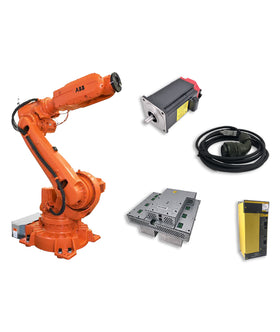

Industrial robots depend on clean and stable servo feedback signals to maintain accurate positioning, smooth motion, and reliable multi-axis synchronization.
When electrical noise enters the feedback system, the robot may continue operating while gradually developing positioning errors, communication faults, motion instability, or unexpected servo alarms.
Unlike a failed encoder or broken cable, servo feedback noise is often intermittent and difficult to identify. The robot may function normally during inspection yet exhibit faults during production when motors, drives, and surrounding equipment generate high levels of electromagnetic interference.
Understanding how servo feedback noise affects encoder communication is essential for diagnosing unstable robot behavior and preventing unnecessary component replacement.
Servo feedback interference rarely produces a single identifiable fault.
Instead, operators often experience:
In many cases, the encoder itself remains functional while noise corrupts the feedback signal reaching the servo drive.
Industrial robots rely on feedback devices such as:
These devices continuously transmit position and speed information to the servo drive.
The servo controller uses this information to:
When signal integrity deteriorates, the controller receives incomplete or distorted feedback data and may respond by generating alarms or corrective motion commands.
Modern servo systems use high-frequency PWM switching to control motor output.
These switching events generate:
The resulting interference can couple into nearby encoder cables.
Industrial facilities often contain numerous VFD-controlled systems.
These devices create:
Nearby robot feedback circuits may become vulnerable if shielding or grounding is compromised.
Robotic welding cells represent one of the most challenging electromagnetic environments.
Arc welding systems generate:
Poorly protected encoder systems may experience communication instability during welding operations.
Additional noise sources include:
The cumulative effect of these systems can significantly increase EMI exposure.
Electromagnetic interference enters servo feedback systems through several mechanisms.
Magnetic fields generated by nearby power conductors induce unwanted voltage in encoder wiring.
Risk increases when:
Rapid voltage changes in power cables create electric fields that transfer energy into nearby signal conductors.
This effect becomes more severe when:
High-frequency electromagnetic fields can be transmitted through free space and captured by improperly protected feedback circuits.

A common misconception is that encoder noise always requires visible cable damage.
In reality, signal distortion can occur even when:
One important mechanism is high-frequency leakage caused by parasitic capacitance between:
As servo drives switch at high frequency, these capacitively coupled currents can introduce noise into feedback channels without any visible mechanical failure.
This is why some encoder communication problems appear despite seemingly healthy cables.
Grounding quality directly affects encoder signal reliability.
Common grounding-related issues include:
Multiple grounding paths can create circulating currents throughout the machine.
Potential consequences include:
Common mistakes include:
When shielding becomes ineffective, encoder circuits become significantly more vulnerable to EMI.
Large industrial facilities may experience voltage differences between grounding points.
These differences can shift signal reference levels and interfere with accurate signal decoding.
Robot movement can directly affect signal quality.
During operation:
As a result, noise-related faults often appear only when the robot reaches specific positions or motion conditions.
Typical symptoms include:
Different feedback technologies respond differently to interference.
Noise may cause:
A key characteristic is that motion errors may accumulate without immediately triggering an alarm.
Noise typically results in:
Instead of gradual drift, the controller often stops motion and generates an alarm.
Although alarm numbers vary by manufacturer, noise-related feedback problems commonly contribute to:
These alarms often indicate signal integrity problems rather than encoder hardware failure.
Successful diagnos is requires analyzing signal quality during actual machine operation.
Monitor:
Verify:
Inspect:
Observe whether alarms occur during:
Position-dependent failures often indicate cable-related interference problems.
Controlled heating can reveal:
Faults that worsen with temperature frequently indicate developing cable or connector issues.
The most effective prevention strategy combines electrical and mechanical design practices.
Recommended measures include:
Proper installation significantly improves long-term servo signal integrity.
Servo feedback reliability depends on multiple interconnected components.
The most common sources of signal integrity issues include:
The primary path for encoder communication signals.
Responsible for protecting low-level signals from external interference.
Critical transition points where contact degradation may occur.
Mechanical routing systems that control cable stress and movement.
Provide the electrical reference required for stable signal transmission.
Failure in any of these areas can contribute to servo instability and encoder communication problems.
Servo feedback noise is one of the most misunderstood causes of robot instability. While symptoms often resemble encoder failure, the underlying issue is frequently related to electromagnetic interference, grounding defects, shielding degradation, cable routing problems, or motion-induced signal distortion.
Because these faults are highly dependent on operating conditions, successful diagnos is requires dynamic testing rather than simple visual inspection.
By maintaining proper grounding, shielding, cable routing, and connector integrity, manufacturers can significantly reduce encoder communication problems, improve servo stability, and prevent costly production interruptions.
High-frequency leakage currents, grounding issues, and electromagnetic coupling can introduce interference without visible cable damage.
Yes. Electromagnetic interference can corrupt encoder data and trigger communication faults.
Motion changes cable geometry, shielding effectiveness, and connector loading conditions, which may expose underlying signal integrity problems.
Many servo drives reset communication error counters during startup, temporarily masking the symptoms.
No. Shielding greatly reduces EMI exposure but cannot eliminate all capacitive coupling or grounding-related noise mechanisms.
In many applications, aging encoder cables, damaged shielding, poor grounding, and connector degradation are more common than actual encoder failure.
If faults occur only during movement or at specific robot positions, the cable and connector system should be investigated before replacing the encoder.
Key components commonly involved in issues and replacements.
No related parts found. Please check available components in our catalog.


{"one"=>"Wählen Sie 2 oder 3 Artikel zum Vergleichen aus", "other"=>"{{ count }} von 3 Elementen ausgewählt"}
Wählen Sie das erste zu vergleichende Element aus
Wählen Sie das zweite zu vergleichende Element aus
Wählen Sie das dritte Element zum Vergleichen aus
Einen Kommentar hinterlassen