

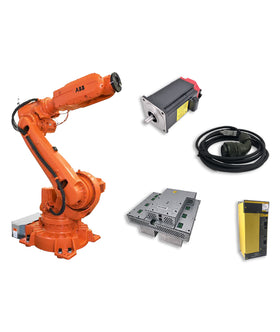

Industrial robots rely on continuous encoder feedback to maintain precise motion control, accurate positioning, and stable servo performance. When encoder feedback becomes intermittent rather than completely lost, troubleshooting becomes significantly more difficult.
Unlike a permanent encoder failure, intermittent feedback problems appear and disappear unpredictably. A robot may operate normally for hours, then suddenly trigger a servo alarm, experience position instability, or stop unexpectedly before returning to normal operation after a restart.
Because these faults are highly dependent on motion conditions, cable stress, temperature changes, vibration, and electrical interference, they are among the most challenging issues faced by robot maintenance engineers.
Understanding the causes of intermittent encoder feedback problems is essential for preventing unplanned downtime and maintaining long-term robot reliability.
Intermittent encoder feedback failures rarely produce consistent symptoms. Instead, operators often observe irregular behavior that appears unrelated to a specific component failure.
Common symptoms include:
A key characteristic of intermittent feedback issues is that the robot may pass static inspections while continuing to fail during actual production.
Industrial robots use closed-loop servo control systems to compare commanded motion with actual motor position.
The encoder continuously reports motor position and speed to the controller, allowing the servo drive to calculate correction commands in real time.
When encoder feedback remains stable:
When feedback becomes intermittent, the controller temporarily loses visibility of actual motor position. Even extremely short signal interruptions can cause the servo system to react as though a position error or communication fault has occurred.
The result may include:
This explains why a seemingly minor signal disturbance can create noticeable robot movement abnormalities.

Intermittent encoder failures are fundamentally different from permanent hardware failures.
A broken wire typically produces a repeatable fault condition. Intermittent signal loss does not.
The problem may occur only when:
As a result, maintenance personnel often encounter situations where:
This non-repeatable behavior frequently leads to extended troubleshooting cycles and unnecessary component replacement.
Encoder cables in industrial robots experience continuous motion, bending, and torsion.
Over time, repeated mechanical stress can cause:
Because damaged conductors may reconnect as the cable moves, faults often appear only during specific robot movements.
Servo and encoder connectors are critical transition points in the feedback system.
Common connector-related problems include:
Even microscopic contact interruptions can destabilize high-speed encoder communication.
Encoder signals are highly sensitive to electrical noise.
When cable shielding becomes damaged or disconnected:
Shielding degradation is particularly common in aging robot dresspack systems.
Temperature changes continuously alter the physical dimensions of electrical components.
Thermal cycling can produce:
As a result, some robots exhibit encoder faults only after warming up or during prolonged operation.
Industrial robots generate constant vibration through:
Long-term vibration can create:
High-power industrial environments contain numerous sources of electromagnetic noise.
Potential sources include:
If grounding or shielding integrity is compromised, encoder communication may become unstable under specific operating conditions.
One of the most common characteristics of intermittent encoder problems is motion-dependent failure.
Faults often occur when the robot reaches:
During these movements, cable geometry changes dynamically.
The resulting mechanical stress may temporarily affect:
This explains why the same robot may operate normally in one position but fail repeatedly in another.
One of the most common diagnostic mistakes is assuming the encoder itself has failed.
In reality, encoder cables are often responsible for intermittent feedback problems.
Because encoder cables experience significantly more mechanical stress than encoders themselves, cable-related faults are often the primary root cause.
Although alarm numbers vary by manufacturer, intermittent encoder feedback frequently contributes to:
In many cases, the alarm is not the root cause but rather the controller's response to unstable feedback information.
When encoder feedback becomes unstable, servo performance deteriorates rapidly.
Possible consequences include:
Corrupted feedback data causes the controller to calculate incorrect position corrections, resulting in gradual positioning errors.
Repeated signal interruptions can create continuous correction cycles, causing visible vibration or oscillation.
The controller may interpret feedback loss as sudden position deviation and generate aggressive corrective torque.
Safety systems often disable motion whenever feedback validity cannot be guaranteed.
These protective responses help prevent uncontrolled movement but may significantly reduce production uptime.
Effective troubleshooting requires testing under actual operating conditions rather than relying solely on visual inspection.
Monitor faults while the robot moves through the positions where failures typically occur.
Evaluate cable integrity during:
Use diagnostic equipment to identify:
Apply controlled heating to reproduce temperature-dependent failures.
Introduce vibration while monitoring encoder communication stability.
This approach often reveals faults that cannot be detected through static measurements.
Reducing intermittent encoder failures requires both electrical and mechanical reliability.
Recommended practices include:
Preventive maintenance is often significantly less costly than emergency production downtime caused by unexpected encoder faults.
Intermittent encoder instability is rarely caused by a single component.
The most commonly affected components include:
The primary transmission path for position feedback signals.
Designed to withstand continuous motion and torsional stress.
Critical connection points where signal integrity can degrade.
Mechanical routing systems that control cable movement and stress distribution.
Failure in any of these areas can ultimately result in servo instability, communication errors, and positioning problems.
Intermittent encoder feedback problems are among the most difficult industrial robot faults to diagnose because they occur only under specific operating conditions. Unlike permanent failures, these issues often involve a combination of cable fatigue, connector degradation, vibration, thermal expansion, shielding defects, and motion-related stress.
Although the resulting alarms may appear random, the underlying cause is typically a gradual loss of signal integrity somewhere within the encoder feedback path.
By focusing on dynamic testing, motion-correlated diagnostics, and proactive maintenance of encoder cables, connectors, and dresspack systems, maintenance teams can significantly reduce servo instability, prevent unexpected robot stops, and improve long-term system reliability.
A restart resets the controller and clears temporary fault conditions, but it does not repair the underlying physical issue. The fault often reappears when the triggering condition occurs again.
Yes. Intermittent feedback loss may cause the servo drive to generate aggressive corrective torque commands, which can temporarily increase motor current and trigger protection alarms.
Thermal expansion can change conductor geometry, connector alignment, and contact pressure, creating temperature-dependent signal interruptions.
Yes. Long-term vibration can produce fretting corrosion, contact wear, and connector instability that interrupt encoder communication.
Cable torsion, bending stress, and connector movement often vary with robot position. Certain positions may place damaged conductors under maximum mechanical stress.
Yes. Damaged shielding, poor grounding, or nearby high-power equipment can introduce noise that disrupts encoder signals.
Not necessarily. Encoder cables, connectors, and dresspack systems should be inspected first because they are frequently responsible for intermittent feedback issues.
The most effective approach is dynamic testing under real operating conditions, including motion, vibration, thermal cycling, and signal integrity monitoring.
Key components commonly involved in issues and replacements.
No related parts found. Please check available components in our catalog.


{"one"=>"Wählen Sie 2 oder 3 Artikel zum Vergleichen aus", "other"=>"{{ count }} von 3 Elementen ausgewählt"}
Wählen Sie das erste zu vergleichende Element aus
Wählen Sie das zweite zu vergleichende Element aus
Wählen Sie das dritte Element zum Vergleichen aus
Einen Kommentar hinterlassen