

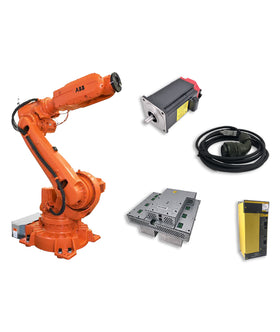

Since the development of robotic arm technology, robotic arms have been successfully applied in industries such as the automotive manufacturing industry in the 1980s. They are the most widely used automated robotic devices in the field of robotics technology.
Currently, robotic arms are the most widely applied automated robotic devices in the field of robotics technology. Apart from being mainly used in industrial manufacturing, they can also be found in commercial agriculture, medical rescue, entertainment services, military security, and even in space exploration.
A robotic arm is an automatically controlled device that mimics the functions of a human arm and can perform various tasks. This robotic system consists of multiple joints connected in a way that allows movement in a plane or three-dimensional space, or linear displacement. Structurally, it is composed of a mechanical body, a controller, servo mechanisms, and sensors. Its specified movements are set according to operational requirements through programming.
The operation of the robot involves a motor driving the movement of an arm, opening or closing a gripper, and accurately feeding back the information to a programmable logic controller. This automatic mechanical device primarily focuses on achieving "wrist and hand" movements. After a skilled operator inputs the sequence of operations, the device can replicate and repeatedly perform the correct and regular operations countless times.
Understanding the key components of robotic arms is crucial for grasping their functionality and versatility. Each component plays a vital role in ensuring that the robotic arm can perform various tasks with precision and efficiency.
The base serves as the foundation of a robotic arm, providing stability and support. It anchors the arm to a surface or structure, enabling it to perform tasks without losing balance. The base often incorporates a rotating mechanism, allowing the arm to pivot around a fixed point. This rotational movement is essential for tasks requiring the arm to cover a large area or reach different positions without repositioning the entire setup.
Joints are the pivotal points that define the range of motion of a robotic arm. They function similarly to human joints, enabling the arm to bend, extend, and rotate. Each joint in a robotic arm is designed to perform specific movements, such as pitch, yaw, and roll. The number and type of joints determine the degrees of freedom (DOF) of the arm, which is a measure of its ability to move in various directions.
The end effector is the tool or attachment located at the end of the robotic arm, responsible for interacting with objects and performing tasks. The type of end effector can vary depending on the application. Common examples include grippers, welding torches, screwdrivers, and suction cups. End effectors are often interchangeable, allowing the same robotic arm to be used for multiple purposes by simply changing the tool.
Actuators are the devices that move the joints of the arm. They convert electrical, hydraulic, or pneumatic energy into mechanical motion. Electric actuators are commonly used for precise, controlled movements and are ideal for applications such as electronic component assembly. Hydraulic actuators, driven by pressurized fluid, can deliver powerful thrust and are suitable for heavy-duty applications like lifting or pressing.
Sensors are critical components that provide feedback on the arm's position, force, and other variables. They ensure precise control and accuracy by continuously monitoring the arm's movements and making adjustments as needed. Position sensors track the exact location of each joint, while force sensors measure the pressure or force exerted by the end effector.
The controller is the computer system or processor that governs the movements of the robotic arm based on programmed instructions. It acts as the brain of the arm, processing input from sensors and executing commands to the actuators. Modern controllers are equipped with advanced algorithms and artificial intelligence, enabling complex decision-making and autonomous operations.
Currently, most robots used in industries are in the form of robotic arms, which vary in shapes and sizes. Common types include linear arms, SCARA arms, and multi-axis articulated robotic arms. From the perspective of joint structure, they can be broadly classified into two categories: those with three axes or fewer (referred to as three-axis) and those with four axes or more (referred to as multi-axis). The classification is necessary because the markets and manufacturers for these two categories do not overlap.
Although the application principles are similar, the technologies involved differ significantly. Additionally, due to varying user needs, there are clear distinctions in their functional capabilities. The robotic hand is equipped with various gripping or processing tools tailored to the specific type of work, primarily designed to mimic human hand functions.
From the perspective of the movement principles of robotic arms, they can be categorized into Cartesian coordinate, cylindrical coordinate, polar coordinate, and articulated coordinate types. The Cartesian coordinate system involves movement at a 90-degree angle relative to the preceding arm segment, with calculations represented by coordinates such as X, Y, and Z. Work or movement is conducted within the length range of each coordinate.
The cylindrical coordinate arm consists of three joints. Its main structure involves rotational movement around a base body, with two upper arms capable of linear sliding motion horizontally and vertical pitching motion. The volume covered by the arm forms a cylindrical shape, allowing the endpoint of the arm to sweep through all points between two cylinders.
The polar coordinate system features an arm supported by two rotational axes. One axis rotates around the base, enabling linear extension and retraction, while the other axis rotates vertically around the base. The articulated coordinate system has three or more rotational axes. One link is mounted on the base, capable of rotating around it, while the other two links move like two workpieces connected by a hinge, allowing relative rotation. Their rotational axes are both horizontal and vertical.
Robotic arms have widespread applications across many industries, thanks to their versatility and precision. Some of the key areas where they are used include:
Manufacturing and Assembly-In industrial settings, robotic arms are often used for assembly tasks such as welding, packaging, and material handling. Their ability to work quickly and accurately reduces the need for manual labor, boosts production efficiency, and minimizes human error.
Medical Field-Robotic arms, also known as surgical robots, are increasingly being used in the medical field for minimally invasive surgery. These arms provide surgeons with enhanced precision and control, allowing for more delicate operations with fewer complications.
Automotive Industry-In automotive manufacturing, robotic arms are used for tasks such as painting, part assembly, and testing. Their ability to work at high speeds and with precision makes them ideal for mass production environments.
Robotics and Research-In academic and research settings, robotic arms are used to study robot-human interaction, autonomous movements, and the integration of artificial intelligence (AI) in robotics. These arms can also be programmed to simulate complex tasks in fields such as space exploration or underwater robotics.
DIY Projects and Education-DIY enthusiasts and students often build robotic arms to understand the principles of robotics, electronics, and programming. These hands-on projects help learners gain practical experience and improve their problem-solving skills in the world of robotics.
Muscle Tissue for Robotic Arms-The National University of Singapore has started making artificial muscle tissue to be able to be placed in robotic arms to be able to help people pick up heavy loads. This artificial tissue can pick up to 500 times its own weight. Depending on how much of the tissue engineers place in the robotic arm, the greater lift strength the arm has. A regular human well-grown adult weighs around 160 to 180 pounds. Now, a person weighing that much could be able to lift an object that weighs around 80,000 pounds.
Sensor Robotic Arms-New robotic arms being used for prosthetics are starting to gain sensors that, with the help of a chip attached to one's spinal cord, allows a person to move the arm. Since sensors can easily be programmed to have a higher sensitivity to anything the sensor touches, people with prosthetic arms will also be able to feel the object they are touching. With this, a person could feel even the slightest vibration. This could be a danger and a good thing. It can danger the human because if dealt with much pressure the person with the prosthetic can suffer severe pain.
Lifelike Robotic Arms-Lifelike robotic arms, along with ordinary human arms, are so similar that it may be hard to distinguish between the two. The reason for this is because a spray, that places a coat on the prosthetic arm, makes the arm look real. This futuristic fantasy is beginning to become more of a reality. Scientists are even starting to create sleeve type artificial skins to keep a prosthetic arm looking like a normal arm.
On the in robots.shop website, you can find a wide variety of robotic arms and related accessories from various brands and models, including renowned brands such as ABB, KUKA, FANUC, and Yaskawa Motoman. These products cover a range of payload capacities and working envelopes, catering to diverse industrial and application scenarios. Supplied directly by the brand owners, they ensure timely delivery and offer global order placement and shipping services.
Robotic arms are a remarkable invention that has transformed various industries and continues to evolve with technological advancements. From manufacturing and healthcare to space exploration and agriculture, robotic arms have enhanced precision, efficiency, and safety. With ongoing research and development, the future of robotic arms looks promising, offering a plethora of innovative and diverse applications.
As we move towards a more automated and interconnected world, the role of robotic arms will become increasingly significant. By integrating advanced technologies such as artificial intelligence, the Internet of Things, and human-robot collaboration, robotic arms will continue to push the boundaries of possibility, shaping the future of industries and improving the way we live and work.
A: When selecting a robotic arm, consider the payload capacity (how much weight it can lift), working range (reach and flexibility), precision (accuracy of movements), and environmental compatibility (e.g., dust resistance, temperature tolerance). Additionally, assess the software compatibility and ease of programming for your specific tasks.
A: Yes, many manufacturers offer customization options for robotic arms, including tailored end-effectors, specialized sensors, or unique programming configurations. It's advisable to consult directly with the supplier (like those on inrobots.shop) to discuss your specific requirements and feasibility.
A: Maintenance requirements vary by model and usage but typically include periodic lubrication of joints, inspection of cables and wiring, and calibration of sensors. Manufacturers often provide maintenance schedules and guidelines. Regular professional servicing is recommended to ensure optimal performance and longevity.
Explore the Full Guide: Industrial Robot Knowledge Hub → Industrial Robot Market & Strategy Cluster
Explore the full guide to discover related topics and gain deeper insights into industrial automation.
Key components commonly involved in market & strategy issues and replacements.
No related parts found. Please check available components in our catalog.


{"one"=>"Wählen Sie 2 oder 3 Artikel zum Vergleichen aus", "other"=>"{{ count }} von 3 Elementen ausgewählt"}
Wählen Sie das erste zu vergleichende Element aus
Wählen Sie das zweite zu vergleichende Element aus
Wählen Sie das dritte Element zum Vergleichen aus
Einen Kommentar hinterlassen