

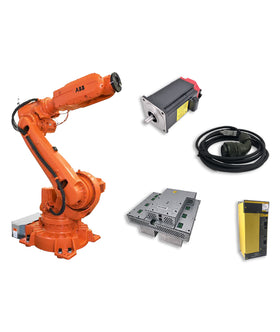

A robot that operates normally and then suddenly stops is one of the most frustrating problems in industrial automation.
The system may run flawlessly for hours, complete hundreds of production cycles, and then unexpectedly generate a servo alarm, communication fault, encoder error, or safety stop. After a reset, the robot often resumes normal operation, making the issue appear random and difficult to reproduce.
In reality, truly random robot failures are rare.
Most unexpected robot stops are caused by intermittent signal interruptions, feedback instability, communication dropouts, or cable-related faults that only occur under specific motion, vibration, load, or temperature conditions.
Understanding how these failures develop is essential for reducing downtime and preventing recurring production interruptions.
Modern industrial robots rely on continuous communication between multiple subsystems, including :
If any of these signal paths become unstable, the controller may interpret the condition as a loss of control and immediately trigger a protective stop.
The most misleading aspect of these failures is that the robot often appears completely normal right before shutdown.
This happens because many failures are threshold-based rather than continuous. A signal may remain within acceptable limits for thousands of cycles before briefly exceeding the controller's tolerance threshold and triggering a fault.

Some faults occur only when the robot reaches a specific position or performs a particular movement.
Common triggers include:
Because the fault exists only under certain mechanical conditions, it may disappear as soon as the robot moves away from the affected position.
Industrial robots depend on deterministic communication between controllers, servo drives, and feedback devices.
Temporary communication disruptions may cause:
Even a brief communication interruption can trigger protective shutdown logic.
Encoder systems provide the position information required for closed-loop motion control.
When encoder communication becomes unstable, the controller may detect:
The result is often an unexpected robot stop despite otherwise normal operation.
Some intermittent faults appear only after the robot has been operating for an extended period.
Common causes include:
Typical symptoms include:
Electrical noise can temporarily corrupt communication signals.
Common EMI sources include:
Because EMI-related faults are transient, they often appear random in alarm history.
Encoder-related faults are among the most common causes of intermittent robot shutdowns.
Encoder communication typically relies on:
Compared with power circuits, feedback signals operate with smaller noise margins and are therefore more sensitive to degradation.
Most encoder-related failures follow a gradual progression:
Cable aging, shielding wear, or connector deterioration reduce communication quality.
The system compensates through retries and error correction mechanisms.
No visible alarms occur.
Occasional encoder communication alarms begin appearing.
Specific robot movements consistently trigger faults.
Communication is lost entirely, resulting in repeated shutdowns.
Robot cables experience continuous bending, twisting, and torsional stress.
Over time, these stresses may cause:
A cable can appear physically intact while generating intermittent communication failures during motion.
Connector interfaces are highly susceptible to degradation.
Common mechanisms include:
These conditions can create temporary signal interruptions that are difficult to detect during static testing.
Many cable-related shutdowns follow a recognizable pattern:
This pattern strongly suggests an underlying cable or connector issue.
The DressPack system plays a critical role in long-term cable reliability.
Improper cable routing can accelerate:
Many intermittent robot stops originate within highly stressed cable sections located near Axis 4, Axis 5, and Axis 6.
Related resources:
Industrial communication systems continuously monitor signal integrity.
Modern protocols such as EtherCAT and PROFINET rely on strict timing requirements.
When communication quality deteriorates, the system may experience:
Once communication errors exceed predefined thresholds, the controller may initiate:
From the operator's perspective, the robot simply appears to stop randomly.
Record:
Patterns often reveal the underlying root cause.
Look for recurring alarm categories such as:
Pay particular attention to:
These are common failure locations.
Inspect for:
Intermittent faults often cannot be found through static inspection.
Useful methods include:
These techniques can reveal hidden defects that standard continuity testing may miss.
Best practices include:
Long-term reliability improves when:
Monitor:
Replacing aging components before complete failure significantly reduces downtime risk.
Unexpected robot shutdowns frequently involve:
In most cases, the root cause is not a single failed component but a gradual loss of signal reliability within the overall motion control system.
A robot that works normally and then stops unexpectedly is rarely experiencing a truly random fault.
Most intermittent shutdowns originate from signal integrity problems, encoder communication instability, cable fatigue, connector degradation, DressPack wear, or industrial network disruptions.
By focusing on motion-dependent failures, communication reliability, and feedback signal quality, maintenance teams can identify root causes earlier, reduce unnecessary component replacement, and significantly improve robot uptime.
Many intermittent faults recover before a persistent error can be logged. The controller may only record the resulting safety stop or communication timeout.
Yes. Internal conductor fatigue, shielding damage, and intermittent open circuits are among the most common causes of unexpected robot stops.
Restarting clears latched fault conditions but does not eliminate the underlying signal or communication issue.
Not typically. Most intermittent shutdowns originate from encoder feedback problems, communication instability, connector degradation, or cable-related failures rather than motion tuning parameters.
Key components commonly involved in issues and replacements.
No related parts found. Please check available components in our catalog.


{"one"=>"Wählen Sie 2 oder 3 Artikel zum Vergleichen aus", "other"=>"{{ count }} von 3 Elementen ausgewählt"}
Wählen Sie das erste zu vergleichende Element aus
Wählen Sie das zweite zu vergleichende Element aus
Wählen Sie das dritte Element zum Vergleichen aus
Einen Kommentar hinterlassen