

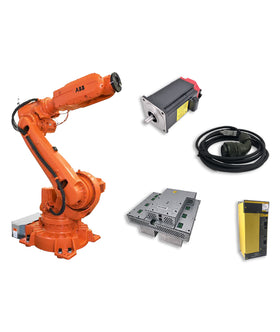

Industrial robots rely on hundreds of electrical connections to maintain stable communication between controllers, servo drives, encoders, safety systems, teach pendants, and fieldbus networks.
While cables often receive the most attention during troubleshooting, connector-related failures are one of the most common causes of intermittent robot faults.
A loose connector, oxidized contact, or degraded terminal can introduce unstable electrical resistance that disrupts signal transmission without creating a complete circuit failure.
The result is often a series of difficult-to-diagnose problems, including encoder alarms, communication errors, servo instability, teach pendant disconnects, and unexpected robot downtime.
Understanding how robot connectors degrade is essential for maintaining signal integrity and improving long-term automation reliability.
Unlike a broken wire, connector failures are usually intermittent.
The connection may function normally for hours or days before a temporary loss of contact triggers a fault.
Unstable connector contacts can interrupt low-voltage encoder signals and generate feedback communication errors.
Motion-induced vibration can momentarily separate worn contacts and trigger servo synchronization faults.
Loose pendant connectors often cause random communication loss between the operator interface and controller.
EtherCAT, PROFINET, DeviceNet, and other industrial networks are highly sensitive to contact instability.
Intermittent resistance changes may trigger position errors, synchronization alarms, or unexpected axis stops.
Temporary signal interruption can activate safety responses and halt robot operation.
| Robot Symptom | Possible Connector Issue |
| Encoder Alarm | Oxidized encoder connector |
| Servo Fault During Motion | Loose feedback connector |
| Teach Pendant Disconnect | Worn pendant connector |
| Communication Timeout | Corroded network connector |
| Random Axis Alarm | Vibration-induced contact loss |
| Safety Circuit Error | High contact resistance |
Because these symptoms often resemble controller or servo failures, connector degradation is frequently overlooked during troubleshooting.
Connector looseness rarely occurs suddenly.
It usually develops gradually as mechanical stress accumulates throughout normal operation.
Robot motion continuously transfers vibration into connectors, especially in high-speed applications.
Over time this can reduce contact pressure and weaken locking mechanisms.
Repeated heating and cooling cycles cause materials to expand and contract.
Small dimensional changes gradually loosen mechanical interfaces and increase contact resistance.
Cable tension can transfer force directly into connectors.
Improper strain relief often accelerates loosening and terminal wear.
Plastic locking tabs, retention clips, and contact springs lose effectiveness as they age.
Eventually, connectors may appear secure while micro-scale separation already exists inside the contact interface.

Electrical connectors do not conduct current across their entire visible surface.
Instead, electrical current flows through microscopic contact points called contact spots.
As oxidation develops:
This is especially critical in:
Even minor oxidation can create significant signal instability in low-voltage systems.
One of the most common connector failure mechanisms is fretting corrosion.
Fretting occurs when vibration causes microscopic movement between mating contacts.
Although movement is extremely small, repeated cycles gradually wear away protective plating.
Stage 1: Micro-Movement
Tiny motion occurs between connector contacts.
Stage 2: Protective Coating Wear
Gold or tin plating begins wearing away.
Stage 3: Base Metal Exposure
Copper alloy surfaces become exposed.
Stage 4: Oxidation Formation
Moisture and oxygen create resistive oxide layers.
Stage 5: Signal Instability
Intermittent communication failures begin appearing.
This explains why many robot faults occur only during movement and disappear during inspection.
Modern servo systems depend on continuous feedback communication.
A simplified signal chain consists of:
Encoder → Connector Interface → Servo Feedback Cable → Servo Amplifier →Motion Controller
When connector resistance becomes unstable, signal quality deteriorates throughout the control loop.
Because servo systems operate in real time, even extremely brief signal interruptions can destabilize motion control.
Certain industrial environments significantly increase connector failure rates.
Moisture accelerates oxidation and corrosion.
Metal particles and electromagnetic interference increase connector degradation risk.
Industrial fluids contaminate contacts and weaken protective coatings.
Frequent cleaning cycles increase moisture intrusion and corrosion potential.
Temperature fluctuations and condensation accelerate oxidation processes.
Check for:
Verify:
Micro-ohm testing can identify abnormal resistance before complete failure occurs.
Many connector faults appear only during:
Monitoring the system while the robot moves often reveals intermittent failures.
Useful for detecting:
Industrial robotic environments require connectors specifically designed for continuous motion and vibration.
Prevent cable movement from transferring force directly into connector interfaces.
Gold-plated contacts generally provide better long-term performance in low-voltage signal circuits.
Benefits include:
Choose connector systems appropriate for the operating environment:
| Protection Level | Typical Application |
| IP65 | Dusty industrial environments |
| IP67 | Wet manufacturing areas |
| IP69K | High-pressure washdown applications |
Regular inspection of high-cycle connectors can identify degradation before intermittent failures begin affecting production.
Particular attention should be given to:
Loose robot connectors and oxidation problems are among the most underestimated causes of intermittent robot faults.
Because these failures develop gradually and often depend on vibration, temperature, or motion, they can be extremely difficult to reproduce during routine troubleshooting.
As contact resistance increases through loosening, oxidation, or fretting corrosion, signal integrity deteriorates and eventually affects encoder feedback, servo synchronization, fieldbus communication, and overall robot reliability.
By recognizing early warning signs, performing targeted diagnostics, and implementing preventive maintenance strategies, maintenance teams can significantly reduce downtime caused by connector-related signal failures.
The most common causes are vibration, thermal expansion cycles, cable stress, and aging of locking mechanisms.
Yes. Oxidized contacts increase resistance and can disrupt low-voltage communication and feedback signals.
Fretting corrosion occurs when microscopic vibration wears away contact plating, exposing metal surfaces that then oxidize and create unstable electrical connections.
Many failures are vibration-dependent and occur only while the robot is moving or under load.
Encoder connectors, servo feedback connectors, teach pendant connectors, and industrial communication connectors are typically the most failure-prone.
Using sealed connectors, gold-plated contacts, proper environmental protection, and regular preventive maintenance can significantly reduce oxidation-related failures.
Key components commonly involved in issues and replacements.
No related parts found. Please check available components in our catalog.


{"one"=>"Wählen Sie 2 oder 3 Artikel zum Vergleichen aus", "other"=>"{{ count }} von 3 Elementen ausgewählt"}
Wählen Sie das erste zu vergleichende Element aus
Wählen Sie das zweite zu vergleichende Element aus
Wählen Sie das dritte Element zum Vergleichen aus
Einen Kommentar hinterlassen