

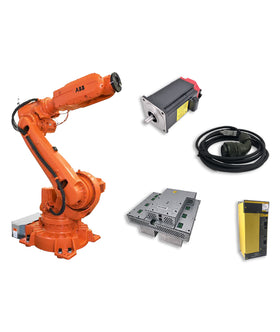

Industrial robots rely on two essential cable systems to operate correctly:
Although both cables connect the servo drive and motor, they perform completely different functions.
A power cable delivers the electrical energy required to move the motor.
A feedback cable delivers the position information required to control the motor.
This distinction is critical because many robot faults that appear to be servo or encoder failures are actually caused by problems within the feedback cable system.
Understanding the differences between feedback cables and power cables can help maintenance teams diagnose faults more accurately, reduce downtime, and select the correct replacement components.
Different cable failures produce different symptoms.
Common robot issues include:
Identifying whether the fault originates in the power cable or feedback cable is often the first step in successful troubleshooting.
A servo power cable transfers electrical power from the servo drive to the motor.
Its primary function is energy transmission.
Typical responsibilities include:
Power cables are designed to handle:
Because power cables carry energy rather than information, they are generally less sensitive to electrical noise.
When a power cable fails, common symptoms include:
These failures are usually obvious and easier to diagnose than feedback-related problems.
A servo feedback cable transmits information rather than power.
The cable connects the motor encoder to the servo controller and continuously reports:
Modern robots depend on this information to maintain accurate closed-loop control.
Without reliable feedback communication, the controller loses visibility of motor position.
The result may include:
For this reason, feedback cables often have a greater impact on robot uptime than power cables.
Although they may appear similar externally, feedback cables and power cables are engineered for entirely different purposes.
| Parameter | Feedback Cable | Power Cable |
| Primary Function | Encoder communication | Motor power transmission |
| Signal Type | Digital position and feedback data | Electrical power |
| Voltage Level | Low voltage | High voltage |
| Current Level | Very low | High |
| Twisted Pair Design | Usually required | Usually not required |
| Shielding Requirement | Critical | Moderate |
| EMI Sensitivity | High | Low |
| Position Accuracy Impact | Direct | Indirect |
| Typical Failure Result | Encoder alarms, position errors | Motor shutdown, drive faults |
| Main Purpose | Motion control | Motor operation |
The most important distinction is that power cables deliver energy, while feedback cables deliver information. A robot can havefullfull motor power available and still stop operating if encoder communication is lost.

Feedback cables typically experience more communication-related failures because they operate with extremely small signal margins.
Several factors contribute to higher failure rates.
Robot motion constantly bends and twists feedback cables.
Over time this can cause:
Encoder communication systems operate using low-voltage digital signals.
Even minor disturbances can trigger:
Feedback cables depend heavily on shielding integrity.
Any reduction in shielding effectiveness increases susceptibility to electromagnetic interference.
As a result, feedback cable degradation often causes recurring servo alarms long before complete electrical failure occurs.
Yes.
In fact, feedback cable problems are among the most common causes of recurring servo alarms.
Potential failure mechanisms include:
Typical symptoms include:
Many intermittent servo faults originate from the feedback cable rather than the encoder itself.
Indirectly, yes.
A damaged power cable may generate excessive electrical noise or grounding problems that interfere with nearby feedback circuits.
However, power cable failures more commonly produce:
If the robot continues moving but reports encoder communication problems, the feedback system should usually be investigated first.
Recognizing symptom patterns can significantly reduce troubleshooting time.
| Symptom | Feedback Cable Issue | Power Cable Issue |
| Encoder communication alarm | ✓ Common | Rare |
| Position drift | ✓ Common | Rare |
| Servo synchronization error | ✓ Common | Rare |
| Random servo alarm | ✓ Common | Possible |
| Motion jitter | ✓ Common | Rare |
| Motor not running | Rare | ✓ Common |
| Overcurrent fault | Possible | ✓ Common |
| Drive trip | Possible | ✓ Common |
| Complete loss of motion | Rare | ✓ Common |
In many industrial robots, encoder communication faults, intermittent alarms, and positioning problems are much more likely to originate from the feedback cable system than from the power cable.
Even high-quality cables can fail prematurely if routing is incorrect.
Parallel routing increases electromagnetic coupling.
Potential consequences include:
Violating bend radius specifications accelerates:
Insufficient strain relief can increase stress at:
| Installation Practice | Reliability Impact |
| Separate power and feedback cables | Best practice |
| Maintain cable spacing | Reduces EMI coupling |
| Cross cables at 90° | Minimizes interference |
| Route cables in parallel for long distances | Increased EMI risk |
| Exceed bend radius limits | Accelerates cable fatigue |
| Poor strain relief | Increases connector stress |
Proper cable management significantly improves long-term reliability and helps prevent communication-related servo faults.
Some robot systems use hybrid cables that combine:
within a single cable assembly.
High-quality hybrid cables use internal separation and advanced shielding to protect encoder communication from power-circuit interference.
Poorly designed hybrid cables may experience intermittent encoder communication faults despite maintaining normal motor power delivery.
When selecting a replacement feedback cable, engineers should evaluate more than connector compatibility.
| Selection Factor | Why It Matters |
| Encoder compatibility | Ensures communication reliability |
| Shielding performance | Improves EMI resistance |
| Continuous flex rating | Extends cable life |
| Torsional capability | Supports robot wrist movement |
| Oil and coolant resistance | Protects against industrial environments |
| Temperature rating | Maintains long-term stability |
Look for:
Verify suitability for:
Consider:
A properly specified feedback cable can significantly reduce recurring servo alarms, communication failures, and unplanned downtime.
Reliable motion control depends on multiple interconnected components.
Primary communication path between encoder and controller.
Provides motor power and drive output transmission.
Maintains signal continuity and shielding performance.
Controls cable movement and stress distribution.
Protects communication signals from EMI and electrical noise.
Failure in any of these components can affect overall system reliability.
Power cables and feedback cables may appear similar, but they serve fundamentally different purposes within industrial robot systems.
Power cables deliver energy.
Feedback cables deliver information.
Because modern robots depend on accurate encoder communication, feedback cable problems often create more difficult and disruptive faults than power cable failures.
Understanding the differences between these cable types helps maintenance teams diagnose servo alarms more effectively, prevent unnecessary component replacement, and improve long-term robot reliability.
When troubleshooting robot motion problems, encoder communication alarms, or intermittent servo faults, the feedback cable should always be considered a primary inspection point.
A power cable delivers electrical energy to the motor, while a feedback cable transmits encoder data used for motion control.
Feedback cables are more commonly associated with encoder communication faults, position errors, and recurring servo alarms.
No. Feedback cables are specifically designed for high-speed signal transmission and require shielding and conductor configurations that power cables do not provide.
They carry low-voltage communication signals that can be affected by EMI, shielding degradation, and signal distortion.
Physical separation is recommended whenever possible to reduce electromagnetic interference.
Common signs include encoder alarms, intermittent faults, position drift, motion-dependent failures, and communication errors.
Yes, when properly designed. High-quality hybrid cables include advanced shielding and internal separation structures to protect encoder communication.
Key components commonly involved in issues and replacements.
No related parts found. Please check available components in our catalog.


{"one"=>"Wählen Sie 2 oder 3 Artikel zum Vergleichen aus", "other"=>"{{ count }} von 3 Elementen ausgewählt"}
Wählen Sie das erste zu vergleichende Element aus
Wählen Sie das zweite zu vergleichende Element aus
Wählen Sie das dritte Element zum Vergleichen aus
Einen Kommentar hinterlassen