

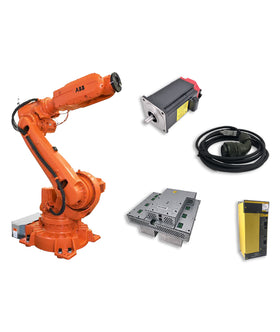


Industrial robots have become a core component of modern manufacturing. From automotive welding lines to high-speed packaging systems, robots improve production efficiency, consistency, and safety.
However, not all robots are designed for the same tasks. Different robot architectures offer distinct advantages depending on payload capacity, movement range, speed, and precision requirements.
Understanding the relationship between robot types and their industrial applications helps manufacturers choose the right automation solution while planning long-term maintenance and spare-parts strategies.
This guide explains the most common industrial robot types, their typical applications, and the key factors engineers should evaluate before selecting a robot system.
Manufacturing environments vary widely. A robot used in an automotive welding cell operates under completely different conditions compared with a robot sorting pharmaceutical products or assembling electronics.
Because of these differences, robot manufacturers have developed several structural designs optimized for specific tasks.
Different robot types are typically designed to prioritize:
Choosing the appropriate robot type not only improves production efficiency but also reduces long-term maintenance costs.
Major industrial robot suppliers such as ABB, FANUC, KUKA, and Yaskawa Electric offer multiple robot architectures to address these diverse manufacturing needs.
Industrial robots can be classified based on mechanical structure and motion capability.
Articulated robots are the most common type of industrial robot. They feature multiple rotary joints that allow complex multi-axis movement, usually with four to six axes.
These robots closely resemble a human arm and offer high flexibility for tasks that require complex positioning.
Typical applications include:
These robots dominate industries that require flexibility and reach.
However, due to their complex joint structures, articulated robots often rely on multiple servo motors, reducers, and signal cables that require periodic inspection and maintenance.
SCARA stands for Selective Compliance Assembly Robot Arm. These robots are designed primarily for high-speed horizontal motion.
Their rigid vertical axis combined with flexible horizontal movement makes them ideal for precision assembly operations.
Common applications include:
SCARA robots are widely used in industries that require fast cycle times and compact production cells.
Cartesian robots move along linear axes, typically labeled X, Y, and Z.
Unlike articulated robots, these systems rely on linear rails and drive mechanisms rather than rotating joints.
Advantages of Cartesian robots include:
Typical applications include:
Their straightforward design often simplifies maintenance compared with multi-axis robots.
Delta robots use a parallel arm structure, which allows extremely fast movement with low inertia.
They are often mounted above production lines and are optimized for high-speed pick-and-place tasks.
Typical industries include:
While delta robots offer exceptional speed, they generally have lower payload capacity compared with articulated robots.
Collaborative robots are designed to work safely alongside human operators. Unlike traditional industrial robots that require safety cages, cobots integrate sensors and force-limiting technologies to reduce collision risk.
Common applications include:
Cobots emphasize flexibility and ease of deployment rather than maximum speed or payload.
The table below summarizes the main differences between common robot types.
| Robot Type | Typical Axes | Speed | Payload Capacity | Best Applications |
| Articulated | 6 | Medium | High | Welding, assembly |
| SCARA | 4 | High | Medium | Electronics assembly |
| Cartesian | 3 | Medium | High | CNC loading, machining |
| Delta | 3 | Very High | Low | Packaging, sorting |
| Collaborative | 6 | Medium | Low–Medium | Human-robot collaboration |
This comparison helps engineers quickly evaluate which robot architecture may fit their production requirements.
Different industries adopt robots for different purposes depending on production requirements.
The automotive industry was one of the earliest adopters of industrial robotics and remains one of the largest users today.
Typical robotic applications include:
Large automotive factories often operate hundreds of articulated robots working simultaneously.
Electronics production requires extremely precise handling of small components.
Robots are commonly used for:
SCARA robots and small articulated robots dominate this sector due to their accuracy and speed.
Robots are widely used in metalworking environments where consistency and repeatability are critical.
Common robotic applications include:
These environments place high stress on cables, servo drives, and gear reducers, making preventive maintenance essential.
In the food industry, robots are frequently used for high-speed sorting and packaging operations.
Typical applications include:
Delta robots and palletizing robots are especially common in these environments due to their speed and efficiency.
Before purchasing, engineers should evaluate the "Big Five" metrics:
Different architectures fail in different ways. Preventive maintenance should be tailored to the robot type:
robot failures often depend on how the robot is used in the production environment.
Examples include:
Welding robots
Frequent cable movement and heat exposure may cause signal cable fatigue.
CNC tending robots
Metal dust and coolant exposure can affect servo motors and connectors.
High-speed pick-and-place robots
Extreme acceleration may increase stress on encoders and mechanical joints.
Painting robots
Chemical contamination may damage connectors and electrical components.
Understanding these patterns helps engineers design better preventive maintenance schedules.
Articulated robots are the most widely used due to flexibility and multi-axis movement.
Six-axis articulated robots are typically used for arc and spot welding due to reach and movement flexibility.
Delta robots and high-speed pick-and-place robots are widely used in packaging lines due to their speed and efficiency.
Cobots are designed for light to medium tasks. Heavy-duty manufacturing still relies on traditional industrial robots.
Yes. More complex robots with multiple axes typically require more servo drives, encoder cables, and reducers, increasing maintenance cost.
Evaluate payload, precision, cycle time, and workspace constraints before selecting a robot system.
Key components commonly involved in issues and replacements.


{"one"=>"Select 2 or 3 items to compare", "other"=>"{{ count }} of 3 items selected"}
Leave a comment on this topic