

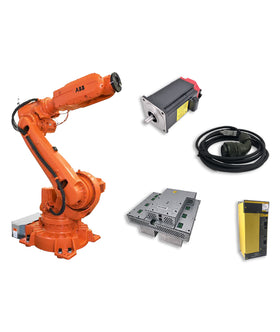

Industrial robots have become a cornerstone of modern manufacturing and automation. From welding car frames in automotive plants to sorting packages in logistics centers, robots now perform millions of tasks that demand precision, speed, and reliability.
But industrial robots are not all the same. They differ in structure, motion capability, control systems, and applications. Understanding how robots are built and how they are classified helps engineers, manufacturers, and system integrators choose the right automation solution.
This guide explains the structure, components, classification, and applications of industrial robots, providing a clear overview of how these machines work and why they have become essential to modern industry.
An industrial robot is a programmable mechanical device designed to automatically perform tasks such as welding, assembly, material handling, inspection, or packaging. Unlike traditional machines, robots can be reprogrammed and adapted to different tasks, making them highly flexible automation tools.
Their ability to operate continuously with consistent precision makes them ideal for repetitive or hazardous tasks. In many environments, robots improve productivity while also increasing worker safety.
Although industrial robots vary in design, most share a similar structural architecture. The typical robot is composed of several interconnected mechanical and electronic systems that allow it to move, sense its environment, and perform tasks.
| Drive Type | Best For | Key Advantage |
| Electric (Servo) | 90% of modern apps | High precision & easy control. |
| Hydraulic | Heavy-duty forging | Extreme lifting capacity & power. |
| Pneumatic | Simple Pick-and-Place | Fast, low-cost, and "soft" grip. |
Industrial robots are classified by their mechanical configuration. Each type offers a different Work Envelope (the space a robot can reach).
The most common type. They feature rotary joints and typically offer 6 axes of motion, allowing them to mimic a human arm's reach and rotation.
Designed for horizontal motion. They are rigid in the Z-axis (vertical) but flexible in the X-Y axes.
Feature three arms connected to a single base above the workspace. They excel at high-speed, low-payload tasks.
Move in linear paths along the X, Y, and Z axes. They are easy to program and can be scaled to massive sizes.
Equipped with advanced safety sensors to work alongside humans without safety cages.
Beyond the mechanical structure, industrial robots rely on several core subsystems that control motion, power, and perception.
The drive system powers the robot’s movement. Three main types of drive systems are used in industrial robots:
Electric drives are the most common in modern robots. They use servo motors and servo drives to achieve precise motion control.
Advantages include:
Hydraulic systems generate large amounts of force, making them suitable for heavy-duty robots used in metal casting or forging.
However, they require more maintenance and are less energy efficient than electric drives.
Pneumatic drives use compressed air to create motion. They are typically used in smaller automation devices rather than complex robots.
Today, electric servo-driven robots dominate industrial automation because of their precision and energy efficiency.
Servo motors generate the movement required for robotic joints. However, motors alone cannot provide sufficient torque for heavy loads.
To solve this problem, robots use precision reducers, such as:
Reducers lower the motor speed while increasing torque, allowing the robot to move heavy payloads with high accuracy.
The control system is often described as the brain of the robot. It coordinates all robot movements and interprets commands from operators or automated programs.
A typical robot controller performs several tasks:
Modern robot controllers rely on powerful processors and advanced motion control algorithms to achieve precise movement control.
Industrial robots use sensors to monitor both their internal state and the surrounding environment.
Internal sensors measure variables such as:
External sensors help robots interact with the environment and may include:
With advanced sensing technologies, robots can detect objects, adjust their movement paths, and even collaborate safely with human workers.
Industrial robots can operate using different control methods depending on the application.
One of the most common programming methods is teach-and-playback.
In this approach:
This method is widely used in applications like painting, welding, and assembly.
In more complex environments, robots may be programmed offline using simulation software. Engineers can design motion paths on a computer and then upload the program to the robot controller.
This approach reduces production downtime and allows engineers to test robot behavior before deployment.
In hazardous environments, robots may be operated remotely through wired or wireless control systems. This is common in:
Advanced robots equipped with AI, sensors, and machine vision can perform tasks autonomously, adapting to changes in their environment without direct human control.
Industrial robots have transformed manufacturing across many sectors.
Key applications include:
Automotive Manufacturing
Robots perform welding, painting, assembly, and material handling tasks on automotive production lines.
Electronics Manufacturing
SCARA and delta robots assemble delicate electronic components with extremely high precision.
Food and Pharmaceutical Packaging
High-speed robots sort, package, and palletize products efficiently.
Metal Processing
Robots handle tasks such as casting, machining, and welding in hazardous environments.
Logistics and Warehousing
Automation robots help manage sorting, picking, and transportation tasks in distribution centers.
The industrial robot industry consists of several interconnected players.
The ecosystem typically includes:
Component Manufacturers
Suppliers producing motors, sensors, reducers, controllers, and cables.
Robot Manufacturers
Companies that design and produce complete robot systems.
Leading global manufacturers include:
System Integrators
These companies design complete automation solutions by integrating robots into production lines.
End Users
Factories and businesses that deploy robots to improve production efficiency.
Industrial robotics continues to evolve rapidly as new technologies emerge.
Key trends shaping the future include:
Artificial Intelligence Integration
AI enables robots to learn from data, improve decision-making, and adapt to changing environments.
Human-Robot Collaboration
Collaborative robots are expanding automation into smaller factories and flexible production lines.
Advanced Vision Systems
Machine vision allows robots to identify objects and adjust movements dynamically.
Mobile Robotics
Autonomous mobile robots (AMRs) are transforming logistics and warehouse automation.
These innovations will continue expanding the capabilities of industrial robots in the coming years.
Industrial robots are one of the most important technologies driving modern manufacturing and automation. Their combination of mechanical precision, programmable control, and intelligent sensing allows them to perform complex tasks efficiently and safely.
By understanding the structure, components, and classification of industrial robots, engineers and businesses can better evaluate automation solutions and select the right robot for their applications.
As robotics technology continues to evolve, industrial robots will play an even larger role in shaping the future of manufacturing, logistics, and global industry.
Explore the Full Guide: Industrial Robot Knowledge Hub → Industrial Robot Types & Applications Cluster
Explore foundational knowledge and practical insights to better understand industrial robot systems and components.
Key components commonly involved in robot applications issues and replacements.
No related parts found. Please check available components in our catalog.


{"one"=>"Select 2 or 3 items to compare", "other"=>"{{ count }} of 3 items selected"}
Leave a comment on this topic