

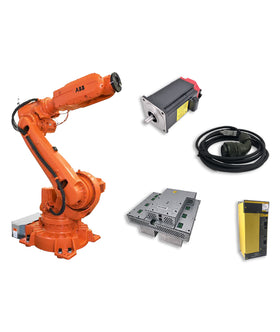


Transitioning to Industry 4.0 and automating production processes has led many businesses to consider investing in industrial robots. This strategic move helps manufacturers improve productivity, efficiency, and competitiveness in a rapidly evolving market. Before making a purchase, it's crucial to understand several key factors that affect robot performance and ROI.

An industrial robot is a programmable, automated machine used to perform complex or repetitive tasks in industrial settings. These robots are commonly found in automotive, electronics, food processing, and logistics industries, handling tasks such as welding, assembly, material handling, packaging, and quality inspection.
Unlike service robots, industrial robots are typically fixed in place and designed to operate in automated production lines. Their purpose is to increase efficiency, precision, and safety while reducing labor costs and production time.
Before purchasing an industrial robot, it's important to understand the main types available:
Articulated Robots: Feature rotary joints; commonly used in welding, assembly, and packaging.
SCARA Robots: Ideal for fast and precise horizontal movements, often used in assembly.
Delta Robots: Lightweight and fast, best for high-speed pick-and-place tasks.
Cartesian Robots: Move in straight lines along X, Y, and Z axes; great for CNC or 3D printing applications.
Collaborative Robots (Cobots): Designed to work safely alongside humans without safety cages.
Each type has unique advantages depending on your application, budget, and space constraints.
First, determine the specific task for your robot. This is the primary factor in selecting the right type of robot. If you need a compact robot for pick-and-place operations, a SCARA robot might be ideal. For high-speed placement of small items, a Delta robot is often the best choice. If you envision the robot working alongside human workers, a collaborative robot would be a suitable option.
This article focuses on industrial robots, which are versatile machines capable of performing a wide range of tasks—from material handling and machine tending to welding and cutting. Today’s industrial robot manufacturers offer a variety of models designed for different applications. Your primary task is to clearly define what you want your robot to do, and then select the appropriate type and model based on your specific needs.
Industrial robots play a vital role in modern automation. Common applications include:
Welding and soldering
Material handling and packaging
Machine tending
Assembly and screwing
Painting and coating
Inspection and quality control
Palletizing and depalletizing
These applications boost productivity, enhance product quality, and ensure consistent output in various industries.

Payload: The payload is the maximum weight a robot can carry while operating. When calculating the payload, consider both the weight of the part and the weight of the robot's end-effector (gripper).
Degrees of Freedom (Axes): The number of axes a robot has determines its range of motion. For simple tasks like picking and placing parts between conveyors, a 4-axis robot may suffice. If the robot needs to work in a confined space and requires twisting and turning motions, a 6-axis or 7-axis robot would be a better choice. The number of axes typically depends on the specific application. Note that having more axes doesn't always equate to greater flexibility. In fact, if you only need four axes for a task and have a six-axis robot, you'll still need to program all six axes. However, having extra axes can be beneficial if you anticipate using the robot for future applications.
Robot manufacturers often use slightly different naming conventions for axes or joints. Generally, the joint closest to the robot's base is labeled J1, followed by J2, J3, J4, and so on, up to the wrist. Some manufacturers, like Yaskawa Motoman, use letters to designate axes.
Maximum Reach: When selecting a robot, consider the maximum distance the robot needs to reach. In addition to payload, you should also pay attention to the robot's maximum reach. Every manufacturer provides the robot's reach specifications, which you can use to determine if it meets your application requirements. The maximum vertical reach refers to the distance between the lowest point the robot's wrist can reach (usually below the robot's base) and the highest point. The maximum horizontal reach is the distance between the farthest point the robot's wrist can reach horizontally and the centerline of the robot's base. You should also consider the maximum working range, which is measured in degrees. These specifications can vary significantly between different robots and may limit certain applications.
Repeatability: The choice of repeatability depends on the application. Repeatability is the precision or variation with which a robot can return to the same position after each cycle. Typically, robots can achieve a repeatability of 0.5 mm or better. For applications like circuit board manufacturing, extremely high repeatability is required. If the application doesn't demand high precision, the robot's repeatability can be lower. Repeatability is usually expressed as a plus or minus value in 2D. In reality, since robots are not linear, they can reach any position within a tolerance radius.
Speed: The required speed varies depending on the application and the time needed to complete the task. Specifications typically provide the maximum speed, but the actual speed of the robot can vary between 0 and the maximum speed. Speed is usually measured in degrees per second. Some robot manufacturers also provide the maximum acceleration.
Robot Weight: The weight of the robot is an important factor when designing the robot cell. If the industrial robot needs to be mounted on a custom workstation or track, you need to know its weight to design the appropriate support.
Braking and Inertia: Robot manufacturers typically provide information about the braking system. Some robots provide braking information for all axes. To ensure accurate and repeatable positioning within the workspace, you need a sufficient number of brakes. The inertia of specific parts of the robot can be obtained from the manufacturer. This is crucial for robot safety. You should also pay attention to the allowable torque of each axis. For example, if your application requires a certain amount of torque, you need to check if the axis's allowable torque can meet the requirement. If not, the robot may fail due to overload.
Protection Rating: The required protection rating depends on the application environment. Robots working with food products, laboratory instruments, medical devices, or in flammable environments require different protection ratings. This is an international standard, and you need to determine the required protection rating based on the actual application or local regulations. Some manufacturers offer different protection ratings for the same robot model to accommodate various working environments.
The cost of industrial robots can vary significantly depending on the brand, payload capacity, number of axes, and features. Entry-level 4- or 6-axis robots may start around $10,000–$25,000, while high-end models designed for complex operations can exceed $100,000.
In addition to the base robot unit, consider the cost of:
Robot controller and programming device
End-effectors (e.g., grippers, welding tools)
Cables and safety systems
Installation and integration
Training and after-sales support
If you're working with a limited budget, refurbished or second-hand industrial robots can be a cost-effective alternative, especially when purchased from a trusted supplier like inRobots.
🛒 Browse our available industrial robots for sale at inRobots.shop to find a solution that fits your needs and budget.
Industrial robots are typically used in enclosed or restricted areas, operating at high speed with minimal human interaction. Collaborative robots (cobots), on the other hand, are designed to safely work alongside humans without fencing, ideal for shared workspaces.
With proper maintenance, an industrial robot can last 10 to 20 years or more. The lifespan depends on usage intensity, environment, and the availability of replacement parts.
Some basic knowledge of programming or robot interfaces is helpful. However, many modern robots come with user-friendly teach pendants and graphical interfaces that make setup and training easier, even for non-experts.
Yes, many businesses choose refurbished robots to save costs. Just ensure you buy from a trusted supplier who tests, reconditions, and supports the products—like inRobots.
In most cases, yes. Many robots are compatible with standard PLCs, conveyors, sensors, and software systems. However, be sure to consult your automation engineer or supplier to ensure integration feasibility.
Explore the Full Guide: Industrial Robot Knowledge Hub → Industrial Robot Market & Strategy Cluster
Explore the full guide to compare options and select the right components for your industrial automation needs.
Key components commonly involved in market & strategy issues and replacements.


{"one"=>"Select 2 or 3 items to compare", "other"=>"{{ count }} of 3 items selected"}
Leave a comment on this topic