



Industrial robots rarely fail without warning.
In most FANUC systems, early symptoms usually appear first through the controller, teach pendant, servo amplifier, or communication system.
A frozen teach pendant, random servo shutdown, emergency stop alarm, or intermittent controller reboot often indicates deeper electrical or mechanical issues developing inside the robot system.
Understanding how the FANUC robot controller, cabinet, servo system, and maintenance cycle work together is essential for reducing downtime and preventing unexpected production stops.
This guide covers:
Industrial robots consist of multiple servo-driven axes connected through reducers and mechanical joints. Each joint represents one degree of freedom, allowing the robot to perform complex motion with high repeatability and precision.
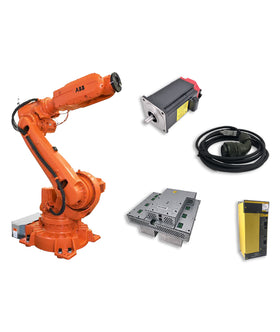
The complete robot system is composed of:
Industrial robots are widely utilized across manufacturing for welding, material handling, assembly, palletizing, machine tending, and inspection applications. As automation systems advance, these components are increasingly integrated with PLC systems, vision networks, and factory safety scanners.

The robot base supports the entire weight of the structure and absorbs intense vibrations generated during high-speed movements or sudden payload changes. A stable, securely mounted base is crucial for motion accuracy, repeatability, load stability, and collision resistance. Improper installation can introduce microscopic base shifts, causing encoder deviation or long-term mechanical wear.
Electrical Safety Note: Most FANUC robot bases feature a dedicated grounding terminal. Proper grounding to the earth is essential for electrical safety, preventing current leakage, reducing electrical interference, and suppressing servo/encoder signal noise.
Each FANUC robot axis is controlled by an independent servo motor and an optical encoder feedback system. Typical 6-axis configurations include:
Servo accuracy directly determines path precision and cycle times. Over time, high duty cycles can introduce encoder instability, servo overheating, reducer backlash, lubrication contamination, and cable fatigue.
Related reading:

The FANUC control cabinet acts as the operational core of the robotic system. It houses the primary processing units, power modules, input/output (I/O) interfaces, and vital safety systems.

The R-30iB control cabinet contains the main CPU board, DRAM modules, FROM/SRAM memory modules, servo control cards, I/O boards, and the power supply unit (PSU). These components process programs and adjust instructions dynamically based on real-time feedback. Hardware or memory instability here can lead to random reboots, teach pendant lockups, program corruption, or sudden communication drops.
Related reading:
The servo amplifier converts incoming factory electrical power into precise, controlled three-phase motor output for each axis. It continuously monitors motor current, temperature, encoder signal integrity, and axis loads. Intermittent overcurrent or regenerative circuit alarms often show up weeks before a total amplifier failure occurs.
Related reading:
The rear section of the cabinet houses the cooling fan unit, main transformer, and regeneration resistors. The transformer steps down factory voltage for the electronics, while the resistors bleed off excess electrical energy generated during axis deceleration.
If the cooling fans degrade or accumulate grease, internal cabinet temperatures spike rapidly. This excessive heat triggers thermal trips on the servo amplifiers, causes CPU instability, and drastically shortens the lifespan of electronic components.
The teach pendant is used for manual jogging, program editing, alarm diagnostics, and system recovery. Reliable operation depends heavily on stable DC power from the cabinet and the physical integrity of the pendant cable. Because this cable is frequently flexed, dropped, or pulled on the factory floor, wire fatigue typically develops gradually, showing up as an intermittent black screen or touch unresponsiveness before failing completely.
Related reading:

Most FANUC downtime stems from electrical instability, communication breaks, safety circuit interruptions, or worn mechanical components. Rather than swapping parts blindly, use the following categorical diagnostic maps.
Implementing regular, routine maintenance preserves path accuracy, limits backlash, and prevents sudden component failure.
| Component | Recommended Interval | Action Required | Risk if Omitted |
|---|---|---|---|
| Main Reducer Grease | 10,000 Hours / 3 Years | Full replacement of internal lubricating oil | Accelerated gear wear, backlash, reducer lockup |
| Balance Cylinder | Every 6 Months | Lubricate both sides of the main cylinder shaft | Axis imbalance, excessive J2/J3 motor strain |
| Robot Arm Batteries | Every 12 Months | Replace the 4 primary alkaline cells in the arm base | Loss of encoder positioning data, mastering errors |
| Cabinet Battery | Every 2–3 Years | Replace the lithium cell on the main CPU motherboard | Loss of system configuration, SRAM memory corruption |
| Cooling Fan Unit | Every 6 Months | Clean dust/debris and check physical fan rotation | Cabinet overheating, intermittent CPU & servo trips |
| Pendant Cable | Quarterly | Inspect insulation, pins, and strain-relief boots | Signal cross-talk, sudden communication loss |
Before starting any maintenance procedure, ensure the following items are prepared:
[1. Perform Full Backups]
[2. Secure Safe Posture]
[3. Lubricate Reducers (J1-J6)]
[4. Live Battery Exchange]
Always create a fresh MC (Memory Card) backup and an IMG (Image) backup via the controller's boot monitor or file menu before starting mechanical work. Verify the integrity of the backup file on an external storage drive to ensure a reliable recovery point if data is lost.
⚠️ CRITICAL WARNING: You MUST keep the main control cabinet power turned ON during the entire battery replacement process. If you replace the batteries while the controller is powered off, all stored pulse coder positional data will be permanently wiped, forcing a time-consuming, manual zero-position mastering calibration.
Most FANUC units require comprehensive preventive maintenance every 10,000 operating hours or every 3 years. However, if the robot operates in harsh environments—such as high-temperature die casting, automotive painting, or abrasive grinding—the maintenance windows for cooling fan cleaning and lubrication should be shortened to 6-month intervals.
When the base batteries drain past a critical threshold, the optical encoders lose their absolute position tracking memory the moment the main cabinet loses power. Upon reboot, the system throws severe positioning alarms, and the robot will refuse to move until new batteries are installed and a full factory mastering and calibration sequence is performed.
This issue is commonly traced to mechanical fatigue within the teach pendant cable, which breaks down the internal RS-422 or Ethernet communication pairs. Other frequent causes include unstable 24V DC lines from a failing PSU, overheating of the main CPU due to clogged cabinet filters, or bad sectors inside the FROM/SRAM memory modules.
This means the safety circuit or external interface has not cleared the robot for automatic operation. Check for dropped safety network connections with the master PLC, missing Remote Enable signals on your I/O matrix, dual-channel safety fence switch mismatches, or an un-cleared software interlock block.
Yes. Operating with degraded, broken-down, or insufficient grease increases metal-on-metal friction inside the RV or harmonic reducers. This leads to internal overheating, rapid gear wear, permanent loss of path accuracy (backlash), and eventual catastrophic mechanical binding of the joint.
Explore the Full Guide: Industrial Robot Knowledge Hub → Repair & Troubleshooting Cluster
Explore the complete guide for troubleshooting, repair strategies, and component replacement across industrial robot systems.
Key components commonly involved in repair guides issues and replacements.


{"one"=>"Seleziona 2 o 3 articoli da confrontare", "other"=>"{{ count }} di 3 elementi selezionati"}
Seleziona il primo elemento da confrontare
Seleziona il secondo elemento da confrontare
Seleziona il terzo elemento da confrontare
Lascia un commento