



When a FANUC robot starts showing positioning issues, it rarely happens all at once.
In most production environments, accuracy degradation appears slowly and is often noticed only after repeated cycles or restart conditions.
On R-30iA / R-30iB systems, this is usually classified as robot position drift or repeatability loss.
Typical field symptoms include:
In real maintenance cases, this is rarely related to mechanical wear such as gearbox backlash or arm deformation.
More often, the issue sits inside the FANUC servo feedback system, especially:
The key is not guessing the symptom — it’s identifying which part of the feedback loop is no longer stable.
Before changing hardware, the first step is to look at how the error behaves.
You usually see:
This typically points to:
In practice, this is not a hardware failure. It’s a configuration issue inside robot kinematics.
More problematic pattern:
This usually points to the feedback side:
In FANUC systems, this pattern is far more related to signal integrity than mechanical wear.
FANUC uses an APC (Absolute Pulse Coder) system to maintain absolute position data.
Unlike incremental encoders, APC retains position information through battery-backed memory even after power-off.
The simplified chain looks like this:
APC Encoder → Backup Battery → Servo Drive → Controller → Motion Loop
If anything inside this chain becomes unstable, the controller starts working with unreliable position reference data.
What you see on the robot side:
APC encoders rarely fail suddenly. They degrade slowly in signal quality.
Common field causes:
What appears on the robot:
Early-stage faults are usually intermittent and only visible during motion.
This is one of the most important FANUC-specific failure points.
The battery maintains absolute position memory when power is off.
When battery voltage drops:
Typical symptoms:
Common alarms include:
In field service, these alarms almost always point to battery or APC memory instability, not mechanical issues.
Even when encoder and battery are healthy, problems can still appear in the transmission layer.
Common causes:
Typical behavior:
High-flex areas near wrist joints are usually the first to degrade.
FANUC robots can also lose accuracy due to mastering instability.
Common symptoms:
In many cases, this is tied to APC or battery inconsistency rather than calibration mistakes.
In real plants, this issue is often mistaken for:
But field data shows a different pattern:
Most FANUC “position not accurate” cases come from feedback chain instability, not mechanical failure.
APC-related faults often behave inconsistently:
These are typical signs of feedback instability inside the servo loop.
Observe:
Focus on instability, not single errors.
Verify:
Low battery voltage is one of the most common real causes in field repairs.
Check:
Flex testing during motion is more reliable than static checks.
A simple but effective field method:
Procedure:
Interpretation:
This test often reveals problems not visible during normal operation.
Most cases are linked to APC memory instability or weak encoder battery affecting absolute reference data.
APC (Absolute Pulse Coder) is FANUC’s absolute encoder system that stores position data using battery-backed memory.
Yes. Low battery voltage can corrupt absolute position reference data and create persistent accuracy issues.
They usually indicate encoder battery or APC memory instability inside the servo system.
Most FANUC position accuracy problems are not mechanical failures.
They come from instability in the APC feedback chain and servo loop system.
In field practice, technicians usually check:
before replacing motors, reducers, or servo amplifiers.
Explore the Full Guide: Repair & Troubleshooting Cluster → Robot Position Accuracy
Explore the complete guide for troubleshooting, repair strategies, and component replacement across industrial robot systems.
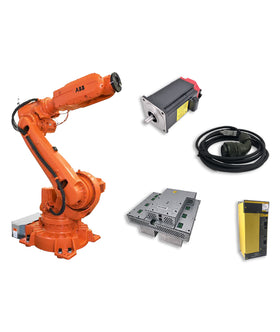
Key components commonly involved in robot position accuracy issues and replacements.


{"one"=>"Seleziona 2 o 3 articoli da confrontare", "other"=>"{{ count }} di 3 elementi selezionati"}
Seleziona il primo elemento da confrontare
Seleziona il secondo elemento da confrontare
Seleziona il terzo elemento da confrontare
Lascia un commento