
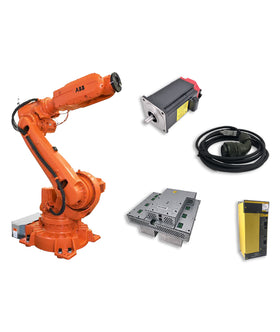
Fanuc controller boards and electronic modules form the core control, communication, motion-interface, and safety infrastructure of Fanuc industrial robot systems.
This index provides a system-level architectural reference explaining how Fanuc controller electronics are:
- Functionally categorized
- Identified across controller generations
- Correlated within the overall control architecture
Rather than listing individual part numbers or replacement options, this page focuses on controller architecture, board families, and functional classification, helping engineers and service professionals quickly orient themselves within the Fanuc controller ecosystem.

Core Reference: Controller Board & Module Architecture
Fanuc robot controllers are built around a modular electronic architecture in which multiple boards and modules coordinate motion execution, communication, safety supervision, and internal power management.nagement, and system I/O.Fanuc robot controllers are built around modular electronic architectures.
| Board / Module Category | Associated Controller Generations | System Role |
|---|---|---|
| Main Control Boards | R-J3, R-J3iB, R-30iA, R-30iB | Central processing and motion coordination |
| Axis Control & Servo Interface Boards | R-J3iB, R-30iA, R-30iB | Interface between motion commands and servo amplifiers |
| I/O & Communication Modules | All generations | Fieldbus, digital I/O, and external device communication |
| Safety & System Monitoring Boards | R-30iA, R-30iB | Safety logic, fault monitoring, and system supervision |
| Power & Auxiliary Modules | All generations | Internal power distribution and controller support functions |
This abstraction reflects how Fanuc structures controller electronics independently of specific robot mechanical models, making it suitable for index-based identification and navigation.
1. Main Control & Processing Boards
Main control boards act as the computational core of Fanuc robot controllers.
They are responsible for:
- Executing motion programs
- Managing system logic and task scheduling
- Coordinating communication between controller subsystems
Because these boards are tightly coupled to controller-generation architecture, they are not interchangeable across different controller families without full system compatibility.
2. Axis Control & Motion Interface Modules
Axis control and motion interface modules translate motion commands from the controller into signals processed by servo amplifiers.
Key characteristics include:
- Generation-specific motion control design
- Dedicated multi-axis coordination interfaces
- Tight electrical and protocol integration with servo amplifier systems
Compatibility is therefore determined by controller generation and motion architecture, not by physical appearance or connector similarity.
3. I/O, Communication & Expansion Modules
Fanuc controllers support a broad ecosystem of I/O and communication expansion modules used for automation system integration.
Typical functions include:
- Digital and analog I/O expansion
- Industrial network communication
- Peripheral device interfacing
These modules allow controllers to adapt to different automation environments while maintaining a consistent core architecture.
4. Safety & System Monitoring Boards
Safety and monitoring boards are responsible for system integrity and operational protection.
They typically handle:
- Safety signal processing
- Fault detection and system status monitoring
- Coordination with emergency stop and protective circuits
Integration depth varies by controller generation and safety architecture, particularly between earlier R-J3 systems and later R-30i platforms.
5. Identification & Classification Scope
When identifying Fanuc controller boards and modules, the following principles apply:
- Board compatibility is defined primarily by controller generation
- Functional classification precedes individual board identification
- Physical similarity does not guarantee electrical or system compatibility
This index is intended to clarify how Fanuc controller electronics are structured, not to determine direct replacement suitability.
Frequently Asked Questions
Q: Are Fanuc controller boards interchangeable across different controller generations?
A: No. Controller boards are designed around generation-specific architectures and are not universally interchangeable.
Q: Do similar-looking boards perform the same function?
A: Not necessarily. Similar form factors may correspond to different electrical roles or firmware dependencies.
Q: Why are controller boards grouped by function rather than part number?
A: Functional grouping reflects how Fanuc organizes controller electronics at a system level, which is more suitable for index-based identification.
Related Fanuc Index Pages
- Fanuc Servo Drive Index
- Robot Communication Boards Index
- Robot I/O Modules & Expansion Cards Index
- Robot Power Supply Units Index
Reference Notes
This section provides supplementary architectural references related to:
- Fanuc controller electronic structure
- Module classification logic
- System-level hardware relationships
All referenced materials are informational only and do not replace official technical documentation, manuals, or software release notes.
👉 View related Fanuc Controller & Hardware reference articles: