


The UR Joint Overload Error is one of the most common Protective Stop conditions seen in Universal Robots systems.
The controller detects one or more joints operating outside the expected torque envelope.
But in real production cells, this is rarely just a “payload too heavy” situation.
Most field cases involve multiple layers interacting together:
UR controllers treat overload as a protection mechanism first.
Goal is simple:
A lot of overload cases start as configuration or motion-behavior problems long before hardware damage appears.
Joint Overload almost never comes from one isolated event.
Controller continuously compares:
If deviation keeps growing:
Then Protective Stop triggers.
Joint overload is usually a system imbalance problem.
Not simply:
“The payload is too heavy.”
Very common field situation:
pushes torque outside the safe model range.
The robot constantly validates motion through a closed-loop control structure.
If mismatch keeps increasing:
Motion is then stopped intentionally.
Not random behavior.
Protection logic working as designed.

Typical causes:
Very common field pattern:
The robot runs normally at low speed.
Fails during fast transport motion.
Especially during:
Typical causes:
Typical behavior:
Overload repeats at the same trajectory corner or transition point.
Usually not hardware.
Usually dynamics.
Typical causes:
Very common aging pattern:
Seen often on older high-duty production cells.
Possible causes:
If overload appears without obvious mechanical resistance, check this layer early.
Especially after:
Typical causes:
Typical field behavior:
Very common timing window:
30–90 minutes after production starts.
Joint overload usually gives warning behavior beforefullfull Protective Stop.
Common field symptoms:
Another common clue:
The current trend slowly rises over repeated cycles before failure appears.
That pattern matters.
Especially when trying to separate friction buildup from collision events.
Most UR Joint Overload cases originate from these areas:
One important field note:
Payload may be correct.
CoG may still be wrong.
That alone can destabilize torque estimation badly enough to trigger Protective Stop.
Do not jump directly into hardware replacement.
First evaluatefullfull system behavior.
Focus on:
Most overload faults begin as motion/configuration issues before becoming true hardware wear problems.
When diagnosing Joint Overload, do not focus only on the joint reporting the alarm.
Instead:
The triggered joint is often not the root cause.
In real production cells, it is frequently:
A very different thing.
Check:
Incorrect CoG is one of the highest-frequency root causes in the field.
Reduce:
Then observe:
If yes:
dynamic torque instability becomes highly probable.
Monitor:
Thermal overload almost always worsens gradually during production runtime.
Check:
Dress pack resistance gets overlooked constantly.
Still one of the most common causes.
Evaluate:
Especially important after firmware updates or motion-profile modifications.
Separating these two behaviors is critical during field diagnos is.
Happens inside a very short time window.
Usually related to:
Failure occurs exactly at a disturbance moment.
Usually highly repeatable.
Builds gradually over time.
Typical causes:
The robot operates normally initially.
Failure appears later during production.
Very common in long-cycle packaging and palletizing systems.
Prioritize:
Prioritize:
Different timing patterns.
Different diagnostic directions.
Joint Overload behavior is heavily posture-dependent.
Even with identical payload.
When robot operates fully extended:
Result:
Higher overload probability even under normal payload conditions.
Especially common on:
Near singularities:
Result:
Sudden overload despite stable external load.
Very common during wrist alignment transitions.
Joint overload is not only about payload.
It is also:
| Observation | Likely Root Cause | Priority Action |
| Overload at startup / cannot unlock | Hardware or brake issue | Check brake release and motor winding resistance |
| Error during high-speed transport | Dynamics / inertia issue | Reduce acceleration and verify CoG |
| Repeated failure at same trajectory corner | Motion planning issue | Increase blend radius and avoid singularity |
| Overload after long runtime | Thermal / friction accumulation | Inspect temperature, lubrication, gearbox wear |
This usually indicates uneven load distribution or external mechanical interference in a specific workspace region.
The system is designed to protect hardware, but repeated overload events can accelerate wear in gear reducers and motors.
Lower speed reduces dynamic torque demand, which helps bring system response back within safe thresholds.
No. Most cases are configuration or motion planning related rather than hardware failure.
Explore the Full Guide: Industrial Robot Knowledge Hub → Repair & Troubleshooting Cluster
Explore the complete guide for troubleshooting, repair strategies, and component replacement across industrial robot systems.
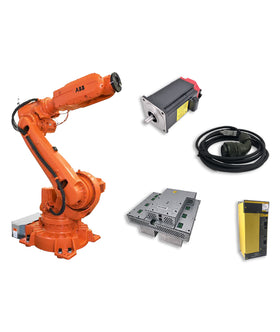
Key components commonly involved in issues and replacements.


{"one"=>"Seleccione 2 o 3 artículos para comparar", "other"=>"{{ count }} de 3 artículos seleccionados"}
Seleccione el primer artículo para comparar
Seleccione el segundo artículo para comparar
Seleccione el tercer elemento para comparar
Dejar un comentario