
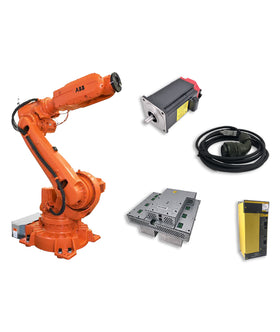


Safety circuit faults in industrial robots are a hard safety shutdown state triggered by the robot’s redundant safety architecture.
Unlike servo or motion alarms, this type of fault immediately disables all motion to prevent unsafe operation.
In most field cases, the root cause is not controller or servo hardware, but external safety loop instability, especially in Teach Pendant systems and associated cable assemblies.
A safety circuit fault occurs when the controller cannot confirm consistent safety signals across redundant channels.
When this happens:
In short:
The robot cannot verify that both safety channels agree on “safe to run” status.
If any of the following occur, the issue is likely in the safety loop:
👉 These symptoms strongly indicate safety loop interruption, not motion system failure
Industrial robots (ABB, FANUC, KUKA, Yaskawa) use a redundant safety design:
Channel A ↔ Safety Controller ↔ Channel B
Both channels must match continuously.
If:
Channel A ≠ Channel B → Safety loop opens → Robot stops immediately
Most safety faults are caused by partial degradation, not full disconnection.
Typical causes:
Key point:
Even with physically intact cables, internal degradation can still break safety consistency.
These alarms typically indicate safety loop interruption, not servo or motion failure.
The Teach Pendant is part of the active safety authorization chain, not just an interface.
It handles:
If replacing the Teach Pendant restores operation, the fault is isolated to the pendant system.
This is one of the most failure-prone components in the safety loop.
Cable-related safety faults often show:
👉 This pattern is highly indicative of intermittent cable failure
Safety loop issues are frequently mistaken for controller or servo faults.
| Action | Cost | Result |
| Replace servo motor | High | No improvement |
| Replace controller | Very high | No improvement |
| Replace Teach Pendant | Medium | Sometimes resolves |
| Replace cable system | Low–Medium | Most effective fix |
Check:
While system is idle:
👉 If behavior changes with movement → cable fault likely
After repair:
If Teach Pendant and cable are confirmed normal, check:
Because safety systems check signal consistency, not just continuity.
Yes. Dual-channel mismatch is enough to triggerfullfull shutdown.
It temporarily resynchronizes unstable safety signals.
Teach Pendant cable — highest failure rate and lowest cost.
Rarely. Servo issues usually trigger motion or drive alarms instead.
Explore the Full Guide: Industrial Robot Knowledge Hub → Repair & Troubleshooting Cluster
Explore the complete guide for troubleshooting, repair strategies, and component replacement across industrial robot systems.
Key components commonly involved in safety circuit fault issues and replacements.


{"one"=>"Seleccione 2 o 3 artículos para comparar", "other"=>"{{ count }} de 3 artículos seleccionados"}
Seleccione el primer artículo para comparar
Seleccione el segundo artículo para comparar
Seleccione el tercer elemento para comparar
Dejar un comentario