

Unexpected robot disconnections are among the most frustrating and expensive problems in industrial automation.
The robot may run normally for hours — then suddenly:
Although symptoms differ across ABB, KUKA, FANUC, and Yaskawa systems, the root cause is often the same:
Unstable communication caused by cable degradation, encoder signal interruption, or fieldbus instability under motion stress.
This diagnostic hub helps maintenance engineers identify whether the issue originates from physical signal transmission failure or deeper controller-level communication problems.

Unlike mechanical failures, communication faults are often:
At industrial communication speeds, even tiny signal interruptions can trigger major system responses.
Common hidden causes include:
In many cases, a communication interruption lasting only 10–50 ms is enough to trigger:
Communication instability usually develops gradually before complete failure.
Typical warning signs include:
If the issue changes with robot movement, cable flexing is often involved.
Each robot brand has different communication architecture, but failure behavior is often similar.
IRC5 / S4C+ communication loops, SMB communication, and FlexPendant signal integrity.
Common ABB-related causes:
Recommended inspection areas:
→ Access ABB communication fault diagnostic guide
FSSB communication, pulse coder feedback, and SRVO-related instability.
FANUC systems are highly sensitive to encoder communication quality.
Common causes include:
Typical symptoms:
→ Access FANUC communication troubleshooting guide
KRC4 EtherCAT communication and smartPAD connectivity.
KUKA systems commonly experience disconnect faults caused by dynamic cable stress and fieldbus instability.
Common causes:
Typical symptoms:
→ Access KUKA communication diagnostic guide
YRC1000 / Sigma-7 / MECHATROLINK communication stability.
Yaskawa systems are especially sensitive to servo communication timing and network jitter.
Common causes:
Typical symptoms:
→ Access Yaskawa communication troubleshooting guide

Despite architectural differences, field failures consistently point to the same physical-layer problems.
High-flex robot cables experience continuous mechanical stress.
Over time this causes:
This is the single most common cause of intermittent disconnect issues.
Industrial robot systems depend heavily on real-time communication networks.
Common problems include:
Fieldbus instability may temporarily disconnect entire robot subsystems.
Servo systems require stable feedback signals at all times.
When encoder communication becomes unstable:
Industrial environments generate significant electrical noise.
Common interference sources:
Poor shielding or grounding can destabilize communication even when cables appear physically intact.
One of the most misunderstood robotic communication failures is the “micro-interruption” problem inside high-flex cables.
In these cases:
These interruptions are extremely brief — often only milliseconds — but still sufficient to trigger:
Because the failure is transient and motion-dependent, standard continuity testing often fails to detect it.
Across ABB, KUKA, FANUC, and Yaskawa systems, one rule consistently applies:
If the fault is intermittent and motion-related, always suspect communication integrity first.
Before replacing expensive hardware such as:
Always verify:
When troubleshooting random robot disconnects:
If alarms appear during movement or vibration, suspect cable fatigue first.
Pendant cables are among the highest-failure components in robotic systems.
Check encoder cables, servo feedback loops, and communication modules.
Inspect EtherCAT, MECHATROLINK, FSSB, or proprietary communication networks.
Only investigate controller replacement after communication integrity is verified.
In real-world robotic maintenance, persistent disconnect faults are usually linked to signal transmission degradation rather than controller failure.
Once diagnostics confirm:
The priority becomes restoring stable communication infrastructure inside the robot system.
Recommended focus areas include:
Because intermittent communication failures often occur too quickly to generate consistent alarm records.
Most cases are caused by:
rather than controller failure.
Communication cable degradation is the most common cause across all major robot brands.
High-flex robotic motion eventually damages internal conductors and shielding.
Restarting resets temporary communication faults and reinitializes the network.
However, it does not repair the underlying physical cable degradation.
The problem usually returns and gradually worsens over time.
A simple field rule:
If the fault changes with robot movement or vibration, it is usually a cable or signal integrity problem.
True controller failures are generally stable and repeatable, while cable-related faults are intermittent and motion-dependent.
Explore the Full Guide: Industrial Robot Knowledge Hub → Repair & Troubleshooting Cluster
Explore the complete guide for troubleshooting, repair strategies, and component replacement across industrial robot systems.
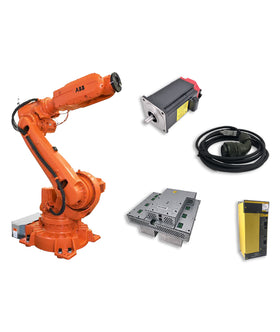
Key components commonly involved in robot disconnects randomly issues and replacements.
No related parts found. Please check available components in our catalog.


{"one"=>"Seleccione 2 o 3 artículos para comparar", "other"=>"{{ count }} de 3 artículos seleccionados"}
Seleccione el primer artículo para comparar
Seleccione el segundo artículo para comparar
Seleccione el tercer elemento para comparar
Dejar un comentario