
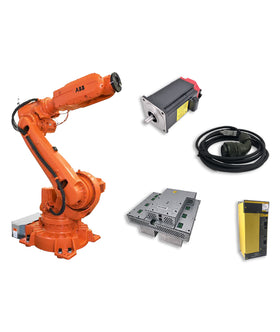

Internal robot cable breaks are one of the most common causes of intermittent servo alarms, encoder faults, communication instability, and unexpected robot downtime in industrial automation systems.
Unlike complete electrical disconnection events, internal conductor fatigue usually develops gradually. A robot may pass static electrical tests and appear normal during inspection while still experiencing unstable encoder feedback, communication retries, servo synchronization errors, or random motion interruptions during operation.
This diagnostic difficulty exists because modern robots depend on continuous high-integrity signal transmission through multiple moving cable systems, including:
In high-cycle robotic environments, an internal cable break should be understood as a dynamic signal-path failure, not simply a broken wire.
Internal cable damage often appears as broader system instability rather than an obvious cable fault.
Intermittent encoder communication faults, CRC errors, or feedback synchronization alarms are common early indicators.
Alarms that occur mainly during acceleration, deceleration, or wrist movement often point to movement-dependent cable fatigue.
Teach Pendant Disconnects
Intermittent pendant communication loss can result from fractured conductors or worn connector interfaces.
Fieldbus retries, temporary axis offline conditions, or unstable network communication may indicate signal integrity problems inside the cable.
Intermittent safety faults can occur when signal continuity fluctuates under motion or vibration.
Temporary signal interruption can force the controller into a protective stop even though the fault disappears after restart.
| Robot Symptom | Possible Internal Cable Failure |
| Encoder alarm | Broken encoder conductor |
| Servo alarm during motion | Fatigued feedback cable |
| Communication timeout | Shielding damage or unstable continuity |
| Teach pendant disconnect | Internal cable fracture |
| Safety circuit fault | Intermittent signal interruption |
| Positioning error | Feedback instability |
This symptom-based approach is often faster than replacing servo amplifiers, encoders, or controller modules unnecessarily.
A key challenge is that damaged conductors may still make temporary electrical contact while the robot is stationary.
During movement, however, cable deformation changes conductor alignment and contact pressure. Fractured strands can separate momentarily, interrupting the signal path and then reconnecting again.
This creates failures that are:
As a result, intermittent cable problems are frequently misdiagnosed as:

Repeated bending cycles gradually harden and fracture ultra-fine copper strands inside the cable. Effective conductor area decreases, resistance becomes unstable, and intermittent continuity develops.
Wrist articulation and DressPack rotation twist conductors repeatedly, damaging both conductor geometry and insulation layers.
Tight bend radii in drag chains or axis transitions create localized stress concentration zones where micro-fractures begin.
Damaged shielding allows electromagnetic noise to interfere with differential encoder and communication signals, causing CRC errors and synchronization instability.
Oil, heat, chemicals, and abrasion degrade insulation materials over time, increasing leakage, impedance fluctuation, and transient signal faults.
Modern servo systems rely on a continuous closed-loop signal chain:
Encoder → Feedback Cable → Connector Interface → Servo Amplifier → Motion Controller → Position Correction Loop.
Any instability inside this chain can disrupt servo synchronization.
Encoder Signal Interruption
High-speed differential protocols such as RS-422, EnDat, or BiSS depend on stable impedance, shielding continuity, and consistent voltage levels. Internal strand fracture can distort signal edges and timing, leading to packet retransmission, CRC validation errors, and intermittent communication loss.
Motion-Dependent Signal Degradation
When the robot moves, conductor geometry changes dynamically. Fractured strands may separate, shielding continuity may fluctuate, and impedance may shift, causing feedback instability only during specific motion paths.
Closed-Loop Servo Instability
Servo systems continuously compare commanded position, actual encoder position, and motor response. Intermittent cable instability disrupts this synchronization and can produce servo hunting, oscillatory correction behavior, abnormal torque compensation, and axis following errors.
| Stage | Failure Condition |
| 1 | Copper fatigue initiation in repeated flex zones |
| 2 | Contact resistance becomes unstable |
| 3 | Differential signal distortion begins |
| 4 | Communication retries and CRC errors appear |
| 5 | Servo synchronization becomes unstable |
| 6 | Intermittent robot shutdown or hard fault occurs |
Recognizing early-stage symptoms can prevent much larger downtime events later.
Thermal radiation, welding spatter, EMI, and intense wrist articulation create severe stress on encoder and feedback cables.
High-cycle vertical motion and rapid acceleration/deceleration transitions accelerate conductor fatigue inside DressPack systems.
Continuous multi-axis motion and repetitive trajectories create long-term bending and torsional stress.
Improper bend radius, cable compression, and repeated cyclic bending frequently cause localized fatigue near transition points.
Extreme acceleration profiles amplify vibration and conductor movement, making intermittent signal faults more likely.
Check for abrasion, cracking, flattening, twisting, connector damage, and stressed bend zones.
Monitor continuity while manually flexing the cable or moving the robot through high-stress positions.
Examine waveform integrity, pulse distortion, amplitude fluctuation, and transient dropout events in encoder signals.
Look for unstable encoder counts, fluctuating correction values, or communication retry accumulation in servo diagnostics.
Check for pin oxidation, loose crimps, shielding discontinuity, thermal discoloration, and unstable contact resistance.
Replacing the suspected cable with a known-good assembly is often the fastest way to confirm the diagnos is.
Choose cables specifically designed for continuous robotic motion, torsion resistance, and dynamic flex applications.
Avoid sharp bends and compressed routing paths that concentrate mechanical stress.
Minimize unnecessary cable twisting in wrist assemblies and DressPack routing.
Ensure cables move freely, avoid abrasion points, and maintain stable motion paths throughout the robot envelope.
Replace cables proactively based on cycle count, application severity, thermal exposure, and historical fatigue data rather than waiting for catastrophic failure.
Preventive replacement is often far less expensive than prolonged troubleshooting and unexpected production downtime caused by intermittent servo feedback problems.
Internal robot cable breaks rarely appear as obvious electrical failures. Instead, they manifest as intermittent signal integrity problems that affect encoder communication, servo synchronization, and overall robot reliability.
Because damaged conductors may temporarily reconnect depending on motion, temperature, and vibration, these faults are frequently misdiagnosed as servo, encoder, grounding, or controller problems.
Understanding the relationship between cable fatigue, differential signal integrity, and closed-loop servo behavior allows maintenance teams to diagnose problems faster, avoid unnecessary component replacement, and reduce unplanned downtime in industrial robotic systems.
An internal robot cable break occurs when conductor strands fracture inside the cable while the outer jacket remains intact.
Yes. Internal conductor fatigue often develops long before external damage becomes visible.
Early signs include intermittent encoder alarms, communication errors, teach pendant disconnects, and motion instability.
A fatigued conductor may temporarily reconnect when cable position changes, making the fault appear resolved.
Yes. Servo systems depend on continuous encoder feedback, and signal interruption can trigger synchronization alarms.
Encoder cables, feedback cables, wrist harnesses, teach pendant cables, and DressPack assemblies are the most susceptible to fatigue.
Effective methods include dynamic flex testing, continuity testing during movement, oscilloscope analysis, and cable substitution.
Use high-flex robotic cables, maintain proper bend radius, reduce torsional stress, optimize DressPack routing, and replace worn cables proactively.
Key components commonly involved in issues and replacements.
No related parts found. Please check available components in our catalog.


{"one"=>"Seleccione 2 o 3 artículos para comparar", "other"=>"{{ count }} de 3 artículos seleccionados"}
Seleccione el primer artículo para comparar
Seleccione el segundo artículo para comparar
Seleccione el tercer elemento para comparar
Dejar un comentario