
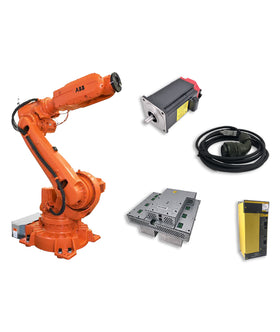

Intermittent robot problems are among the most challenging failures in industrial automation.
Unlike permanent faults that remain continuously present, intermittent failures appear unexpectedly, disappear without warning, and often leave little diagnostic evidence behind. A robot may operate normally for days or even weeks before generating a random encoder alarm, communication fault, servo synchronization error, or unexpected stop condition.
After a reset, the robot frequently returns to normal operation, making troubleshooting difficult and increasing the risk of repeated production interruptions.
In many cases, the controller is not the true source of the problem. Instead, intermittent failures originate within the signal transmission system that connects controllers, servo drives, encoders, safety devices, and industrial networks.
Common root causes include:
Understanding how these mechanisms develop is essential for improving robot reliability and reducing unplanned downtime.
Intermittent faults often occur only when certain operating conditions align.
Examples include:
Once conditions change, the fault may disappear completely.
Most robot controllers record the final alarm condition rather than the physical event that triggered it.
Examples include:
The actual signal disturbance may have occurred milliseconds or microseconds earlier and is often absent from alarm history.
A single alarm may originate from several unrelated mechanisms.
| Alarm Type | Possible Causes |
| Encoder communication fault | Cable fatigue, connector wear, EMI |
| Network timeout | Communication cable degradation, jitter |
| Random robot stop | Safety signal interruption |
| Servo synchronization error | Feedback signal corruption |
This overlap is one reason intermittent robot failures are frequently misdiagnosed.

Temporary communication loss may occur between:
Symptoms commonly include:
Servo systems depend on continuous feedback communication.
Signal disturbances may create:
Some faults occur only when the robot reaches a specific position where cable stress becomes highest.
These issues frequently involve:
Thermal expansion can temporarily alter electrical connections.
Typical symptoms include:
Electrical noise can corrupt communication signals without causing permanent hardware damage.
mitigation typically requires upgrading to shielded Communication Cables designed to maintain stable robot signal integrity under electromagnetic interference (EMI) conditions.
Common noise sources include:
Industrial robots depend on continuous communication between:
Even a brief interruption can trigger protective shutdown logic.
As communication speeds increase, signal integrity becomes a critical reliability factor.
High-flex robot cables experience millions of bending and torsional cycles throughout their service life.
Over time, internal conductor strands may begin to fracture while the cable appears visually intact.
When the robot moves into specific positions, damaged conductors may separate momentarily and reconnect immediately afterward.
This can create:
Because these interruptions may last only microseconds, standard continuity testing often fails to detect them.
Connectors are among the most common sources of intermittent robot failures.
Contributing factors include:
Even small increases in contact resistance can affect high-speed communication reliability.
Encoder-related failures often progress gradually rather than appearing suddenly.
Cable aging, shielding degradation, or connector wear begin reducing communication quality.
Internal retries and error correction mechanisms compensate for signal degradation.
No visible alarms are generated.
The controller begins reporting sporadic encoder communication faults.
Specific robot movements repeatedly trigger communication errors.
Complete communication loss eventually occurs.
At this stage, production downtime becomes unavoidable.
The robot DressPack system plays a critical role in long-term signal stability.
Poor cable routing or excessive torsional loading can accelerate:
Many intermittent communication failures originate within heavily flexed cable sections near the robot wrist.
Related resources:
Although alarm numbering varies by manufacturer, intermittent feedback problems frequently appear as:
Fanuc Systems
Yaskawa Systems
ABB Systems
In most cases, the alarm is only the final symptom of an underlying signal transmission problem.
Connectors are among the most common sources of intermittent robot failures.
Contributing factors include:
Even small variations in contact resistance can affect communication quality.
Robot cables experience continuous mechanical stress throughout their service life.
Common degradation mechanisms include:
Over time, these conditions reduce signal reliability and increase the likelihood of intermittent faults.
Internal conductor damage is particularly difficult to diagnose because external cable surfaces may appear normal.
The result is often a classic intermittent robot problem:
Cable routing architecture directly affects long-term communication reliability.
Engineers investigating intermittent signal failures should understand:
Related resources:
Electromagnetic interference remains a major contributor to robot communication issues.
Common noise sources include:
Modern industrial networks rely on deterministic timing.
When shielding degradation, grounding problems, or external interference affect signal quality, communication timing becomes less stable.
This can produce:
Many so-called random robot faults are actually timing-related communication failures.
Temperature changes can alter:
This explains why some faults appear only after extended operating periods.
External vibration can temporarily affect:
These conditions frequently create highly intermittent communication behavior.
Record:
Patterns often provide the strongest clue to the underlying failure mechanism.
Focus on recurring alarm families rather than isolated events.
Particular attention should be paid to:
Focus inspections on:
These areas frequently contain hidden mechanical damage.
Inspect connectors for:
Connector-related issues are often overlooked during troubleshooting.
Useful technologies include:
Time Domain Reflectometry (TDR)
Used to identify:
Oscilloscope-Based Signal Analysis
Helps detect:
Wiggle and Tap Testing
With communication signals monitored in real time, controlled manipulation of cables and connectors can expose intermittent defects that remain invisible during static inspection.
Long-term reliability improvements typically focus on three areas:
Best practices include:
Preventive inspections should verify:
Replace high-wear components according to:
Waiting for complete failure often results in significantly higher downtime costs.
Intermittent faults commonly involve:
Together, these components form the signal transmission infrastructure that determines overall robot reliability.
Intermittent robot failures can appear as unexpected stops, temperature-dependent faults, communication dropouts, vibration-related signal problems, or sporadic servo alarms. Explore the resources below to identify the most likely root cause.
Most intermittent robot problems are not truly random.
They are often the result of gradual degradation within the robot's signal transmission system. Cable fatigue, connector instability, EMI exposure, feedback communication errors, and DressPack wear can all create temporary signal disruptions long before a permanent failure occurs.
By focusing on signal integrity, communication reliability, and motion-dependent cable stress, maintenance teams can identify root causes earlier, reduce unnecessary part replacement, and significantly improve robot uptime.
An intermittent robot problem is a fault that appears unpredictably, disappears temporarily, and cannot be consistently reproduced under identical operating conditions.
Signal integrity degradation caused by cable fatigue, connector instability, EMI exposure, feedback communication issues, or network synchronization problems is among the most common causes.
Yes. Internal conductor fractures may separate only under specific mechanical loads, making the fault difficult to detect during static testing.
Motion changes cable geometry and stress distribution, which can temporarily expose hidden conductor, shielding, or connector defects.
Key components commonly involved in issues and replacements.
No related parts found. Please check available components in our catalog.


{"one"=>"Seleccione 2 o 3 artículos para comparar", "other"=>"{{ count }} de 3 artículos seleccionados"}
Seleccione el primer artículo para comparar
Seleccione el segundo artículo para comparar
Seleccione el tercer elemento para comparar
Dejar un comentario