
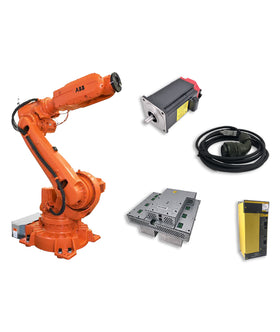

Many ABB robot faults that appear to be servo, encoder, or communication problems actually originate inside the DressPack system.
The DressPack protects and routes power cables, encoder cables, feedback cables, communication lines, and pneumatic tubing throughout the robot arm. Because these cables move with every robot cycle, the DressPack is one of the highest-wear areas in an ABB robot.
As cable wear accumulates, mechanical damage gradually develops into signal instability, communication errors, and motion-control problems. Identifying the warning signs early can help prevent unexpected downtime and expensive component replacement.
DressPack problems often appear long before a cable completely fails.
Common symptoms include:
| Symptom | Possible DressPack Cause |
| SMB Communication Error | Encoder cable fatigue |
| Intermittent encoder faults | Shield degradation |
| Random servo alarms | Conductor fatigue |
| Position drift | Feedback signal instability |
| Communication dropouts | Cable damage or EMI intrusion |
| Motion-dependent faults | Cable stress at specific robot positions |
| Frequent Axis 4–6 alarms | Torsional fatigue |
| Unexpected production stops | Severe cable degradation |
If these issues repeatedly occur during robot movement, the DressPack should be inspected before replacing servo motors, drives, or controller components.

A DressPack is the cable management system that controls cable movement throughout the robot arm.
Typical ABB DressPack assemblies may contain:
The purpose of the system is to maintain proper cable routing while reducing bending, twisting, and abrasion during robot operation.
Because every robot movement affects these cables, the DressPack experiences continuous mechanical stress throughout its service life.
Most DressPack failures develop gradually through accumulated wear.
Repeated contact between cables, conduit walls, brackets, or robot structures gradually wears away protective jackets.
As wear increases, shielding and conductors become vulnerable to damage.
ABB robot wrist axes continuously twist cable bundles during operation.
Axis 4, Axis 5, and Axis 6 generate the highest torsional loads.
Over millions of cycles this may cause:
Improper cable routing can force cables into bends tighter than their recommended dynamic bend radius.
This accelerates conductor fatigue and shortens cable life.
Continuous vibration and movement can gradually damage connectors through:
Mechanical cable damage eventually becomes an electrical problem.
A typical failure sequence follows this pattern:
External abrasion begins damaging the cable jacket.
Protective layers wear away and shielding becomes exposed.
Electrical noise begins affecting signal quality.
Encoder data and communication packets become unstable.
The controller detects abnormal feedback and stops operation.
This is why many communication alarms originate from cable wear rather than controller failure.
One of the most common ABB DressPack-related issues is SMB communication instability.
Typical causes include:
When shielding deteriorates, electromagnetic interference can affect encoder communication and create intermittent SMB faults.
These alarms often appear only during robot motion when cable stress is highest.
The wrist area is the most demanding section of any ABB DressPack system.
Axis 4–6 cables experience:
Over time, torsional stress accumulates and increases the likelihood of:
For this reason, troubleshooting should typically begin with the wrist area whenever DressPack-related faults occur.
Several ABB alarms are commonly associated with cable degradation.
| ABB Alarm | Possible DressPack Cause |
| 39521 SMB Communication Error | Encoder cable fatigue |
| 39530 SMB Communication Error | Shield degradation |
| 50021 Joint Position Error | Feedback cable interruption |
| 50056 Joint Speed Error | Motion-dependent signal loss |
While these alarms do not always indicate DressPack failure, recurring faults during robot motion frequently point to cable-related problems.
Check for:
Move the robot through its full working range while monitoring:
Many DressPack faults only appear when cables are under stress.
Verify:
For PROFINET and Industrial Ethernet systems, monitor:
These indicators often reveal problems before complete cable failure occurs.
Several maintenance practices can significantly extend cable life.
A commonly accepted guideline is:
Dynamic Bend Radius ≥ 10 × Cable Diameter
Maintaining proper bend radius reduces conductor fatigue and insulation damage.
Optimize routing to minimize accumulated torsional stress.
Leave approximately 20–30% free space inside conduits to allow natural cable movement.
Proper separation reduces EMI and improves communication reliability.
Preventive replacement is often less expensive than unexpected production downtime.
Primary cable assembly supporting power and signal transmission.
Provides position feedback from robot motors.
Supports closed-loop motion control.
Supports PROFINET and other industrial communication networks.
Critical electrical interfaces exposed to vibration and motion-related stress.
Cable abrasion, exposed shielding, intermittent communication alarms, and motion-dependent faults are among the most common early warning signs.
Yes. Encoder cable fatigue and shielding damage are common causes of SMB communication instability.
Many cable failures are position-dependent and only occur when conductors are stretched, bent, or twisted.
Continuity tests cannot detect shielding damage, impedance changes, or signal-reflection issues that affect high-speed communication circuits.
Axis 4, Axis 5, and Axis 6 typically experience the highest torsional loading and are the most common cable failure locations.
Key components commonly involved in issues and replacements.
No related parts found. Please check available components in our catalog.


{"one"=>"Seleccione 2 o 3 artículos para comparar", "other"=>"{{ count }} de 3 artículos seleccionados"}
Seleccione el primer artículo para comparar
Seleccione el segundo artículo para comparar
Seleccione el tercer elemento para comparar
Dejar un comentario