
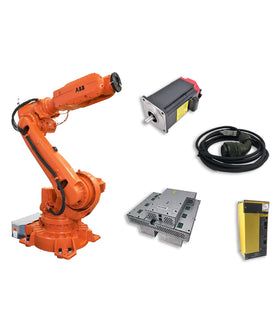

When an industrial robot stops operating because of a failed component, every hour of downtime can affect production schedules, delivery commitments, and maintenance costs.
For overseas factories and maintenance teams, sourcing a replacement part is only one part of the problem. The component must also be identified correctly, confirmed by the supplier, prepared for shipment, and delivered through international logistics and customs procedures.
An urgent order can still be delayed by an incorrect part number, incomplete shipping information, an unverified replacement, or missing import documents.
A clear purchasing plan helps reduce these risks.
This guide explains how to organize an urgent international industrial robot spare parts order, from the initial request to final delivery.
The first priority is to identify the failed component accurately.
Sending an urgent request with only a general description, such as "FANUC servo board" or "ABB pendant cable," may lead to unnecessary clarification and incorrect quotations.

Whenever possible, prepare the following information:
| Information | What to Provide |
|---|---|
| Part number | Complete number from the product label or manual |
| Manufacturer | ABB, FANUC, KUKA, Yaskawa, or other brand |
| Robot model | Exact robot model or series |
| Controller model | Controller generation or model |
| Quantity | Required quantity |
| Product photos | Label, connectors, overall appearance |
| Failure description | What happened and why the part is needed |
Two components that look similar may not be compatible with the same robot controller.
For example, Teach Pendants, servo amplifiers, control boards, and communication cables can have different hardware revisions or electrical specifications.
Do not assume that a similar part number or matching connector guarantees compatibility.
Before placing an urgent order, verify the complete part number and relevant controller information. If an alternative or superseded part is proposed, request supporting compatibility information before approving it.
Practical tip: If the original part number is difficult to read, send clear photos of the label and connectors. A supplier may be able to help identify the component from available information.
A supplier stating that a part is available does not necessarily mean it can be shipped immediately.
There may still be steps such as warehouse verification, condition inspection, functional testing, packaging, or export documentation.
For urgent orders, ask the supplier to confirm:
Is the exact part number physically available?
Is the quoted quantity available?
What is the product condition: new, new surplus, used, or refurbished?
Has the item been inspected or tested? What does the inspection or test cover?
Are product photos available before shipment?
When can the order actually be dispatched?
Is the item ready for export?

These are two different questions.
| Supplier Information | What It Means |
|---|---|
| In stock | The supplier reports that the item is available |
| Stock confirmed | The supplier has verified the physical item and quantity |
| Ready to ship | Required preparation and documentation are complete or scheduled |
| Dispatched | The carrier has received the shipment |
| In transit | The shipment is moving through the logistics network |
For an urgent purchase, ask for a realistic dispatch date rather than relying only on a general stock statement.
When a production line is down, buyers may be tempted to select the first available replacement.
However, product condition should still be considered carefully.
Industrial robot spare parts may be offered in several conditions:
| Condition | What Buyers Should Confirm |
|---|---|
| New | Original packaging, labels, and product identity |
| New Surplus | Unused condition, storage history where available, and packaging |
| Used | Physical condition, visible wear, and known operating history |
| Refurbished | Scope of refurbishment, replaced components, and test evidence |
The best choice depends on the component, availability, budget, and risk tolerance.
For example, a used Teach Pendant may be a practical option if its screen, keypad, communication functions, and other relevant features have been checked.
A servo drive or control board may require more detailed inspection and testing evidence because an internal electronic failure can cause additional downtime.
Do not treat "tested" as a universal guarantee. Ask what was tested, under which conditions, and whether the results apply to the functions required by your application.
For a more detailed purchasing comparison, see our guide:
New vs Used vs Refurbished Robot Parts: What Evidence Should Buyers Request?
International shipping is often the most time-sensitive part of an urgent order.
However, the fastest available service is not automatically the best option. Buyers should consider the destination, shipment size, customs requirements, carrier coverage, and delivery deadline.
Common shipping options include:
| Shipping Method | Typical Use | Considerations |
|---|---|---|
| International Express | Small, urgent spare parts | Usually suitable for time-sensitive shipments; service availability varies |
| Air Freight | Larger or heavier shipments | May require additional airport handling and local delivery |
| Economy Air | Less urgent shipments | Lower priority and potentially longer transit |
| Sea Freight | Large or non-urgent orders | Generally unsuitable for immediate production recovery |
Express courier services are often suitable for:
Teach Pendants and pendant accessories
Small control boards
Sensors and electronic modules
Compact servo components
For larger or heavier components, air freight may be more appropriate.
Do not ask only, "How many days does shipping take?"
Instead, request an estimate covering:
Order confirmation and payment processing
Product preparation and packaging
Export dispatch
International transit
Customs clearance
Final delivery to the destination
Transit time and total delivery time are not the same.
A carrier's estimated transit time may not include supplier preparation, customs inspection, import duties, or local delivery delays.
Always request the estimated delivery date and the assumptions behind it.
Customs clearance can become a major source of delay when the shipment documents are incomplete or inconsistent.
Before the supplier dispatches the order, confirm that the required commercial documents can be prepared accurately.
Common documents include:
Commercial Invoice
Packing List
Air Waybill or other transport document
Product description and part number
Country of origin, where required
HS code, where applicable
Additional certificates or declarations if required by the destination country and product category
The commercial invoice should describe the goods accurately.
For industrial robot spare parts, a useful description may include:
Product name
Manufacturer
Part number
Quantity
Unit value and total value
Country of origin, where applicable
Avoid descriptions that are too vague, such as "machine accessories" or "electronic parts," when a more specific and accurate description is available.
The buyer should provide the correct:
Company name
Delivery address
Contact person
Phone number
Tax or importer identification number, if required
Importer or customs broker details, where applicable
The importer should also confirm who is responsible for duties, taxes, and customs clearance.
Import requirements vary by destination and product classification. Buyers should check local requirements with their customs broker or relevant authorities before shipment.
International orders can involve different responsibilities for the seller and buyer.
Before payment, confirm the agreed Incoterms® rule and named place.
For example:
| Shipping Arrangement | What to Clarify |
|---|---|
| EXW | Buyer arranges collection and most transportation responsibilities |
| FCA | Seller delivers the goods to the agreed carrier or location |
| CPT | Seller pays carriage to the named destination; risk transfers according to the rule |
| CIP | Similar to CPT, with seller-arranged insurance under the applicable rule |
| DAP | Seller arranges delivery to the named destination; buyer generally handles import clearance and duties |
| DDP | Seller takes responsibility for delivery including import clearance and applicable duties, where legally and practically possible |
These terms are not interchangeable.
For urgent orders, DAP or DDP may appear simpler for buyers, but the actual arrangement depends on the seller's ability to support import procedures in the destination country.
Always confirm:
Who books the carrier?
Who pays international freight?
Who handles export clearance?
Who handles import clearance?
Who pays duties and taxes?
Who is responsible if customs requests additional information?
Use the current official Incoterms® rules and clearly identify the named place in the agreement.
Urgent orders often involve several people:
Maintenance engineers
Purchasing departments
Supplier sales teams
Warehouse and shipping staff
Customs brokers
Freight forwarders
If each person works with different part numbers, delivery dates, or shipping instructions, misunderstandings can quickly delay the order.
A single order summary helps keep everyone aligned.
Before payment or dispatch, confirm the following:
Product
Complete part number confirmed
Robot and controller compatibility checked
Quantity confirmed
Product condition agreed
Inspection or test scope clarified
Commercial
Unit price and total amount confirmed
Payment method and payment status confirmed
Warranty and return conditions reviewed
Alternative part approval documented, if applicable
Shipping
Dispatch date confirmed
Shipping method selected
Estimated delivery date provided
Freight cost confirmed
Incoterms® rule and named place agreed
Customs
Commercial invoice details checked
Packing list prepared
Importer information confirmed
Customs requirements reviewed
Tracking
Tracking number received
Carrier information shared
Delivery contact confirmed
An urgent purchase solves the immediate shortage, but it does not necessarily prevent the same problem from happening again.
For frequently used or production-critical components, consider a backup purchasing plan.
Useful steps include:
Identify parts with long lead times.
Record the complete part numbers of critical components.
Keep verified alternatives documented separately from confirmed equivalents.
Maintain a small quantity of essential spare parts where justified.
Review failure history and replacement frequency.
Keep supplier and logistics contact information accessible.
For example, factories that regularly use Teach Pendants, pendant cables, servo drives, and control boards may benefit from reviewing which components could stop production if no replacement is available.
A basic critical spare parts list can help purchasing teams respond faster during the next unexpected failure.
The fastest way to start an urgent sourcing request is to provide enough information for the supplier to identify the product and evaluate delivery options.
Use this checklist:
| Required Information | Example |
|---|---|
| Brand | FANUC, ABB, KUKA, Yaskawa |
| Part number | Complete number from the product label |
| Product name | Teach Pendant, Servo Drive, Robot Cable |
| Robot model | Exact robot model |
| Controller model | Controller generation |
| Quantity | Required number of units |
| Product condition | New, New Surplus, Used, or Refurbished |
| Destination | Country, city, postal code |
| Required delivery date | Actual deadline |
| Photos | Product label and overall appearance |
If the robot is currently down, explain that clearly and state the required delivery deadline.
This helps the supplier evaluate stock, sourcing options, and suitable shipping methods from the beginning.
Delivery time depends on product availability, supplier preparation, shipping method, destination, customs clearance, and local delivery.
International express is often suitable for small urgent components, but buyers should confirm the actual dispatch date and estimated delivery date before placing the order.
Yes, a sourcing request can still be started with the available information.
Provide the manufacturer, robot and controller models, product photos, label details, and a description of the failed component.
However, compatibility should be confirmed before the replacement is approved.
It may be suitable depending on the component, its condition, inspection results, test evidence, and application requirements.
For electronic components, buyers should request clear information about testing scope and any known limitations before purchase.
No. Express is often suitable for small and relatively lightweight parts, but air freight may be more appropriate for larger or heavier components.
Compare total delivery time, cost, customs handling, and destination coverage before choosing.
This depends on the agreed Incoterms® rule and the specific import arrangement.
Confirm the responsible party before payment and shipment. The buyer should also check local import requirements.
Ask the supplier to investigate verified superseded parts, manufacturer-approved replacements, or other alternatives with supporting compatibility information.
Do not approve a substitute based only on a similar appearance or part number.
The complete part number, product photos, robot or controller model, required quantity, and destination are the most useful starting points.
Also provide the actual delivery deadline so the supplier can evaluate available shipping options.
When a robot is down, a clear and complete request can help shorten the sourcing process.
InRobots supports international sourcing requests for industrial robot spare parts, including:
ABB, FANUC, KUKA, and Yaskawa components
Robot Cables and Teach Pendant Cables
Servo Drives and Servo Motors
Control Boards and Power Supply Modules
Send us the part number, product photos, robot or controller model, required quantity, and delivery destination.
If the exact part number is unavailable, provide the information you have. Our team can help review the identification and sourcing options.
Key components commonly involved in issues and replacements.
No related parts found. Please check available components in our catalog.


{"one"=>"Seleccione 2 o 3 artículos para comparar", "other"=>"{{ count }} de 3 artículos seleccionados"}
Seleccione el primer artículo para comparar
Seleccione el segundo artículo para comparar
Seleccione el tercer elemento para comparar
Dejar un comentario