
Zu Inhalt springen

Industrial Robot Safety Circuit Fault Symptoms

Teach Pendant & Safety Loop Diagnostic Guide

Safety circuit faults in industrial robots are a hard safety shutdown state triggered by the robot’s redundant safety architecture.

Unlike servo or motion alarms, this type of fault immediately disables all motion to prevent unsafe operation.

In most field cases, the root cause is not controller or servo hardware, but external safety loop instability, especially in Teach Pendant systems and associated cable assemblies.

What a Safety Circuit Fault Means

A safety circuit fault occurs when the controller cannot confirm consistent safety signals across redundant channels.

When this happens:

  • Motion is immediately blocked
  • Servo power is disabled
  • System enters emergency stop state

In short:

The robot cannot verify that both safety channels agree on “safe to run” status.

Quick Identification Checklist

If any of the following occur, the issue is likely in the safety loop:

  • Robot cannot jog in manual mode
  • Teach Pendant is frozen or unresponsive
  • Emergency stop resets but re-triggers immediately
  • Servo power cannot be enabled
  • Safety relay does not latch after reset
  • Motion enable remains blocked

👉 These symptoms strongly indicate safety loop interruption, not motion system failure

Dual-Channel Safety Architecture (Core Principle)

Industrial robots (ABB, FANUC, KUKA, Yaskawa) use a redundant safety design:

Channel A ↔ Safety Controller ↔ Channel B

Both channels must match continuously.

If:

Channel A ≠ Channel B → Safety loop opens → Robot stops immediately

Why Channel Mismatch Happens

Most safety faults are caused by partial degradation, not full disconnection.

Typical causes:

  • Increased resistance in one conductor
  • Intermittent signal loss under motion
  • Connector looseness or vibration shift
  • Internal wire fatigue affecting only one channel

Key point:

Even with physically intact cables, internal degradation can still break safety consistency.

Safety Circuit Alarm Patterns (Cross-Brand)

ABB

  • Event 20252 — Guard Stop
  • Event 20288 — Emergency Stop

FANUC

  • SRVO-001 — E-Stop
  • SRVO-002 — Teach Pendant E-Stop

KUKA

  • KSS15053 — Emergency Stop
  • KSS00404 — Safety Circuit Interrupted

Yaskawa

  • Alarm 4311 — Safety Circuit Input Error

Engineering Interpretation

These alarms typically indicate safety loop interruption, not servo or motion failure.

High-Frequency Failure Point #1: Teach Pendant

The Teach Pendant is part of the active safety authorization chain, not just an interface.

It handles:

  • Deadman switch validation
  • Motion enable signal
  • Emergency stop propagation
  • Safety handshake synchronization

Common failure modes:

  • Deadman switch wear or inconsistency
  • Internal PCB aging or moisture damage
  • Button matrix false triggering
  • Display or communication freeze
  • Intermittent enable signal loss

Key diagnostic rule:

If replacing the Teach Pendant restores operation, the fault is isolated to the pendant system.

High-Frequency Failure Point #2: Teach Pendant Cable

This is one of the most failure-prone components in the safety loop.

Stress sources:

  • Continuous bending during operation
  • Operator twisting force
  • Vibration and mechanical fatigue
  • Long-cycle torsional stress

Failure mechanisms:

  • Internal conductor fatigue (outer jacket intact)
  • Micro-fractures from repeated bending
  • Intermittent dual-channel loss
  • Shielding degradation causing noise instability

Typical Behavior Pattern

Cable-related safety faults often show:

  • Fault appears during movement only
  • System recovers when cable is stationary
  • Restart temporarily clears alarm
  • Random emergency stop during jogging

👉 This pattern is highly indicative of intermittent cable failure

Why Safety Faults Are Often Misdiagnosed

Safety loop issues are frequently mistaken for controller or servo faults.

Action Cost Result
Replace servo motor High No improvement
Replace controller Very high No improvement
Replace Teach Pendant Medium Sometimes resolves
Replace cable system Low–Medium Most effective fix

Diagnostic Workflow

Step 1 — Visual Inspection

Check:

  • Cable bending or flattening
  • Connector looseness
  • Strain relief damage
  • Screen flicker or instability

Step 2 — Cable Movement Test

While system is idle:

  • Move Teach Pendant cable gently
  • Observe if alarm triggers or clears
  • Watch for communication interruption

👉 If behavior changes with movement → cable fault likely

Step 3 — Isolation Test

  • Swap Teach Pendant
  • Swap cable assembly
  • Compare system response

Step 4 — System Validation

After repair:

  • Verify safety relay stability
  • Confirm motion enable consistency
  • Run extended jogging tests

Key Engineering Insights

  • Safety faults are electrical + mechanical hybrid failures
  • Dual-channel mismatch is the most common hidden cause
  • Intermittent faults are more critical than permanent ones
  • Cable fatigue develops gradually over time
  • “Restart temporarily fixes it” strongly indicates signal degradation

If the Fault Persists

If Teach Pendant and cable are confirmed normal, check:

  • Emergency stop modules
  • Safety relay boards
  • Safety I/O circuits
  • Door/fence interlocks
  • External safety PLC systems

FAQ

1. Why does the robot stop when cable looks fine?

Because safety systems check signal consistency, not just continuity.

2. Can partial cable damage trigger E-stop?

Yes. Dual-channel mismatch is enough to triggerfullfull shutdown.

3. Why does restart temporarily fix the issue?

It temporarily resynchronizes unstable safety signals.

4. What should be replaced first?

Teach Pendant cable — highest failure rate and lowest cost.

5. Can servo faults cause safety alarms?

Rarely. Servo issues usually trigger motion or drive alarms instead.

Explore the Full Guide: Industrial Robot Knowledge Hub  →  Repair & Troubleshooting Cluster

Explore the complete guide for troubleshooting, repair strategies, and component replacement across industrial robot systems.

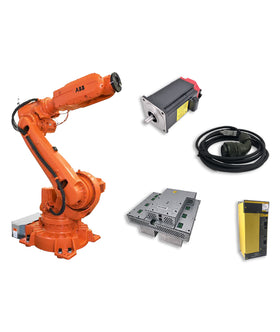
🔧 Recommended Parts for Safety circuit fault

Key components commonly involved in safety circuit fault issues and replacements.

Vorheriger Artikel UR Joint Overload Error – Symptoms & Diagnostic Guide

Einen Kommentar hinterlassen

* Erforderliche Felder

Blog posts

Produkte vergleichen

{"one"=>"Wählen Sie 2 oder 3 Artikel zum Vergleichen aus", "other"=>"{{ count }} von 3 Elementen ausgewählt"}

Wählen Sie das erste zu vergleichende Element aus

Wählen Sie das zweite zu vergleichende Element aus

Wählen Sie das dritte Element zum Vergleichen aus

Vergleichen