



When an industrial robot starts losing position, the issue is often not immediately obvious.
In field maintenance, technicians usually begin with recalibration, mastering, or servo replacement. These steps sometimes restore temporary accuracy, but the drift often returns during production.
In most real cases, the problem is not in motion control itself — but inside the feedback loop.
Encoder signal instability in the servo system is the most common underlying cause.
Across ABB, KUKA, FANUC, and Yaskawa systems, position accuracy depends on a continuous feedback chain between encoder, cable, drive system, and controller.
Once this chain becomes unstable, the robot no longer holds consistent positional reference during motion.
Robot position is not a fixed stored value.
It is continuously rebuilt in real time using encoder feedback and servo correction.
When feedback quality drops, the controller starts to “reconstruct” position with errors.
In practice, this shows up as:
In field terms: position loss is almost always a feedback problem, not a mechanical one.
Most real cases follow a similar pattern:
This behavior usually points to one direction:
👉 unstable encoder feedback under dynamic conditions
Industrial robots operate under constant stress:
Over time, the feedback path starts degrading in ways that are not visible externally.
Most common issues:
These problems do not fully break the system — they distort it.
That is why robots often still “work,” but lose accuracy.
In almost every brand, the encoder cable is the first component to suspect.
It is not just wiring — it carries real-time position data between motor and controller.
When it starts degrading:
This is why many robots are repaired multiple times without real resolution — the root cause is still in the signal path.
👉 Often linked to encoder signal desync
→ Access ABB robot position loss troubleshooting guide
👉 Usually feedback interruption or RDC sync loss
→ Access KUKA robot position loss troubleshooting guide
👉 Pulse coder signal degradation is common
→ Access FANUC robot position loss troubleshooting guide
👉 Absolute encoder or cable degradation
→ Access Yaskawa robot position loss troubleshooting guide
Move encoder cable slightly during jogging:
Most real cases are solved before reaching motor replacement.
One of the most reliable patterns in industry:
If the robot works normally at startup but drifts during production cycles, the encoder cable is almost always involved.
This is especially true when:
To reduce repeat failures:
Preventive work on feedback systems usually costs far less than production downtime.
Most cases come from unstable encoder feedback under motion load, not mechanical wear.
Yes. Even small internal damage introduces noise into the servo loop, which accumulates as position error.
Because recalibration does not fix signal instability. The error returns once motion starts again.
Always check encoder cable first. It is the highest failure probability point in field diagnostics.
Explore the Full Guide: Repair & Troubleshooting Cluster → Robot Loses Position
Explore the complete guide for troubleshooting, repair strategies, and component replacement across industrial robot systems.
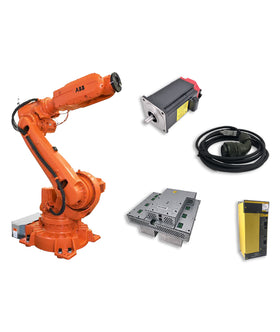
Key components commonly involved in robot loses position issues and replacements.


{"one"=>"Wählen Sie 2 oder 3 Artikel zum Vergleichen aus", "other"=>"{{ count }} von 3 Elementen ausgewählt"}
Wählen Sie das erste zu vergleichende Element aus
Wählen Sie das zweite zu vergleichende Element aus
Wählen Sie das dritte Element zum Vergleichen aus
Einen Kommentar hinterlassen