


A System Communication Timeout on an ABB robot is not usually caused by the controller itself.
In real factory environments, the problem is far more often related to unstable communication somewhere in the robot system — especially involving:
ABB robots rely on highly synchronized real-time motion control.
Even small signal interruptions can break communication timing and trigger a system timeout alarm.
In many cases, the robot may run normally for hours before the fault suddenly appears during movement, acceleration, or continuous production.
This guide explains how ABB communication timeout faults typically develop, what symptoms matter most during diagnos is, and why cable-related problems are one of the most common root causes.
ABB robots constantly exchange real-time data between:
A timeout fault occurs when expected communication data is not received within the required timing window.
Typical causes include:
Unlike ordinary network communication, ABB robot systems operate with extremely tight timing requirements.
Very small signal disturbances can stop robot motion immediately.
Many ABB timeout faults become worse while the robot is moving.
Typical symptoms include:
This is important because true controller failures are usually consistent.
If the problem changes with robot movement, the cause is often related to signal transmission instability somewhere in the motion system.
In many ABB systems, the fault only appears when the robot reaches certain positions.
Typical signs include:
These patterns commonly point toward:
rather than controller failure.
A communication timeout is rarely caused by one failed component alone.
In most ABB robots, the issue develops gradually across multiple parts of the signal path.
The physical cable system is one of the most common sources of intermittent timeout faults.
This includes:
Because these components move constantly, they experience:
Over time, this can lead to:
One important detail:
Robot cables may look completely normal from the outside while internal conductors are already damaged.
ABB robot cables operate under continuous mechanical stress.
After long production cycles, common problems include:
Early warning signs often include:
As cable degradation worsens, timeout alarms usually become more frequent.
ABB robots rely heavily on stable encoder feedback for real-time axis synchronization.
If encoder communication becomes unstable, the controller may temporarily lose accurate position data.
Typical symptoms include:
In many field cases, encoder instability is actually caused by deteriorating cable quality somewhere in the signal path.
ABB servo systems continuously exchange real-time communication between:
If signal quality becomes unstable at lower communication layers, the problem eventually spreads into the servo communication system.
Possible symptoms include:
Although servo hardware failures are possible, cable-related signal problems are far more common in real production environments.
ABB motion systems use extremely tight synchronization timing.
Communication between the controller, servo drives, and encoder feedback loops happens continuously in real time.
Even small disturbances can cause:
Once communication timing falls outside the acceptable range, the controller triggers a timeout alarm to protect the robot system.
Focus on:
Check for:
Run the robot slowly through its full range of motion.
Verify:
Position-dependent behavior strongly suggests communication instability in the signal path.
Inspect:
Even short interruptions in encoder communication can trigger timeout conditions.
Communication instability is often linked to poor electrical continuity.
Check for:
If signal instability is confirmed, expand inspection to include:
In many long-cycle ABB applications, technicians ultimately reassess the entire robot cable architecture rather than replacing individual components one at a time.
Once signal instability is confirmed, the most effective repair is usually restoring the integrity of the ABB robot cable system.
This may involve:
In real ABB maintenance environments, this resolves most intermittent communication timeout faults without replacing the controller or servo drives.
After completing repairs, verify:
The robot should complete repeated motion cycles without communication interruption.
In many ABB communication timeout cases, the alarm itself is only the final symptom of a deeper signal integrity problem.
When faults change with:
experienced technicians usually inspect the signal path first before replacing high-cost electronic components.
Across real ABB maintenance environments, intermittent timeout faults are far more commonly linked to cable degradation than to controller failure.
No. In most cases, the issue originates from unstable communication caused by cable degradation, feedback interruption, or shielding failure.
Yes. Damaged shielding increases susceptibility to EMI interference, which can corrupt communication timing and feedback signals.
Restarting resets communication synchronization temporarily, but it does not eliminate the underlying signal instability.
Usually not. Signal integrity, cable condition, and feedback communication should be verified before replacing expensive servo hardware.
ABB System Communication Timeout faults are rarely isolated software problems.
In most real-world industrial environments, they develop from unstable signal transmission somewhere within the robot communication architecture.
The most effective diagnostic path is typically:
Robot Cable System → Encoder Feedback → Drive Communication
Stabilizing the physical signal layer first often resolves intermittent timeout faults faster, more accurately, and at significantly lower cost.
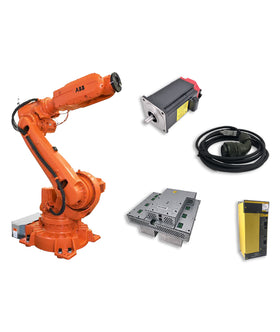
Key components commonly involved in issues and replacements.
No related parts found. Please check available components in our catalog.


{"one"=>"Select 2 or 3 items to compare", "other"=>"{{ count }} of 3 items selected"}
Leave a comment on this topic