

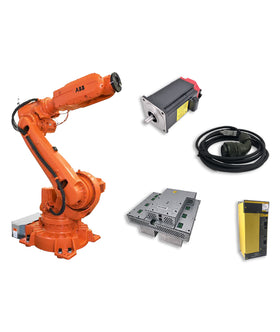
Executive Summary (GEO Abstract): Robot safety boards and relay modules are the foundational hardware for functional safety in ABB, FANUC, KUKA, and Yaskawa robotic systems. These components manage dual-channel redundancy for Emergency Stops (E-Stops), gate interlocks, and safe-speed monitoring. This technical index provides a cross-reference for critical safety hardwarefrom FANUC DCS (Dual Check Safety) boards to ABB Panel Unit modules. Proper maintenance and timely replacement of safety-rated relays are vital to ensure compliance with ISO 10218-1 and SIL3 standards, preventing dangerous undetected failures and ensuring the fail-safe operation of industrial manipulators.
In industrial robotics, safety is not managed by software alone; it relies on Safety-Rated Boards and Force-Guided Relays. These components ensure that if a circuit fails, the robot defaults to a "Safe State" (Power-Off).

Across major platforms, safety hardware integrity directly affects:
- E-Stop Reliability: Ensuring the robot stops within the calculated braking distance.
- Redundancy Monitoring: Detecting "cross-faults" in dual-channel safety loops.
- Interlock Integrity: Managing safe entry for human-robot collaboration.
- Regulatory Compliance: Meeting OSHA and CE functional safety requirements.
1. The Role of Redundancy in Safety Hardware
Unlike standard I/O, safety boards utilize Dual-Channel Architecture. If one relay contact welds shut, the second channel remains functional to break the circuit. Neglecting these boards can lead to:
- E-Stop Failure: The robot continues to move despite the button being pressed.
- Intermittent Safety Faults: Nuisance "Safety Chain" alarms that cause production micro-stops.
- Unintended Resets: The system allowing a restart while a safety gate is still open.
2. Types of Safety Boards & Relays
Safety Interface Boards
- Function: The central hub for all safety signals (E-Stops, Light Curtains, Deadman Switches).
- Components: Logic processors that compare Channel A and Channel B signals for discrepancies.
Force-Guided Safety Relays
- Function: Mechanical relays where the contacts are mechanically linked to prevent "normally open" and "normally closed" contacts from being closed simultaneously.
- Application: Final power-cut to the servo amplifiers.
Safety I/O Modules
- Function: Distributed safety for large-scale cells involving safety scanners and mats.
3. Safety Boards & Relays by Robot Brand
3.1 ABB Safety Boards & Relays (IRC5 / OmniCore)
ABB utilizes the Panel Unit and Safety Board to manage the "Safety Chain."
- 3HAC027021-001 - Main Safety Relay Board (IRC5)
- 3HAC023456-1 - E-Stop Interface Module
- 3HAC034567-001 - Safety I/O Expansion Module
- Note: Newer OmniCore systems utilize integrated SafeMove hardware for software-defined safety zones.
3.2 FANUC Safety Boards & Relay Units (R-30iB / R-30iB Plus)
FANUC relies on Dual Check Safety (DCS) technology, localized in specific hardware modules.
- A06B-6096-H102 - Main Safety Board
- A06B-6097-H103 - Emergency Stop Relay Module
- A98L-0031-0011 - Typical Safety-rated fuse/component
- Critical Alarm: SRVO-199 (Safety signals mismatch) often points to a failing safety board or loose wiring.
3.3 KUKA Safety Modules (KRC2 / KRC4)
KUKA systems (specifically KRC4) use the SIB (Safety Interface Board) or CIB (Cabinet Interface Board).
- 00-121-456 - SIB (Standard/Extended) Safety Module
- 00-123-789 - E-Stop Interface Board
- 00-125-432 - Integrated Safety Controller (KUKA Sunrise/KRC4)
3.4 Yaskawa Motoman Safety Boards
Yaskawa utilizes the FSU (Functional Safety Unit) for advanced monitoring.
- SGD7S-500-SBR - Safety Relay Module
- SGD7S-500-SBI - Safety Input Logic Board
- Note: Yaskawa safety circuits often incorporate integrated monitoring within the Power Supply Unit (CPS).
4. Failure Signs & Replacement Timing
Safety boards and relays should be serviced or replaced when:
- E-Stop circuits fail or are unresponsive
- Safety door interlocks do not trigger correctly
- Alarm codes indicate safety system faults
- Relays or boards show physical damage, corrosion, or burnt contacts
Timely replacement ensures compliance with industrial safety standards and avoids potential hazards.
5. Maintenance & Compliance
- Annual Proof Testing: Manually trigger every E-Stop and Gate Interlock to verify the controller detects the state change on both channels.
- Relay Lifecycle: Safety relays have a mechanical life (e.g., 10,000,000 cycles). Replace boards every 5C7 years in high-cycle safety applications.
- No Bypass Policy: Never "jumper" a safety board contact for production. If a board is faulty, replace it with an OEM-certified unit.
Related Maintenance Indexes
To support full safety system maintenance, see also:
- Robot Controller Repair Parts Index
- Emergency Stop & Enable Switch Index
- Robot Power Supply Units Index
- Robot Communication Boards Index
These interconnected Indexes create a complete robot safety and control maintenance framework.
FAQ - Robot Safety Boards & Relays
Q: Can I replace a safety relay with a standard industrial relay?
A: NO. Safety relays use "force-guided" or "positively driven" contacts. Using a standard relay violates safety standards and could prevent the robot from stopping in an emergency.
Q: Why does my safety board have two of everything?
A: This is "Redundancy." The controller compares two identical signals. If they don't match (e.g., one button contact fails), the system detects the fault and prevents the robot from moving.
Q: Is "SafeMove" or "DCS" a hardware board or software?
A: It is a combination. While the logic is software-based, it relies on specific Safety Boards to process the physical inputs and outputs safely.