

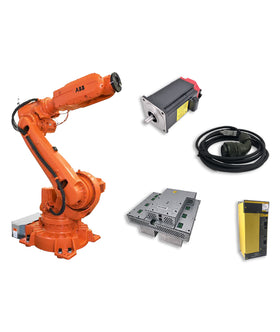


When a Yaskawa robot loses position (DX200 / YRC1000 systems), the first assumption in the field is usually calibration or mastering related.
But in actual maintenance work, that’s rarely the real cause.
Most cases end up being feedback instability in the servo loop — not controller failure, not program drift, and not mechanical wear.
Yaskawa positioning depends on a closed loop like this:
Absolute Encoder → Encoder Cable → Servo Pack → Controller
If anything in this chain becomes unstable, the robot starts to show drift, offset, or mastering inconsistency during production.
Sometimes it looks random. Sometimes it only happens under motion.
Position in Yaskawa robots is not a fixed stored value.
It is rebuilt continuously from encoder feedback + servo correction inside the servo pack.
When that feedback becomes unstable, you start seeing:
In most real cases, this is not mechanical movement. It’s feedback not staying consistent.
Signal path is simple on paper:
Absolute Encoder → Encoder Cable → Servo Pack → Controller
Servo pack is doing real-time interpretation of encoder data.
So even small issues matter:
At this level, the robot doesn’t “break” suddenly — it just becomes slightly wrong over time.
In Yaskawa systems, encoder cable is not just wiring.
It is the actual data path for absolute position.
When it starts degrading, you usually see:
Because the motor is not the failing part most of the time.
Typical pattern in the field:
That cycle usually points back to cable or connector, not motor.
Seen mostly on wrist / high-movement axes.
Result is not instant failure — it’s slow drift.
Servo pack misreads encoder signals when noise increases.
Typical behavior:
Often mistaken as tuning problem.
Common signals include encoder / feedback related alarms.
Important point:
Alarm is not the root cause
It is the result of unstable loop feedback.
Still less common than cable issues.
In real factories, people often jump to:
But in field data, most cases come back to:
Encoder cable or feedback instability
That’s why symptoms often look “weird”:
If yes → feedback issue likely
During jogging:
If position changes → internal fatigue likely
Look for:
Check:
Most cases stop at step 1 or 2.
Absolute Encoder
↓
Encoder Cable
↓
Servo Pack
↓
Controller
↓
Motion Output
Any weak point here = drift, alarm, or offset.
If you see this pattern:
This is almost always encoder cable degradation.
Most cases come from feedback instability, usually encoder cable or signal degradation inside servo loop.
Yes. Even small shielding or internal damage affects feedback accuracy over time.
Always cable first. Motor failure is far less common in these cases.
Explore the Full Guide: Repair & Troubleshooting Cluster → Yaskawa Robot Loses Position
Explore the complete guide for troubleshooting, repair strategies, and component replacement across industrial robot systems.
Key components commonly involved in yaskawa robot loses position issues and replacements.


{"one"=>"Select 2 or 3 items to compare", "other"=>"{{ count }} of 3 items selected"}
Leave a comment on this topic