

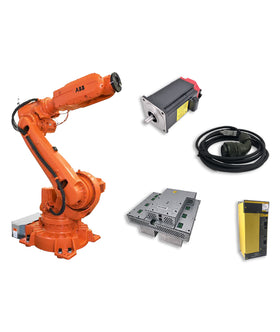


On Universal Robots systems, an encoder fault does not automatically mean the encoder itself has failed.
In many production environments, the controller is actually reacting to something more critical:
loss of confidence in joint position feedback stability.
Once feedback integrity becomes inconsistent, the robot may no longer trust its calculated motion path. What initially appears to be a simple encoder alarm can gradually evolve into broader motion instability across the system.
Engineers commonly see the problem develop in stages:
On modern UR platforms — especially e-Series robots — most encoder-related faults are more closely tied to:
rather than complete encoder hardware destruction.

One of the earliest signs of encoder instability is gradual trajectory deviation during production movement.
The robot may initially appear stable during manual jogging or low-speed operation, while small positional errors begin accumulating during normal cycle execution.
Typical field behavior includes:
In many field cases, the instability becomes significantly more noticeable during:
A common diagnostic mistake is assuming the encoder has completely failed simply because positioning becomes unstable at production speed.
In reality, low-speed jogging can remain perfectly smooth while dynamic motion exposes:
This pattern is especially common on robots with long operating hours or heavy wrist articulation cycles.
Encoder-related problems in UR robots often begin on a single joint before spreading into wider synchronization instability.
In many cases, the affected axis behaves normally during startup, then gradually develops intermittent hesitation or deviation once motion load increases.
As the instability progresses, the same joint may repeatedly trigger motion-related stops while neighboring axes continue operating normally.
This localized behavior is possible because each UR joint operates through its own:
Failures therefore tend to appear first in high-stress joints such as:
where repeated flex movement places continuous stress on internal signal routing.
Repeated Protective Stops without any obvious collision or overload condition are frequently linked to feedback validation instability.
In these situations, the controller may not be reacting to external safety risk at all.
Instead, the system is detecting inconsistency between expected and measured joint position behavior during dynamic movement.
This is why some encoder-related Protective Stops appear highly inconsistent:
The underlying issue is often tied to transient feedback instability rather than permanent servo hardware failure.
Encoder-related startup failures are especially common after unstable shutdown events or interrupted power cycles.
The robot may suddenly fail initialization even though no hardware components were replaced.
In many cases, the robot operated normally before shutdown and only developed startup faults after:
This is particularly important on e-Series systems where startup validation depends heavily on internally reconstructed position data.
UR encoder faults should not be treated as isolated sensor problems.
Modern UR systems continuously validate motion integrity across multiple layers simultaneously, including:
As a result, many encoder alarms are actually validation failures between different motion models inside the controller.
On e-Series robots, joint position is continuously cross-validated between:
The controller compares both values in real time to confirm motion consistency.
Engineering representation:
Δ position=Pmotor−Pestimated\Delta\ position = P_{motor} - P_{estimated}Δ position=Pmotor−Pestimated
When the deviation exceeds the allowable tolerance range, the controller may trigger:
In real production environments, this mismatch is often caused by:
An important diagnostic detail is that the encoder itself may still function electrically while the controller no longer trusts the relationship between its internal motion models.
This is why replacing the encoder alone does not always eliminate the fault.
UR encoder systems rely on high-resolution differential signals that are highly sensitive to electrical instability.
In many field failures, the root problem develops gradually rather than appearing as an immediate hard failure.
A common progression is:
The underlying cause is frequently related to signal degradation somewhere along the feedback path.
Engineers commonly find issues involving:
One important field characteristic is that the robot may remain stable during low-speed movement while becoming increasingly unstable at production speed.
Even extremely short signal interruptions can break controller confidence in encoder position integrity.
One of the most common troubleshooting mistakes is treating all encoder-related alarms as the same failure category.
In reality, UR systems distinguish between several different validation failures.
Position loss occurs when the controller can no longer maintain a trusted joint reference.
This is commonly associated with:
The robot may temporarily recover after restart, only for the same instability to return during motion.
A feedback timeout occurs when encoder data does not arrive within the expected timing window.
This is more commonly linked to:
In many field cases, the timeout appears only during acceleration or rapid directional change where communication timing becomes more sensitive.
Sanity check failures occur during startup validation when the controller determines that reconstructed position data is internally inconsistent.
This is often associated with:
A repeated “Sanity check failed” condition after every reboot should not immediately be treated as encoder destruction.
In many cases, the real issue involves corrupted reference reconstruction rather than physical feedback loss.
Although less common, storage subsystem instability can also interfere with encoder validation during startup.
Problems involving:
can all affect how the controller reconstructs joint reference information during initialization.
A strong field indicator is repeated startup instability immediately after reboot while motion behavior had previously appeared normal.
Before replacing encoder hardware, engineers should verify:
especially on systems with repeated improper shutdown history.
Encoder feedback systems are highly sensitive to electromagnetic interference because they rely on low-voltage differential signaling.
In high-noise industrial environments, the encoder itself may remain functional while electrical disturbance corrupts the feedback signal seen by the controller.
High-risk environments commonly include:
Failure mechanism:
Engineering representation:
Vcm = (V1 + V2) / 2
Where:
A very common field pattern is:
When this behavior appears, grounding quality becomes critical.
Engineers should inspect:
This type of instability is extremely common in robotic welding environments.
Before replacing components, determine how the instability develops over time.
Key questions include:
Motion-phase behavior is often more valuable than the alarm text itself.
Focus inspection on areas exposed to repeated flex movement and long-term vibration.
Critical inspection zones include:
Special attention should be given to:
where long-term cable fatigue commonly develops.
Do not focus only on major stop events.
In many UR systems, minor warnings appear long before catastrophic motion faults develop.
Look for patterns involving:
Trend progression is often more important than individual alarm codes.
Temporarily isolate nearby high-frequency equipment and retest the robot in a cleaner electrical environment.
Observe whether:
This test is particularly effective in welding environments where electrical noise fluctuates dynamically during production.
When mechanically safe:
If resistance changes abruptly during manual rotation, the problem may involve:
A common field pattern is uneven resistance across different joint positions.
The joint may feel smooth through one section of travel, then suddenly tighter or rougher in another.
This type of behavior usually points toward mechanical-origin instability rather than electrical noise alone.
If the joint rotates smoothly by hand while PolyScope feedback values fluctuate unexpectedly, the issue is more likely related to feedback integrity rather than mechanical resistance.
In many field cases, engineers eventually trace the instability to:
The important diagnostic clue is that physical movement remains stable while the controller receives inconsistent position data.
If both mechanical resistance and feedback values remain stable during testing, the fault may only appear under dynamic operating conditions.
This commonly includes:
In these situations, intermittent signal degradation or EMI becomes more likely than mechanical failure.
A very common UR encoder degradation pattern is:
This behavior usually indicates:
rather than complete encoder destruction.
No.
Most industrial cases are actually related to:
rather than physical encoder destruction.
Each UR joint operates through its own:
This is why instability often begins on a single axis before spreading into broader synchronization faults.
Temporary recovery usually indicates:
Hardware-origin failures typically return once motion load increases again.
Yes.
Differential encoder signals are highly sensitive to common-mode electrical noise, especially near:
This is one of the most overlooked causes of intermittent UR encoder instability.
Explore the Full Guide: Industrial Robot Knowledge Hub → Repair & Troubleshooting Cluster
Explore the complete guide for troubleshooting, repair strategies, and component replacement across industrial robot systems.
Key components commonly involved in issues and replacements.


{"one"=>"Select 2 or 3 items to compare", "other"=>"{{ count }} of 3 items selected"}
Leave a comment on this topic