



When an industrial robot controller cannot detect a motor, the problem is often assumed to be a failed servo motor.
In reality, across ABB, KUKA, FANUC, and Yaskawa systems, the root cause is far more likely to be:
In most cases, the motor itself is still mechanically functional.
This diagnostic hub helps maintenance engineers quickly identify the actual failure point, avoid unnecessary motor replacement, and locate the correct system-specific troubleshooting path.
Industrial robot controllers rely on continuous encoder feedback to confirm that each motor is present, synchronized, and safe to operate.
The detection process depends on:
When this feedback chain is interrupted:
As a result, many “motor not detected” alarms are actually encoder communication failures rather than true motor damage.
Encoder cables operate under constant robotic motion stress and are one of the highest-failure components in industrial robots.
Typical causes include:
Common symptoms:
Even brief feedback interruptions can cause the controller to disable the axis.
Typical symptoms include:
In many systems, the motor reappears temporarily once signal stability returns.
Some failures originate from the communication architecture itself rather than the motor or encoder.
Possible causes:
This type of fault may affect multiple axes simultaneously.
Small connection problems frequently create major feedback faults.
Common issues include:
Because encoder signals are highly sensitive, even minor resistance changes can trigger motor detection alarms.
Different robot brands use different feedback architectures, but the failure logic is fundamentally similar.
Primary Focus: SMB communication, resolver feedback, and encoder cable integrity.
Recommended checks:
→ Access ABB controller cannot detect motor troubleshooting guide
Primary Focus: RDC transmission and KSS feedback stability.
Recommended checks:
→ Access KUKA controller cannot detect motor troubleshooting guide
Primary Focus: FSSB serial communication and pulse coder feedback.
Recommended checks:
→ Access FANUC controller cannot detect motor troubleshooting guide
Primary Focus: Σ-Series encoder communication and servo pack feedback.
Recommended checks:
→ Access Yaskawa controller cannot detect motor troubleshooting guide
Before replacing any motor hardware:
Always verify encoder signal integrity and feedback cable condition first.
This single diagnostic rule prevents a large percentage of unnecessary motor replacements in industrial robotics.
Across ABB, KUKA, FANUC, and Yaskawa systems, motor detection failures usually follow the same progression:
This pattern almost always indicates feedback instability rather than mechanical motor failure.
Encoder cables operate in one of the harshest environments inside an industrial robot.
They experience:
Over time, this leads to:
In real-world repair cases, replacing the encoder cable is often the fastest and most cost-effective solution.
To avoid unnecessary downtime and incorrect parts replacement, follow this order:
This workflow significantly improves troubleshooting efficiency and reduces repair costs.
After encoder-related faults are confirmed, prioritize components designed for robotic dynamic motion environments.
High-flex industrial cables are specifically engineered to withstand continuous robotic movement and long-cycle automation workloads.
Because all major industrial robot platforms depend on encoder feedback communication.
If the controller loses encoder communication, the system disables motor detection automatically to protect the robot from unsafe motion conditions.
This usually indicates intermittent encoder signal instability rather than motor failure.
Typical causes include:
Once signal quality temporarily stabilizes, the controller may detect the motor again.
Yes.
When several axes disappear simultaneously, the issue is often related to shared communication architecture rather than individual motors.
Possible causes include:
This strongly suggests a system-level communication issue.
No.
Intermittent encoder feedback instability can lead to:
The robot should be inspected immediately before further operation.
Explore the Full Guide: Industrial Robot Knowledge Hub → Repair & Troubleshooting Cluster
Explore the complete guide for troubleshooting, repair strategies, and component replacement across industrial robot systems.
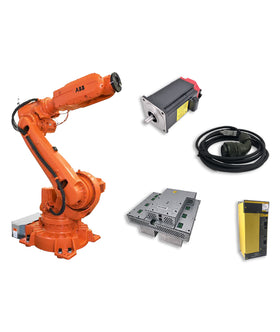
Key components commonly involved in controller cannot detect motor issues and replacements.


{"one"=>"Selecione 2 ou 3 itens para comparar", "other"=>"{{ count }} de 3 itens selecionados"}
Selecione o primeiro item para comparar
Selecione o segundo item para comparar
Selecione o terceiro item para comparar
Deixe um comentário